Chatzidiakou Lia, Krause Anika, Popoola Olalekan A M, Di Antonio Andrea, Kellaway Mike, Han Yiqun, Squires Freya A, Wang Teng, Zhang Hanbin, Wang Qi, Fan Yunfei, Chen Shiyi, Hu Min, Quint Jennifer K, Barratt Benjamin, Kelly Frank J, Zhu Tong, Jones Roderic L
Department of Chemistry, University of Cambridge, Cambridge, CB2 1EW, UK.
Atmospheric Sensors Ltd, Bedfordshire, SG19 3SH, UK.
Atmos Meas Tech. 2019;12(8):4643-4657. doi: 10.5194/amt-12-1-2019. Epub 2019 Aug 30.
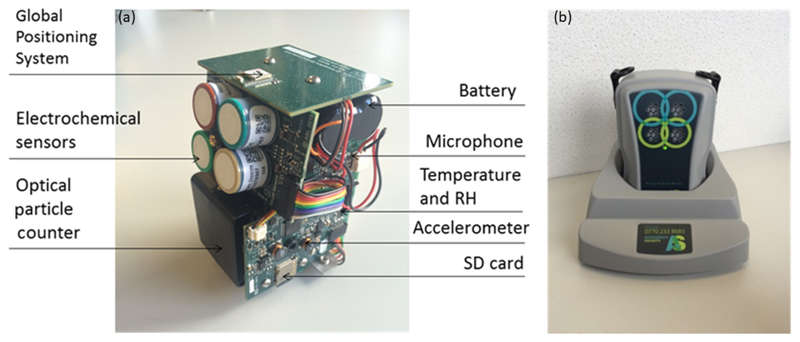
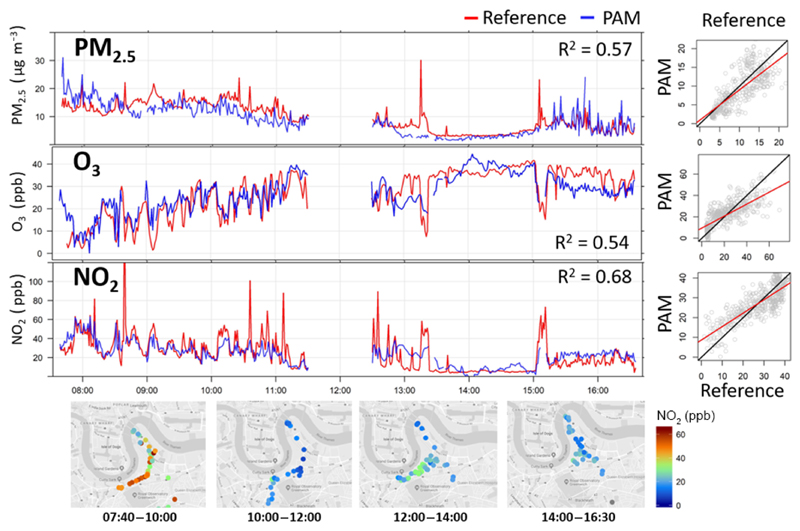
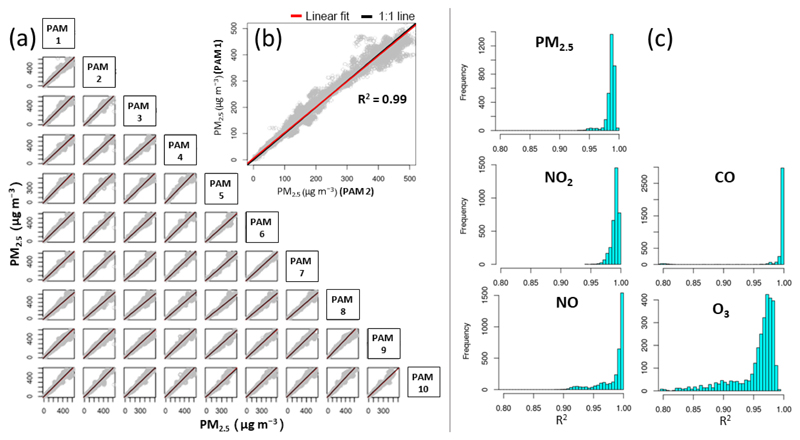
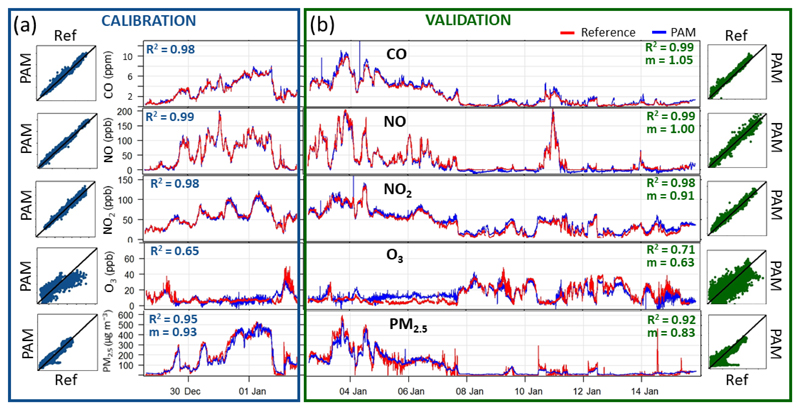
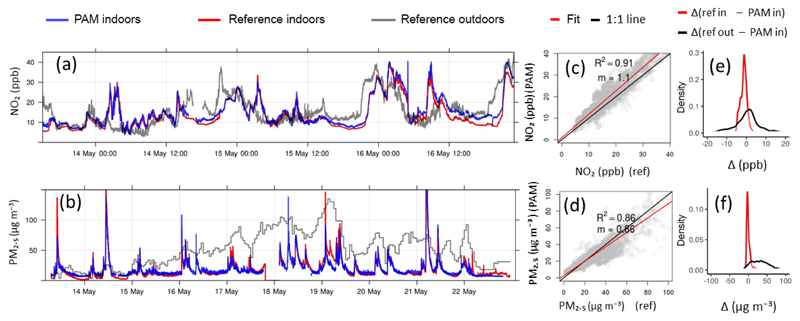
The inaccurate quantification of personal exposure to air pollution introduces error and bias in health estimations, severely limiting causal inference in epidemiological research worldwide. Rapid advancements in affordable, miniaturised air pollution sensor technologies offer the potential to address this limitation by capturing the high variability of personal exposure during daily life in large-scale studies with unprecedented spatial and temporal resolution. However, concerns remain regarding the suitability of novel sensing technologies for scientific and policy purposes. In this paper we characterise the performance of a portable personal air quality monitor (PAM) that integrates multiple miniaturised sensors for nitrogen oxides (NO ), carbon monoxide (CO), ozone (O) and particulate matter (PM) measurements along with temperature, relative humidity, acceleration, noise and GPS sensors. Overall, the air pollution sensors showed high reproducibility (mean = 0.93, min-max: 0.80-1.00) and excellent agreement with standard instrumentation (mean = 0.82, min-max: 0.54-0.99) in outdoor, indoor and commuting microenvironments across seasons and different geographical settings. An important outcome of this study is that the error of the PAM is significantly smaller than the error introduced when estimating personal exposure based on sparsely distributed outdoor fixed monitoring stations. Hence, novel sensing technologies such as the ones demonstrated here can revolutionise health studies by providing highly resolved reliable exposure metrics at a large scale to investigate the underlying mechanisms of the effects of air pollution on health.
个人空气污染暴露的不准确量化会在健康评估中引入误差和偏差,严重限制全球流行病学研究中的因果推断。价格合理、小型化的空气污染传感器技术的快速发展,为解决这一限制提供了潜力,通过在大规模研究中以前所未有的空间和时间分辨率捕捉日常生活中个人暴露的高度变异性。然而,对于新型传感技术是否适用于科学和政策目的,仍存在担忧。在本文中,我们描述了一种便携式个人空气质量监测仪(PAM)的性能,该监测仪集成了多个小型传感器,用于测量氮氧化物(NO )、一氧化碳(CO)、臭氧(O)和颗粒物(PM),以及温度、相对湿度、加速度、噪声和GPS传感器。总体而言,在不同季节和不同地理环境的室外、室内和通勤微环境中,空气污染传感器显示出高重现性(平均值 = 0.93,最小值 - 最大值:0.80 - 1.00),并且与标准仪器具有良好的一致性(平均值 = 0.82,最小值 - 最大值:0.54 - 0.99)。这项研究的一个重要成果是,PAM的误差明显小于基于分布稀疏的室外固定监测站估计个人暴露时引入的误差。因此,本文展示的这类新型传感技术可以通过大规模提供高度解析的可靠暴露指标来彻底改变健康研究,以探究空气污染对健康影响的潜在机制。