Lauwers Marianne, Croubels Siska, De Baere Siegrid, Sevastiyanova Milena, Romera Sierra Eva Maria, Letor Ben, Gougoulias Christos, Devreese Mathias
Department of Pharmacology and Toxicology, Faculty of Veterinary Medicine, Ghent University, 9820 Merelbeke, Belgium.
Innovad Global, Postbaan 69, 2910 Essen, Belgium.
Toxins (Basel). 2019 Sep 18;11(9):541. doi: 10.3390/toxins11090541.
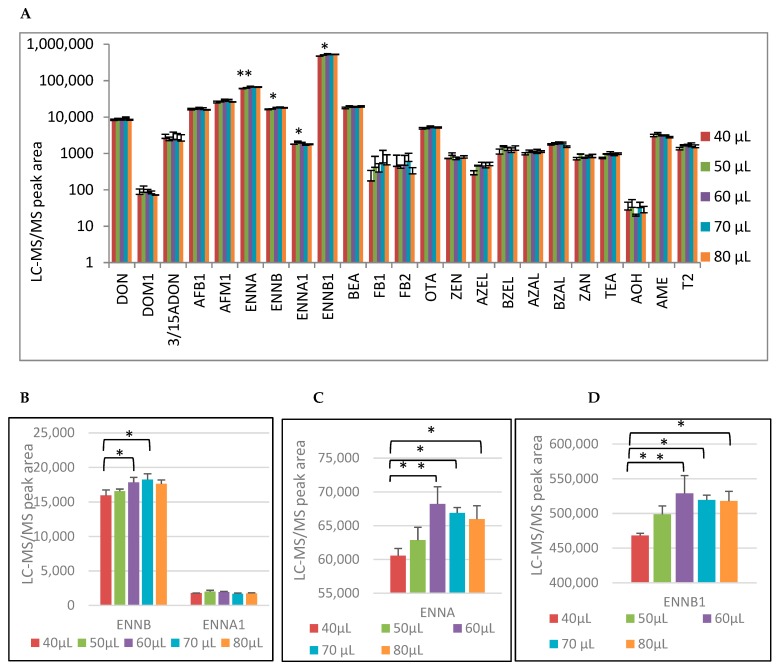
Dried blood spots (DBSs), a micro-sampling technique whereby a drop of blood is collected on filter paper has multiple advantages over conventional blood sampling regarding the sampling itself, as well as transportation and storage. This is the first paper describing the development and validation of a method for the determination of 23 mycotoxins and phase I metabolites in DBSs from pigs and broiler chickens using liquid chromatography-tandem mass spectrometry (LC-MS/MS). The targeted mycotoxins belong to groups for which the occurrence in feed is regulated by the European Union, namely, aflatoxins, ochratoxin A and several mycotoxins, and to two groups of unregulated mycotoxins, namely mycotoxins and mycotoxins (enniatins and beauvericin). The impact of blood haematocrit, DBS sampling volume and size of the analysed DBS disk on the validation results was assessed. No effects of variation in size of the analysed disk, haematocrit and spotted blood volume were observed for most mycotoxins, except for the aflatoxins and β-zearalanol (BZAL) at the lowest haematocrit (26%) level and for the enniatins (ENNs) at the lowest volume (40 µL). The developed method was transferred to an LC-high resolution mass spectrometry instrument to determine phase II metabolites. Then, the DBS technique was applied in a proof-of-concept toxicokinetic study including a comparison with LC-MS/MS data from plasma obtained with conventional venous blood sampling. A strong correlation ( > 0.947) was observed between plasma and DBS concentrations. Finally, DBSs were also applied in a pilot exposure assessment study to test their applicability under field conditions.
干血斑(DBS)是一种微量采样技术,即将一滴血液采集在滤纸上,与传统血液采样相比,在采样本身以及运输和储存方面具有多种优势。本文首次描述了一种使用液相色谱 - 串联质谱(LC-MS/MS)测定猪和肉鸡DBS中23种霉菌毒素及其I相代谢物的方法的开发和验证。目标霉菌毒素属于欧盟对饲料中出现情况进行监管的类别,即黄曲霉毒素、赭曲霉毒素A和几种霉菌毒素,以及两类不受监管的霉菌毒素,即霉菌毒素和霉菌毒素(恩镰孢菌素和白僵菌素)。评估了血液血细胞比容、DBS采样体积和分析的DBS圆盘大小对验证结果的影响。对于大多数霉菌毒素,未观察到分析圆盘大小、血细胞比容和点样血量变化的影响,但黄曲霉毒素和β-玉米赤霉醇(BZAL)在最低血细胞比容(26%)水平以及恩镰孢菌素(ENNs)在最低体积(40µL)时除外。所开发的方法被转移到LC高分辨率质谱仪上以测定II相代谢物。然后,DBS技术应用于一项概念验证毒代动力学研究,包括与传统静脉血采样获得的血浆LC-MS/MS数据进行比较。观察到血浆和DBS浓度之间有很强的相关性(>0.947)。最后,DBS也应用于一项试点暴露评估研究,以测试其在现场条件下的适用性。