Department of Analytical Chemistry, Faculty of Chemistry, Regional Campus of International Excellence "Campus Mare Nostrum", University of Murcia, E-30100, Murcia, Spain.
Department of Legal and Forensic Medicine, Faculty of Medicine, Biomedical Research Institute (IMIB-Arrixaca), University of Murcia, Murcia, Spain.
Anal Bioanal Chem. 2024 Jan;416(2):449-459. doi: 10.1007/s00216-023-05040-8. Epub 2023 Nov 21.
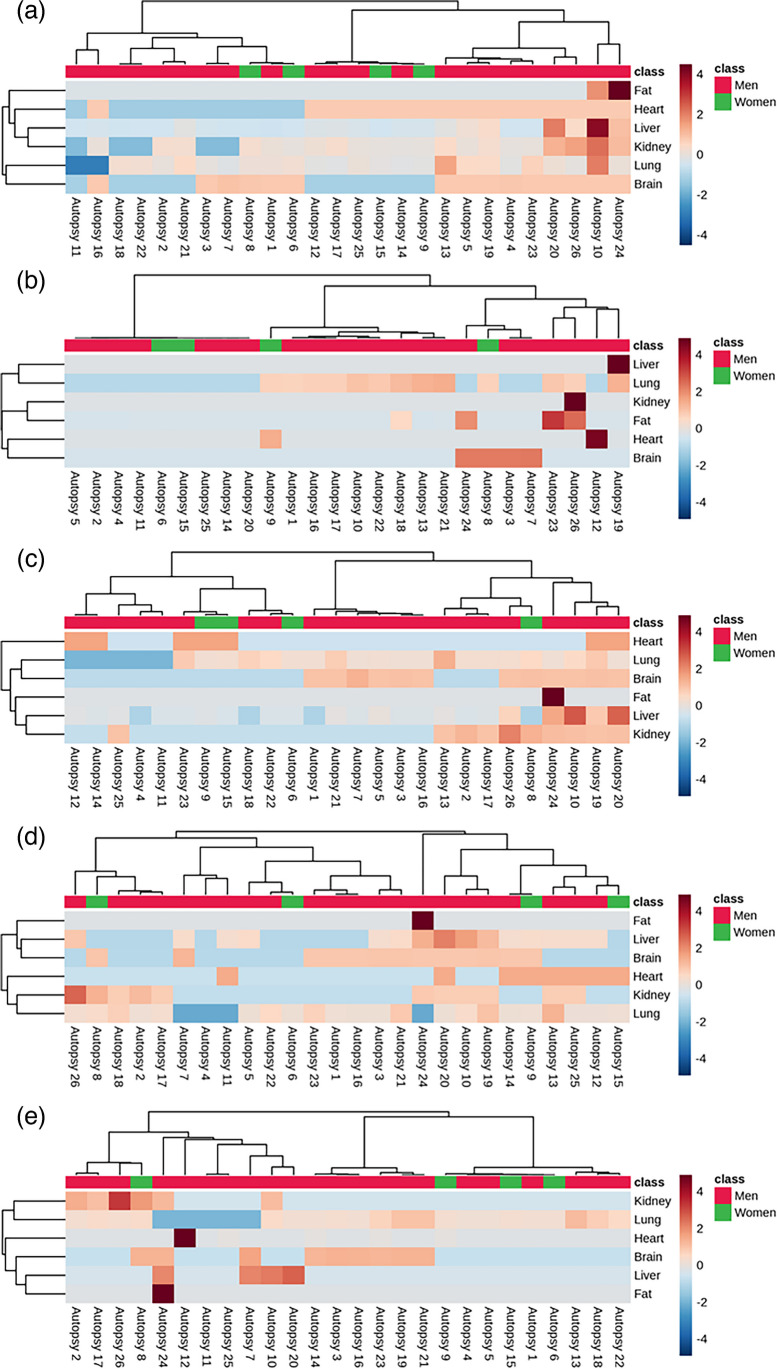
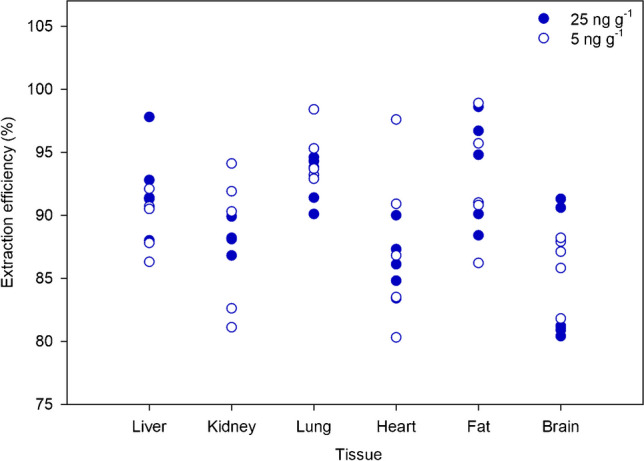
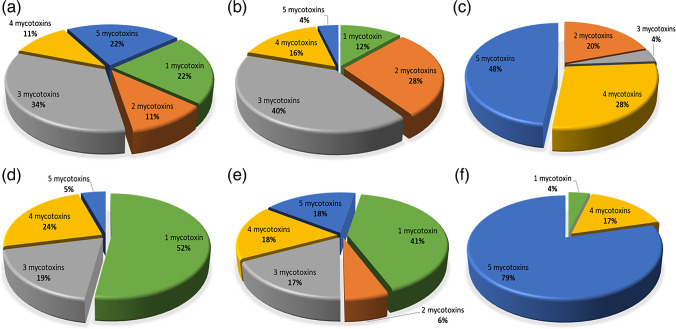
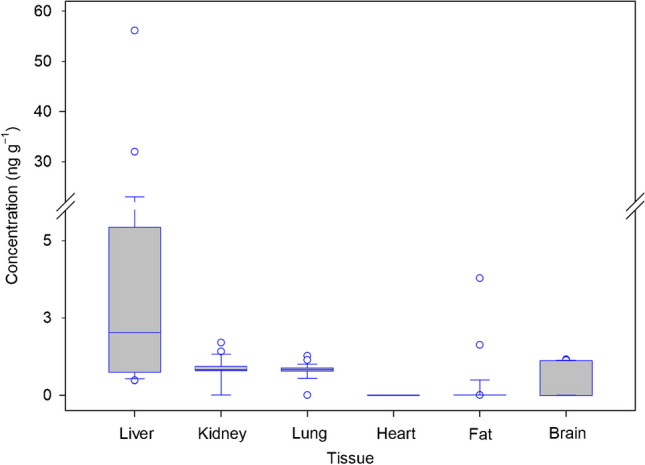
In this work, a complete study of the distribution of emerging mycotoxins in the human body has been carried out. Specifically, the presence of enniatins (A, A, B, B) and beauvericin has been monitored in brain, lung, kidney, fat, liver, and heart samples. A unique methodology based on solid-liquid extraction (SLE) followed by dispersive liquid-liquid microextraction (DLLME) was proposed for the six different matrices. Mycotoxin isolation was performed by adding ultrapure water, acetonitrile, and sodium chloride to the tissue sample for SLE, while the DLLME step was performed using chloroform as extraction solvent. Subsequently, the analysis was carried out by high-performance liquid chromatography coupled to tandem mass spectrometry (HPLC-MS/MS). The proposed method allowed limits of quantification (LOQs) to be obtained in a range of 0.001-0.150 ng g, depending on the tissue and mycotoxin. The precision was investigated intraday and interday, not exceeding of 9.8% of relative standard deviation. In addition, trueness studies achieved 75 to 115% at a mycotoxin concentration of 25 ng g and from 82 to 118% at 5 ng g. The application of this methodology to 26 forensic autopsies demonstrated the bioaccumulation of emerging mycotoxins in the human body since all mycotoxins were detected in tissues. Enniatin B (ENNB) showed a high occurrence, being detected in 100% of liver (7 ± 13 ng g) and fat samples (0.2 ± 0.8 ng g). The lung had a high incidence of all emerging mycotoxins at low concentrations, while ENNB, ENNB, and ENNA were not quantifiable in heart samples. Co-occurrence of mycotoxins was also investigated, and statistical tests were applied to evaluate the distribution of these mycotoxins in the human body.
本工作对人体中新兴霉菌毒素的分布进行了全面研究。具体而言,监测了脑、肺、肾、脂肪、肝和心脏样本中恩镰孢菌素(A、A、B、B)和 beauvericin 的存在。提出了一种基于固相萃取(SLE)和分散液液微萃取(DLLME)的独特方法,用于六种不同基质。对于 SLE,向组织样品中加入超纯水、乙腈和氯化钠,进行霉菌毒素分离,而 DLLME 步骤则使用氯仿作为萃取溶剂。随后,通过高效液相色谱-串联质谱(HPLC-MS/MS)进行分析。该方法允许在 0.001-0.150ng g 的范围内获得定量限(LOQs),具体取决于组织和霉菌毒素。日内和日间精密度研究不超过 9.8%的相对标准偏差。此外,在 25ng g 霉菌毒素浓度和 5ng g 霉菌毒素浓度下,真实度研究达到 75-115%和 82-118%。将该方法应用于 26 例法医解剖,证明了新兴霉菌毒素在人体内的生物累积,因为在组织中均检测到了所有霉菌毒素。恩镰孢菌素 B(ENNB)的出现率较高,在 100%的肝(7±13ng g)和脂肪样本(0.2±0.8ng g)中均有检测到。肺部在低浓度下所有新兴霉菌毒素的发生率较高,而心脏样本中无法定量检测到 ENNB、ENNB 和 ENNA。还研究了霉菌毒素的共同出现情况,并应用统计检验评估这些霉菌毒素在人体内的分布。