Department of Neurology, The First Affiliated Hospital of Chongqing Medical University, Chongqing, China.
Department of Pediatrics, The Third Affiliated Hospital & Field Surgery Institution, Army Medical University, Chongqing, China.
CNS Neurosci Ther. 2019 Oct;25(10):1189-1194. doi: 10.1111/cns.13219. Epub 2019 Sep 22.
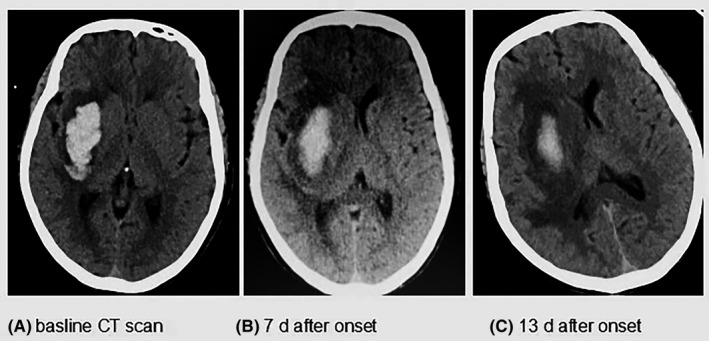
We hypothesize delayed perihematomal edema (DHE) leads to secondary injury after spontaneous intracerebral hemorrhage (sICH) with a poor prognosis. Hence, we need to investigate the risk factors of DHE and identify whether DHE will predict the poor outcome of sICH.
We retrospectively recruited 121 patients with sICH admitted to the Department of Neurology from January 2014 to August 2018. After dividing all these patients into DHE group and non-DHE group, we analyzed the potential risk factors and outcome of DHE using a multivariate logistic regression model.
We conclude DHE after sICH associates with age, hospitalization time, hematoma shape, blood pressure upon admission, alcohol consumption, blood sodium level, and baseline hematoma volume within 24 hours after symptom onset, among which differences were statistically significant (P < .05). Logistic regression analysis finally identified that age (OR = 0.958, 95% CI = 0.923-0.995) and the baseline hematoma volume (OR = 1.161, 95% CI = 1.089-1.238) were the most significant risk factors for DHE, and moreover, the DHE (OR = 3.062, 95% CI = 1.196-7.839) was also a risk factor for poor prognosis in sICH patients.
We suggest DHE is a clinical predictor of secondary injury following sICH and poor prognosis. In addition, age and baseline hematoma volume are considered significant high-risk factors for DHE in patients with sICH.
我们假设迟发性血肿周围水肿(DHE)会导致自发性脑出血(sICH)后的继发性损伤,预后不良。因此,我们需要研究 DHE 的危险因素,并确定 DHE 是否会预测 sICH 的不良结局。
我们回顾性招募了 2014 年 1 月至 2018 年 8 月期间在神经内科就诊的 121 例 sICH 患者。将所有患者分为 DHE 组和非 DHE 组后,我们使用多变量逻辑回归模型分析 DHE 的潜在危险因素和结局。
我们得出结论,sICH 后发生 DHE 与年龄、住院时间、血肿形态、入院时血压、饮酒、血钠水平和发病后 24 小时内的基线血肿体积有关,其中差异具有统计学意义(P<0.05)。逻辑回归分析最终确定年龄(OR=0.958,95%CI=0.923-0.995)和基线血肿体积(OR=1.161,95%CI=1.089-1.238)是 DHE 的最显著危险因素,而且 DHE(OR=3.062,95%CI=1.196-7.839)也是 sICH 患者预后不良的危险因素。
我们认为 DHE 是 sICH 后继发性损伤和不良预后的临床预测指标。此外,年龄和基线血肿体积被认为是 sICH 患者发生 DHE 的显著高危因素。