Department of Kinesiology & Community Health, University of Illinois at Urbana-Champaign, Urbana, IL 61801, USA.
Neuroscience Program, University of Illinois at Urbana-Champaign, Urbana, IL 61801, USA.
Int J Environ Res Public Health. 2019 Sep 19;16(18):3495. doi: 10.3390/ijerph16183495.
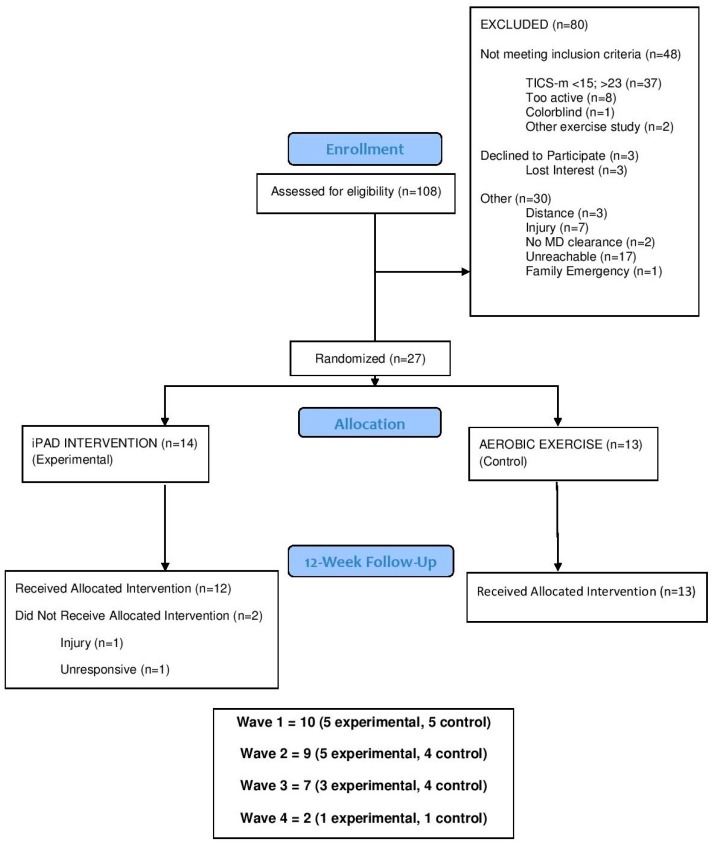
The purpose of this pilot study was to test the feasibility and efficacy of an iPad-enhanced aerobic exercise intervention designed to enhance wayfinding efficacy and performance and relevant cognitive functioning among middle-aged adults at risk for cognitive impairment. Twenty-seven low active adults (21 females) aged 45 to 62 years (51.22 ± 5.20) participated in a ten-week randomized controlled trial. Participants were randomized to an iPad-enhanced aerobic exercise group (experimental group) or an aerobic exercise-only group (control group) following baseline assessment. Both groups exercised at 50% to 75% of age-predicted heart rate maximum for 30 to 50 min/d, 2 d/wk for 10 weeks. During aerobic exercise, the experimental group engaged in virtual tours delivered via iPad. Baseline and post-intervention assessments of wayfinding self-efficacy, wayfinding task performance, cognitive functioning, electroencephalogram (EEG), and psychosocial questionnaires were administered. The results suggest that ten weeks of iPad-enhanced, moderately intense aerobic exercise had specific effects on wayfinding self-efficacy; however, no statistical differences were found between groups on the behavioral wayfinding task or spatial memory performance at follow-up. Performance scores on an inhibitory attentional-control cognitive assessment revealed significant differences between groups, favoring the experimental group ( < 0.05). Virtual reality-enhanced aerobic exercise may prove to be an effective method for improving cognitive function and increasing confidence to navigate real-world scenarios among individuals at risk of cognitive impairment.
本初步研究旨在测试一项基于 iPad 的有氧运动干预的可行性和效果,该干预旨在提高中年认知障碍高危人群的寻路效率和表现,以及相关认知功能。27 名低活动度成年人(21 名女性)年龄在 45 至 62 岁之间(51.22±5.20)参与了一项为期十周的随机对照试验。参与者在基线评估后被随机分配到基于 iPad 的有氧运动组(实验组)或仅有氧运动组(对照组)。两组均按照 50%至 75%的年龄预测最大心率进行 30 至 50 分钟/天、每周 2 天、持续 10 周的有氧运动。在有氧运动过程中,实验组通过 iPad 参与虚拟旅行。在干预前后,对寻路自我效能、寻路任务表现、认知功能、脑电图(EEG)和心理社会问卷进行评估。结果表明,十周基于 iPad 的中等强度有氧运动对寻路自我效能具有特定影响;然而,在随访时,两组在行为寻路任务或空间记忆表现方面没有统计学差异。抑制性注意力控制认知评估的表现评分显示组间存在显著差异,实验组更占优势(<0.05)。虚拟现实增强型有氧运动可能被证明是一种有效的方法,可以提高认知功能,并增加认知障碍高危人群在现实世界场景中导航的信心。