Wall Kathryn, Stark Jessica, Schillaci Alexa, Saulnier Emilie T, McLaren Elizabeth, Striegnitz Kristina, Cohen Brian D, Arciero Paul J, Kramer Arthur F, Anderson-Hanley Cay
Healthy Aging & Neuropsychology Lab, Union College, Schenectady, NY 12308, USA.
Biology Department, Union College, Schenectady, NY 12308, USA.
J Clin Med. 2018 Aug 30;7(9):249. doi: 10.3390/jcm7090249.
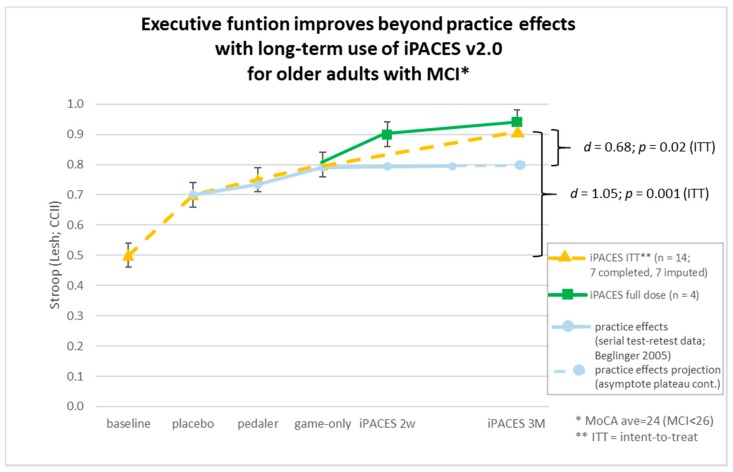
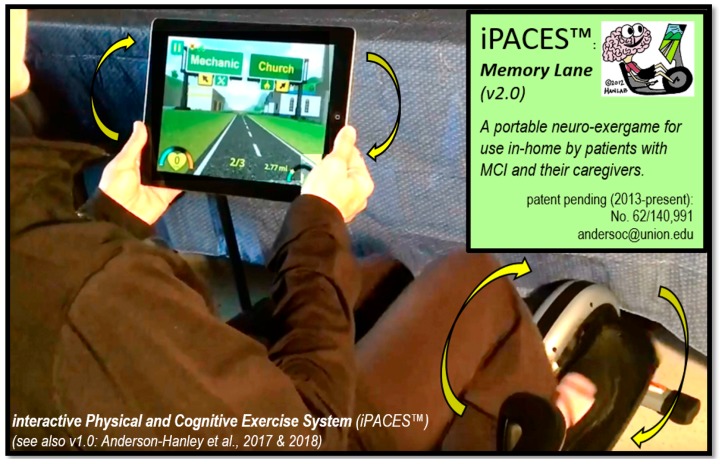
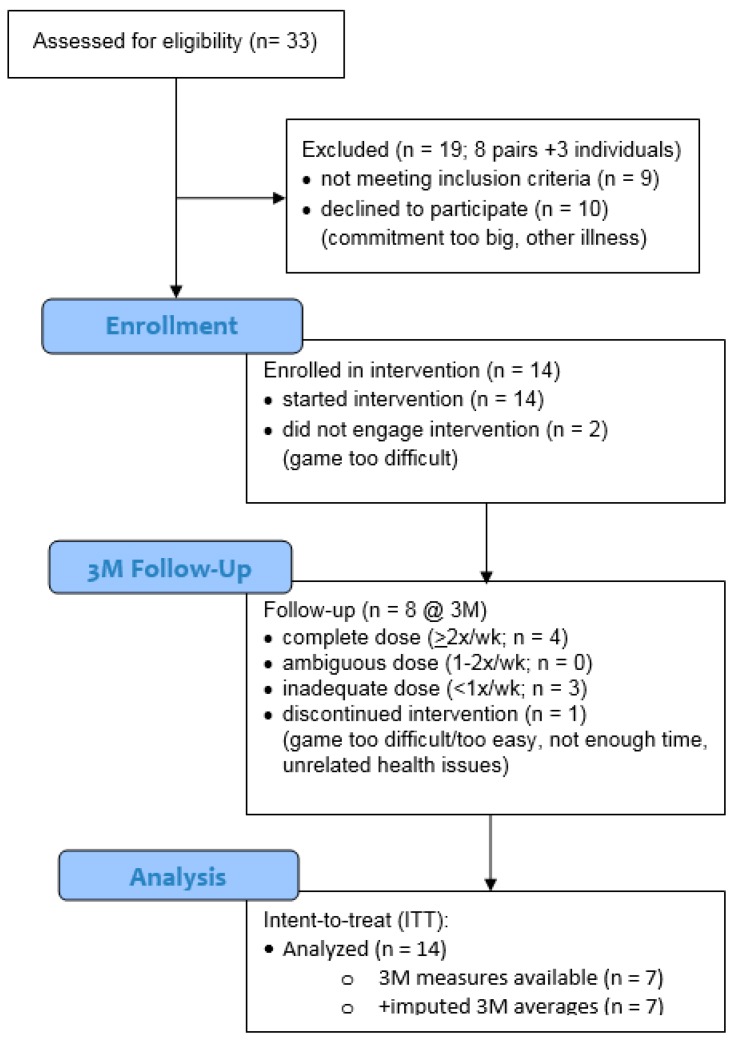
Given increasing longevity worldwide, older adults and caregivers are seeking ways to curb cognitive decline especially for those with mild cognitive impairment (MCI, now mild neurocognitive disorder, mNCD, Diagnostic and Statistical Manual of Mental Disorders, 5th ed. (DSM-V). This quasi-experimental, within-subjects pilot clinical trial was designed to replicate and extend the study of cognitive benefits for MCI by improving upon our prior interactive Physical and Cognitive Exercise Study (iPACES v1.0) by increasing the usability of the neuro-exergame and exploring possible underlying neurobiological mechanisms. Older adults were enrolled in a three-month, in-home trial of a portable neuro-exergame (iPACES™ v2.0) where participants pedaled and steered along a virtual bike path (Memory Lane™). Neuropsychological function was assessed at baseline after component familiarization intervals (e.g., two weeks of exercise-only, game-only, etc.) and after three months of interactive neuro-exergame intervention. Fourteen participants were enrolled in the study and seven completed the final evaluation. Intent-to-treat analyses were conducted with imputed missing data (total = 14). Significant improvement in executive function (Stroop) was found ( = 0.68, = 0.02) only. Changes in salivary biomarkers (cortisol and insulin-like growth factor 1; IGF-1) were significantly associated with improved cognition. Further research is needed, but pilot data suggest that a portable in-home neuro-exergame may be an additional, practical tool to fight back against cognitive decline and dementia.
鉴于全球范围内人们的寿命不断延长,老年人和护理人员都在寻找抑制认知衰退的方法,尤其是对于那些患有轻度认知障碍(MCI,现称为轻度神经认知障碍,mNCD,《精神疾病诊断与统计手册》第5版(DSM-V))的人。这项准实验性的、受试者内的试点临床试验旨在复制并扩展对MCI认知益处的研究,通过改进我们之前的交互式身体和认知锻炼研究(iPACES v1.0),提高神经锻炼游戏的可用性,并探索可能的潜在神经生物学机制。老年人参加了一项为期三个月的便携式神经锻炼游戏(iPACES™ v2.0)居家试验,参与者在虚拟自行车道(记忆之路™)上踩踏板和转向。在组件熟悉期(例如仅锻炼两周、仅游戏两周等)结束后的基线以及交互式神经锻炼游戏干预三个月后,对神经心理功能进行评估。14名参与者被纳入研究,7名完成了最终评估。采用插补缺失数据进行意向性分析(总计 = 14)。仅发现执行功能(斯特鲁普测试)有显著改善( = 0.68, = 0.02)。唾液生物标志物(皮质醇和胰岛素样生长因子1;IGF-1)的变化与认知改善显著相关。虽然还需要进一步研究,但试点数据表明,便携式居家神经锻炼游戏可能是对抗认知衰退和痴呆的一种额外实用工具。