National Institute of Gastroenterology, "S. de Bellis" Research Hospital, 70013 Castellana Grotte (Bari), Italy.
Department of Molecular Medicine, Sapienza University of Rome, 00161 Roma, Italy.
Cells. 2019 Sep 19;8(9):1110. doi: 10.3390/cells8091110.
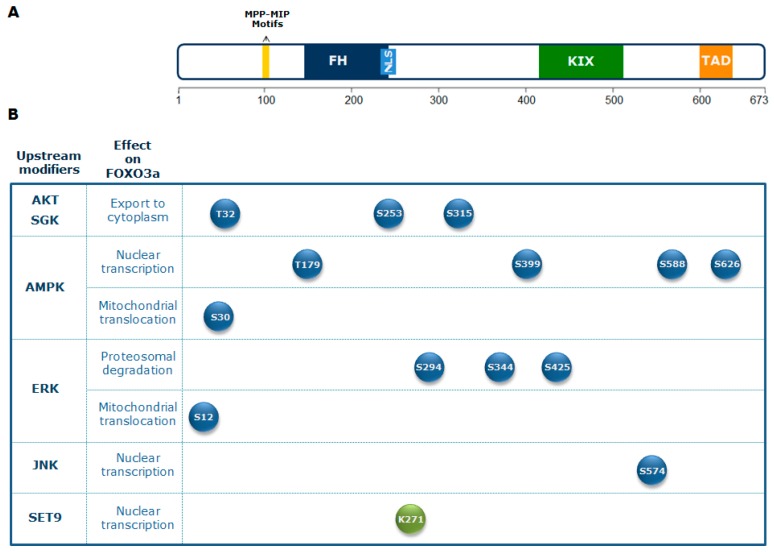
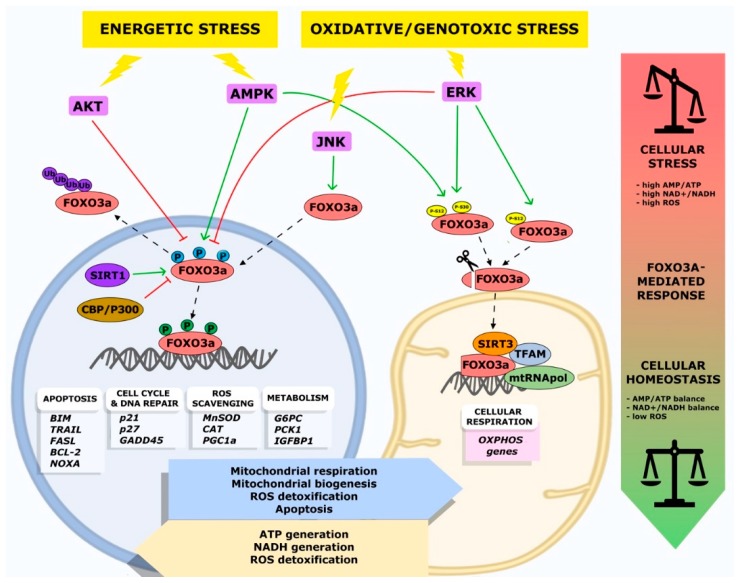
Cellular stress response is a universal mechanism that ensures the survival or negative selection of cells in challenging conditions. The transcription factor Forkhead box protein O3 (FOXO3a) is a core regulator of cellular homeostasis, stress response, and longevity since it can modulate a variety of stress responses upon nutrient shortage, oxidative stress, hypoxia, heat shock, and DNA damage. FOXO3a activity is regulated by post-translational modifications that drive its shuttling between different cellular compartments, thereby determining its inactivation (cytoplasm) or activation (nucleus and mitochondria). Depending on the stress stimulus and subcellular context, activated FOXO3a can induce specific sets of nuclear genes, including cell cycle inhibitors, pro-apoptotic genes, reactive oxygen species (ROS) scavengers, autophagy effectors, gluconeogenic enzymes, and others. On the other hand, upon glucose restriction, 5'-AMP-activated protein kinase (AMPK) and mitogen activated protein kinase kinase (MEK)/extracellular signal-regulated kinase (ERK) -dependent FOXO3a mitochondrial translocation allows the transcription of oxidative phosphorylation () genes, restoring cellular ATP levels, while in cancer cells, mitochondrial FOXO3a mediates survival upon genotoxic stress induced by chemotherapy. Interestingly, these target genes and their related pathways are diverse and sometimes antagonistic, suggesting that FOXO3a is an adaptable player in the dynamic homeostasis of normal and stressed cells. In this review, we describe the multiple roles of FOXO3a in cellular stress response, with a focus on both its nuclear and mitochondrial functions.
细胞应激反应是一种普遍机制,可确保细胞在挑战性条件下的生存或负选择。转录因子叉头框蛋白 O3(FOXO3a)是细胞内稳态、应激反应和长寿的核心调节剂,因为它可以在营养物质短缺、氧化应激、缺氧、热休克和 DNA 损伤时调节多种应激反应。FOXO3a 的活性受翻译后修饰的调节,这些修饰促使其在不同的细胞区室之间穿梭,从而决定其失活(细胞质)或激活(细胞核和线粒体)。根据应激刺激和亚细胞环境,激活的 FOXO3a 可以诱导特定的核基因集,包括细胞周期抑制剂、促凋亡基因、活性氧(ROS)清除剂、自噬效应物、糖异生酶等。另一方面,在葡萄糖限制下,5'-AMP 激活的蛋白激酶(AMPK)和丝裂原激活的蛋白激酶激酶(MEK)/细胞外信号调节激酶(ERK)依赖性 FOXO3a 线粒体易位允许转录氧化磷酸化(OXPHOS)基因,恢复细胞内 ATP 水平,而在癌细胞中,线粒体 FOXO3a 介导化疗诱导的遗传毒性应激下的存活。有趣的是,这些靶基因及其相关途径是多样化的,有时是拮抗的,这表明 FOXO3a 是正常和应激细胞动态内稳态的适应性参与者。在这篇综述中,我们描述了 FOXO3a 在细胞应激反应中的多种作用,重点介绍其核和线粒体功能。