Department of Biology, Pennsylvania State University, University Park, PA 16802.
Bioinformatics and Genomics Graduate Program, Pennsylvania State University, University Park, PA 16802.
Proc Natl Acad Sci U S A. 2018 Nov 27;115(48):12170-12175. doi: 10.1073/pnas.1807988115. Epub 2018 Nov 9.
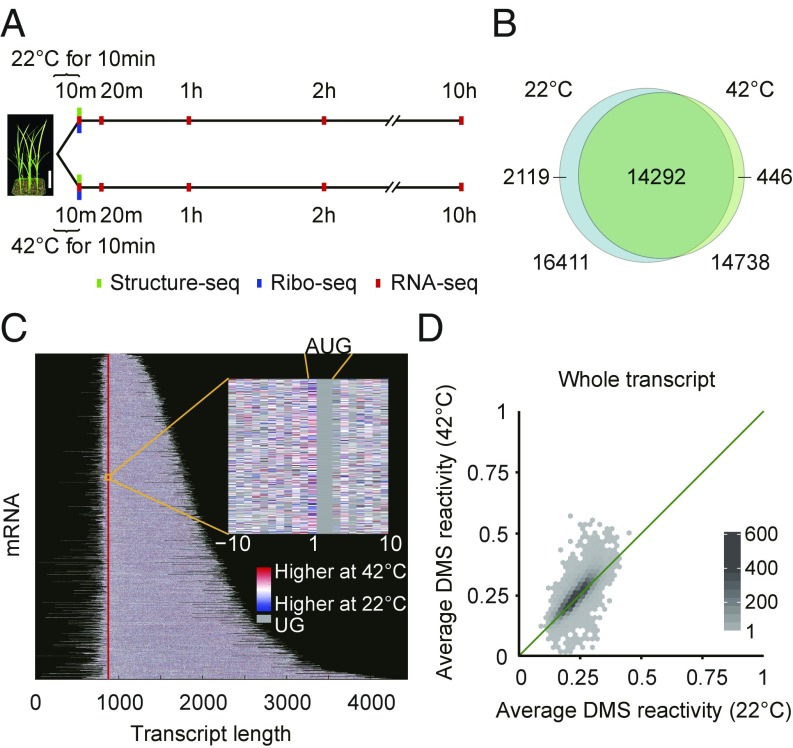
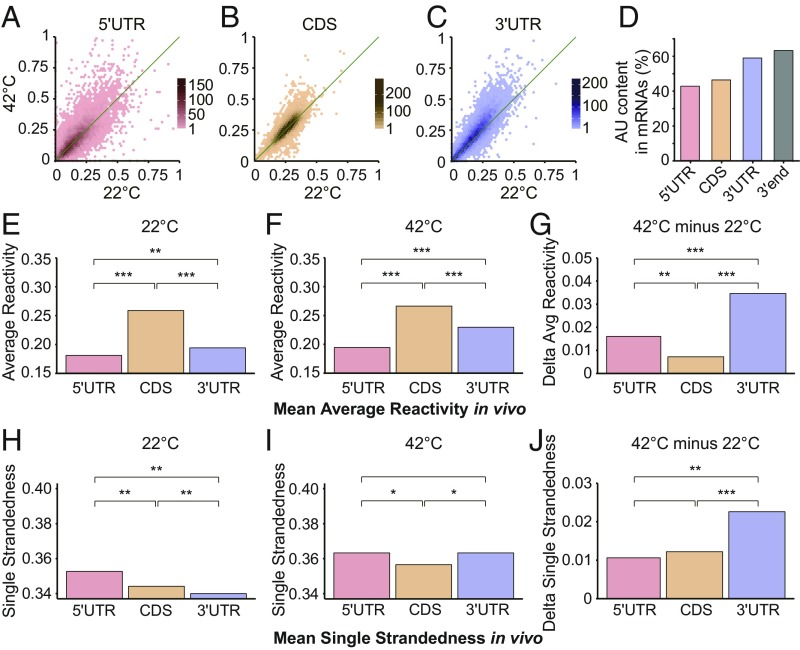
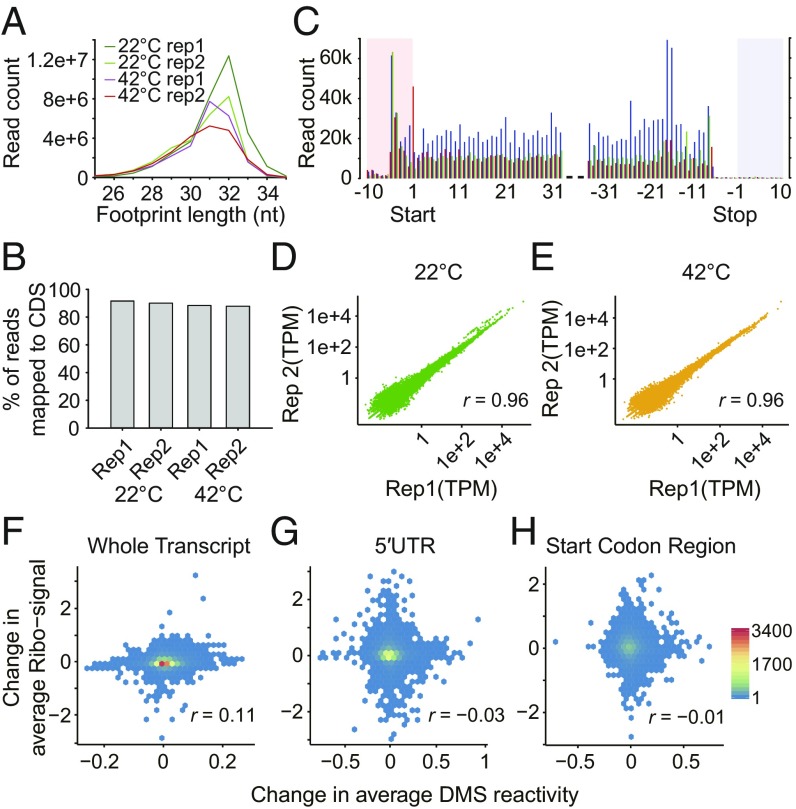
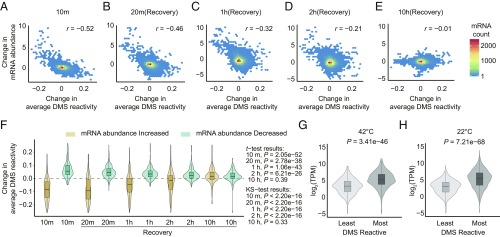
The heat shock response is crucial for organism survival in natural environments. RNA structure is known to influence numerous processes related to gene expression, but there have been few studies on the global RNA structurome as it prevails in vivo. Moreover, how heat shock rapidly affects RNA structure genome-wide in living systems remains unknown. We report here in vivo heat-regulated RNA structuromes. We applied Structure-seq chemical [dimethyl sulfate (DMS)] structure probing to rice ( L.) seedlings with and without 10 min of 42 °C heat shock and obtained structural data on >14,000 mRNAs. We show that RNA secondary structure broadly regulates gene expression in response to heat shock in this essential crop species. Our results indicate significant heat-induced elevation of DMS reactivity in the global transcriptome, revealing RNA unfolding over this biological temperature range. Our parallel Ribo-seq analysis provides no evidence for a correlation between RNA unfolding and heat-induced changes in translation, in contrast to the paradigm established in prokaryotes, wherein melting of RNA thermometers promotes translation. Instead, we find that heat-induced DMS reactivity increases correlate with significant decreases in transcript abundance, as quantified from an RNA-seq time course, indicating that mRNA unfolding promotes transcript degradation. The mechanistic basis for this outcome appears to be mRNA unfolding at both 5' and 3'-UTRs that facilitates access to the RNA degradation machinery. Our results thus reveal unexpected paradigms governing RNA structural changes and the eukaryotic RNA life cycle.
热休克反应对生物在自然环境中的生存至关重要。已知 RNA 结构会影响与基因表达相关的许多过程,但关于体内普遍存在的全 RNA 结构组,研究甚少。此外,热休克如何在活系统中快速影响全基因组范围内的 RNA 结构仍然未知。我们在这里报告了体内热调节的 RNA 结构组。我们应用结构测序化学(二甲磺酸酯(DMS))结构探测技术,对有和没有 10 分钟 42°C 热休克的水稻( L.)幼苗进行了研究,并获得了>14000 个 mRNA 的结构数据。我们表明,在这个重要的作物物种中,RNA 二级结构广泛调节基因表达对热休克的反应。我们的结果表明,在全转录组中,DMS 反应性在这个生物温度范围内显著升高,揭示了 RNA 的展开。我们的平行 Ribo-seq 分析没有提供证据表明 RNA 展开与热诱导的翻译变化之间存在相关性,这与在原核生物中建立的模式相反,在原核生物中,RNA 温度计的熔化促进了翻译。相反,我们发现,热诱导的 DMS 反应性增加与转录物丰度的显著降低相关,正如从 RNA-seq 时间过程中定量的那样,这表明 mRNA 的展开促进了转录物的降解。这种结果的机制基础似乎是 5'和 3'-UTR 处的 mRNA 展开,这有助于获得 RNA 降解机制。因此,我们的结果揭示了支配 RNA 结构变化和真核 RNA 生命周期的意想不到的模式。