Tan Monique, He Feng J, Ding Jingmin, Li Yuan, Zhang Puhong, MacGregor Graham A
Wolfson Institute of Preventive Medicine, Barts and The London School of Medicine & Dentistry, Queen Mary University of London, London, UK.
Nutrition and Lifestyle Program, The George Institute for Global Health at Peking University Health Science Center, Beijing, China.
BMJ Open. 2019 Sep 23;9(9):e025623. doi: 10.1136/bmjopen-2018-025623.
(1) To assess the changes in the salt content of sauces in the UK in the past 10 years; (2) to compare the salt content of sauces in China with equivalent products sold in the UK and (3) to calculate the proportion of sauce products meeting the salt targets set by the UK Department of Health (DoH).
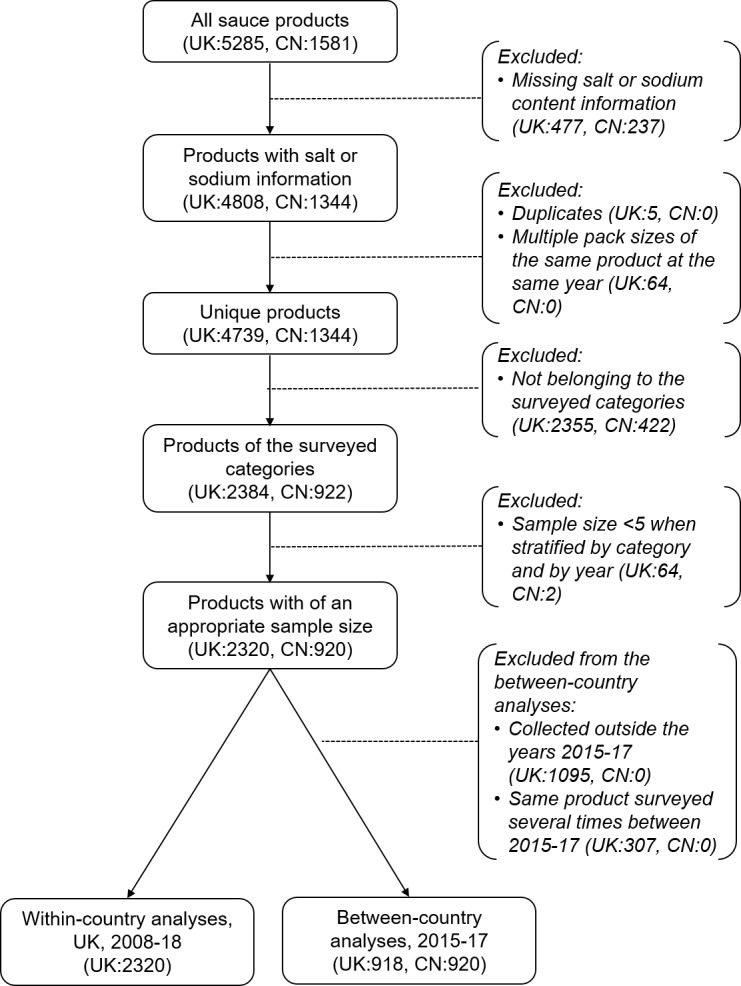
Cross-sectional surveys from the nutrition information panels of sauces.
Major retailers in London, Beijing and Shijiazhuang operating at data collection times.
Salt content of sauces.
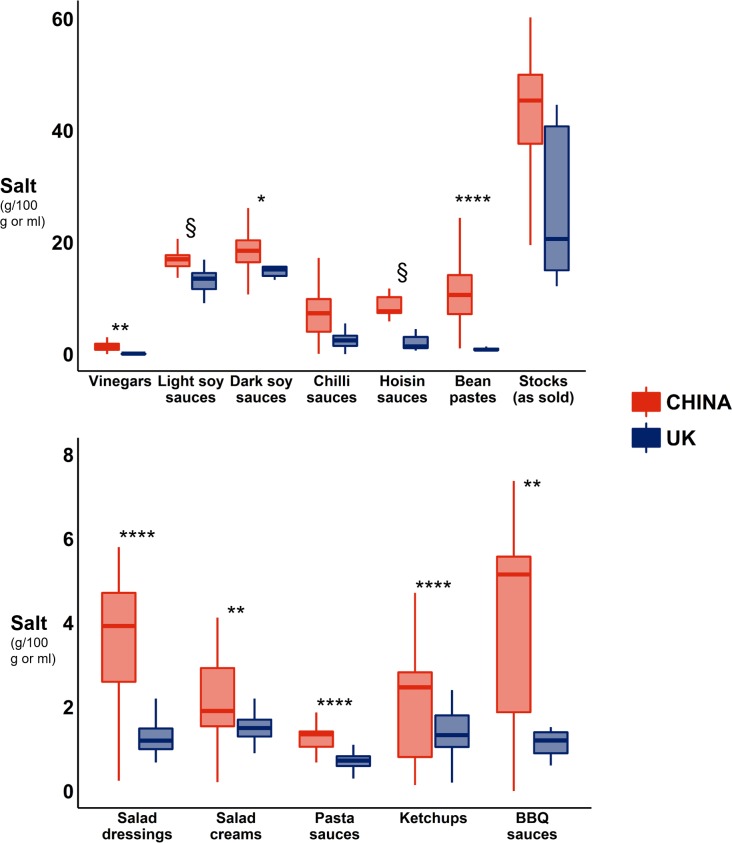
Relative change in the median salt content of UK products ranged from -70.6% to +3.0% in sauces for which salt targets were set, whereas it ranged from -27.1% to +111.5% in sauces without targets. Median salt contents were on average 4.4-fold greater in Chinese sauces compared with their UK equivalents surveyed during the same period (2015-2017). Only 13.4% of the Chinese products met the UK 2017 salt targets, compared with 70.0% of UK products.
In the UK, the target-based approach contributed to the reduction in the salt content of sauces over the course of the past 10 years. Currently, large variations in salt content exist within the same categories of sauces and 70% of the products have met DoH's 2017 targets, demonstrating that further reductions are possible and lower salt targets should be set. In China, salt content of sauces is extremely high with similarly large variations within same categories of sauces, demonstrating the feasibility of reducing their salt content. As processed foods (including sauces) are expected to become an important contributor to salt intake in China, national salt reduction efforts such as setting salt targets would be a valuable, proactive strategy.
(1)评估英国过去10年调味汁含盐量的变化;(2)比较中国调味汁与英国销售的同类产品的含盐量;(3)计算达到英国卫生部(DoH)设定的盐含量目标的调味汁产品比例。
对调味汁营养信息面板进行横断面调查。
在数据收集期间营业的伦敦、北京和石家庄的主要零售商。
调味汁的含盐量。
在设定了盐含量目标的调味汁中,英国产品的中位盐含量相对变化范围为-70.6%至+3.0%,而在未设定目标的调味汁中,该范围为-27.1%至+111.5%。与同期(2015 - 2017年)调查的英国同类产品相比,中国调味汁的中位盐含量平均高4.4倍。只有13.4%的中国产品达到了英国2017年的盐含量目标,而英国产品的这一比例为70.0%。
在英国,基于目标的方法促使过去10年中调味汁的含盐量有所降低。目前,同一类调味汁的含盐量存在很大差异,70%的产品达到了卫生部2017年的目标,这表明进一步降低含盐量是可行的,应设定更低的盐含量目标。在中国,调味汁的含盐量极高,同一类调味汁中也存在类似的巨大差异,这表明降低其含盐量是可行的。由于加工食品(包括调味汁)预计将成为中国盐摄入量的重要来源,设定盐含量目标等全国性的减盐措施将是一项有价值的积极策略。