The George Institute for Global Health at Peking University Health Science Center, Level 18, Tower B, Horizon Tower, 6, Zhichun Road, Haidian District, Beijing 100088, China.
Chinese Center for Disease Control and Prevention, 155, Changbai Road, Changping District, Beijing 102206, China.
Nutrients. 2015 Apr 10;7(4):2719-30. doi: 10.3390/nu7042719.
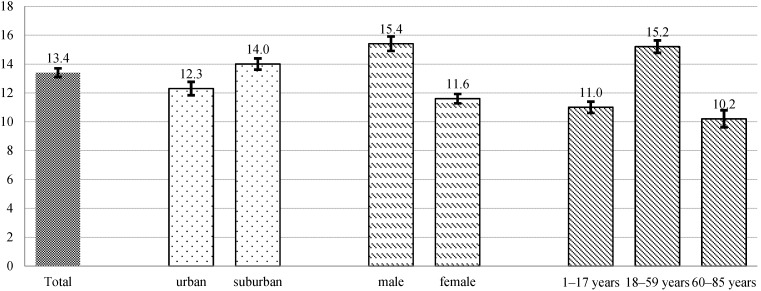
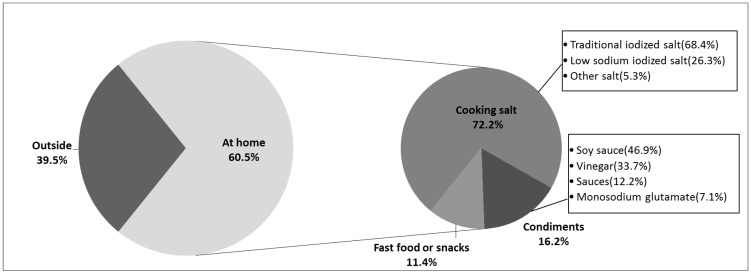
In China, few people are aware of the amount and source of their salt intake. We conducted a survey to investigate the consumption and sources of dietary salt using the "one-week salt estimation method" by weighing cooking salt and major salt-containing food, and estimating salt intake during dining out based on established evidence. Nine hundred and three families (1981 adults and 971 children) with students in eight primary or junior high schools in urban and suburban Beijing were recruited. On average, the daily dietary salt intake of family members in Beijing was 11.0 (standard deviation: 6.2) g for children and adolescents (under 18 years old), 15.2 (9.1) g for adults (18 to 59 years old), and 10.2 (4.8) g for senior citizens (60 years old and over), respectively. Overall, 60.5% of dietary salt was consumed at home, and 39.5% consumed outside the home. Approximately 90% of the salt intake came from cooking (household cooking and cafeteria or restaurant cooking), while less than 10% came from processed food. In conclusion, the dietary salt intake in Beijing families far surpassed the recommended amounts by World Health Organization, with both household cooking and dining-out as main sources of salt consumption. More targeted interventions, especially education about major sources of salt and corresponding methods for salt reduction should be taken to reduce the risks associated with a high salt diet.
在中国,很少有人了解他们的盐摄入量和来源。我们采用称重法和膳食调查法调查了北京 8 所城乡中小学 903 户家庭(1981 名成人和 971 名儿童)的盐摄入量和来源,通过已有证据估计在外就餐的盐摄入量。结果显示,北京居民家庭中成员的平均盐摄入量分别为:儿童青少年(<18 岁)11.0(6.2)g/d、成人(18-59 岁)15.2(9.1)g/d、老年人(≥60 岁)10.2(4.8)g/d。总体来看,60.5%的盐来自家庭烹饪,39.5%来自外出就餐。约 90%的盐来自烹调,不到 10%来自加工食品。北京家庭的盐摄入量远远超过世界卫生组织的推荐量,家庭烹饪和外出就餐是盐摄入的主要来源。应采取有针对性的干预措施,特别是加强对主要盐来源的教育和相应的减盐措施,以降低高盐饮食带来的风险。