Department of Pharmacy, Keelung Chang Gung Memorial Hospital, Keelung, Taiwan.
School of Pharmacy, Institute of Clinical Pharmacy and Pharmaceutical Sciences, College of Medicine, National Cheng Kung University, No. 1, University Road, Tainan, 701, Taiwan.
Cardiovasc Diabetol. 2019 Sep 24;18(1):120. doi: 10.1186/s12933-019-0919-9.
To compare the cardiovascular event risk in type 2 diabetes patients newly receiving dapagliflozin vs. empagliflozin.
We conducted a retrospective cohort study by analyzing a multi-institutional electronic medical records database (Chang Gung Research Database) in Taiwan and included adult type 2 diabetes patients who were newly receiving sodium-glucose co-transporter 2 (SGLT2) inhibitors from 2016 to 2017. The primary outcome was a composite of cardiovascular death, myocardial infarction, ischemic stroke and heart failure. We followed up patients from initiation of SGLT2 inhibitors until the occurrence of cardiovascular events before December 31, 2018. We performed multivariable Cox proportional hazard modeling, adjusting for patients' age, sex, laboratory data, co-morbidities, and concomitant medications.
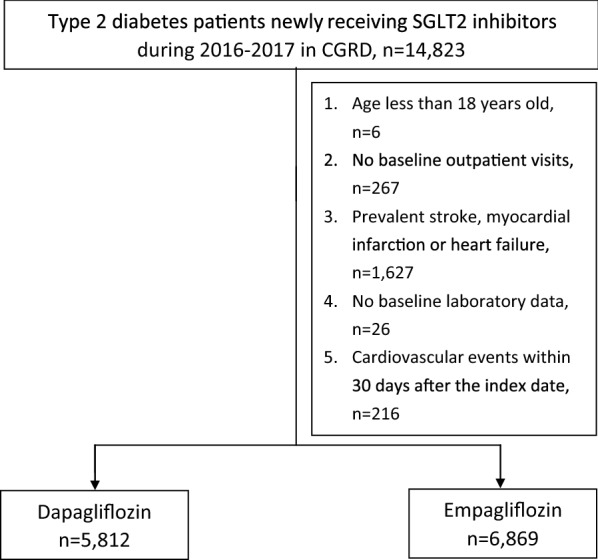
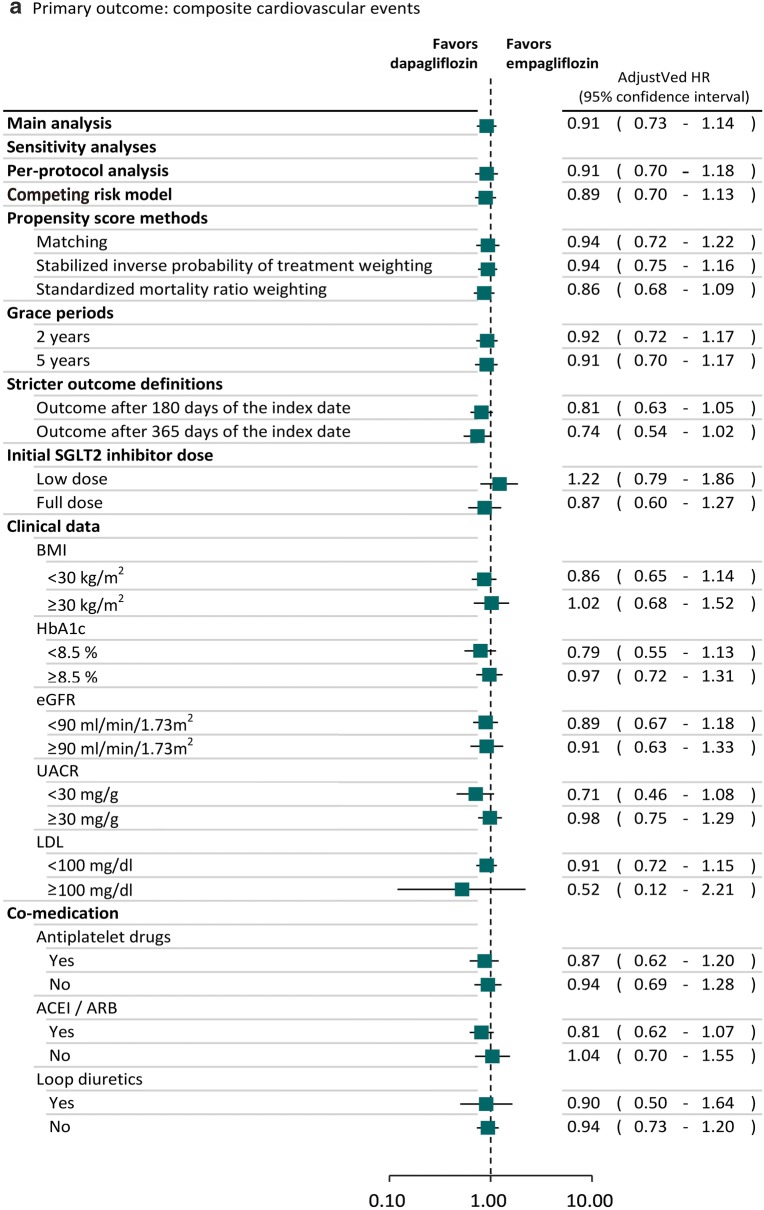
We identified 12,681 new SGLT2 inhibitor users with a mean age of 58.9 (SD 11.8) years, of whom 43.9% were female and 45.8% were new dapagliflozin users. A total of 10,442 person-years of dapagliflozin use and 12,096 person-years of empagliflozin use were included. Compared to empagliflozin users, new users of dapagliflozin were found to have similar risks for primary composite outcome (adjusted HR: 0.91; 95% CI 0.73-1.14), cardiovascular death (adjusted HR: 0.54; 95% CI 0.14-2.12), myocardial infarction (adjusted HR: 0.77, 95% CI 0.49-1.19) and ischemic stroke (adjusted HR: 1.15; 95% CI 0.80-1.65), but a lower risk of heart failure (adjusted HR: 0.68; 95% CI 0.49-0.95).
The risk of cardiovascular events was similar between dapagliflozin and empagliflozin new users, but dapagliflozin may have a better outcome in the reduction of heart failure in type 2 diabetes patients. Future prospective studies are required to confirm the findings.
比较新接受达格列净与恩格列净的 2 型糖尿病患者的心血管事件风险。
我们通过分析台湾多个医疗机构的电子病历数据库(长庚研究数据库)进行了一项回顾性队列研究,纳入了 2016 年至 2017 年新接受钠-葡萄糖共转运蛋白 2(SGLT2)抑制剂的成年 2 型糖尿病患者。主要结局为心血管死亡、心肌梗死、缺血性卒中和心力衰竭的复合结局。我们从开始使用 SGLT2 抑制剂开始对患者进行随访,直至 2018 年 12 月 31 日前发生心血管事件。我们使用多变量 Cox 比例风险模型,调整了患者的年龄、性别、实验室数据、合并症和伴随用药。
我们确定了 12681 名新的 SGLT2 抑制剂使用者,平均年龄为 58.9(11.8)岁,其中 43.9%为女性,45.8%为新的达格列净使用者。达格列净的总使用人数为 10442 人年,恩格列净的使用人数为 12096 人年。与恩格列净使用者相比,新使用达格列净的患者主要复合结局(调整后的 HR:0.91;95%CI 0.73-1.14)、心血管死亡(调整后的 HR:0.54;95%CI 0.14-2.12)、心肌梗死(调整后的 HR:0.77,95%CI 0.49-1.19)和缺血性卒中等风险相似,但心力衰竭的风险较低(调整后的 HR:0.68;95%CI 0.49-0.95)。
在新使用达格列净和恩格列净的患者中,心血管事件的风险相似,但达格列净可能在降低 2 型糖尿病患者心力衰竭方面有更好的效果。需要进一步的前瞻性研究来证实这些发现。