State Key Laboratory of Veterinary Etiological Biology, Key Laboratory of Veterinary Parasitology of Gansu Province, Lanzhou Veterinary Research Institute, Chinese Academy of Agricultural Sciences, Lanzhou, China.
Jiangsu Co-innovation Center for Prevention and Control of Animal Infectious Diseases and Zoonoses, Yangzhou, China.
Front Immunol. 2019 Sep 3;10:2070. doi: 10.3389/fimmu.2019.02070. eCollection 2019.
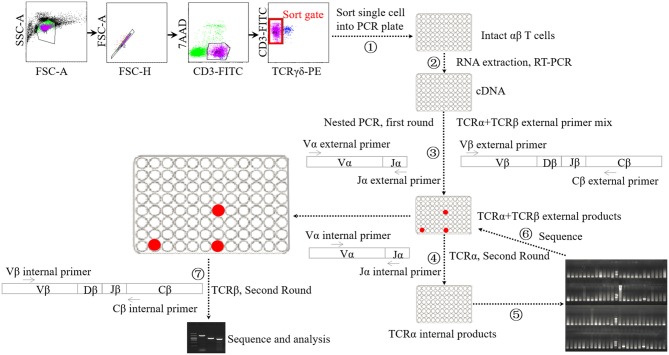
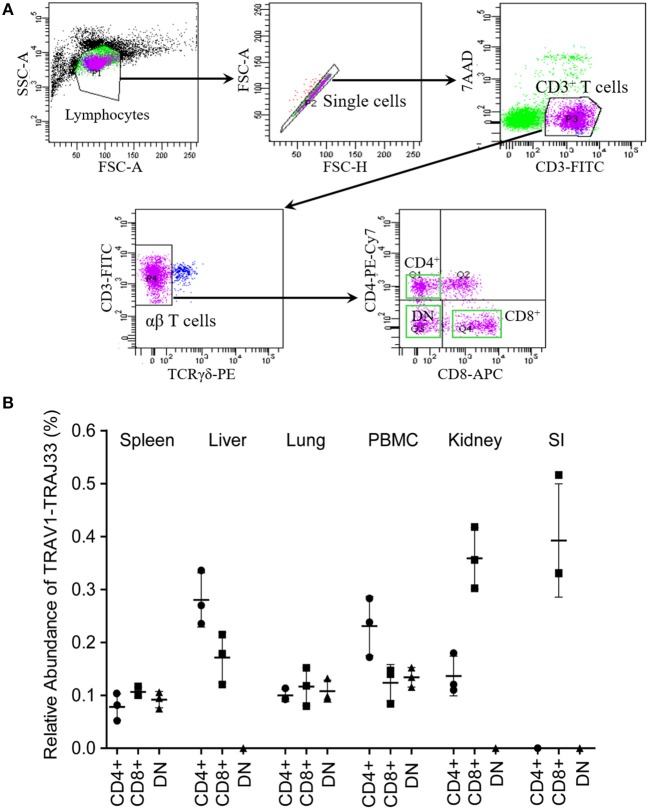
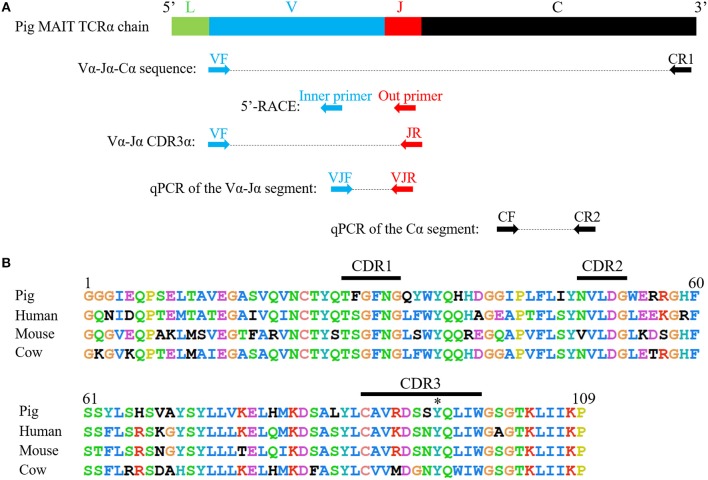
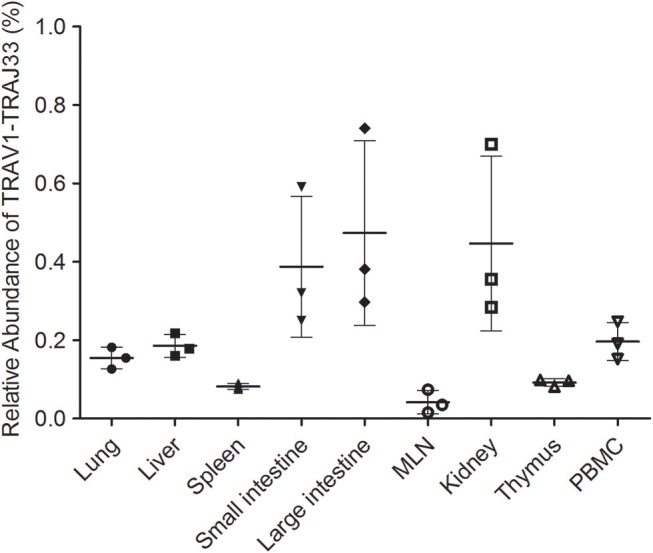
Mucosal-associated invariant T (MAIT) cells are a subpopulation of evolutionarily conserved innate-like T lymphocytes bearing invariant or semi-invariant TCRα chains paired with a biased usage of TCRβ chains and restricted by highly conserved monomorphic MHC class I-like molecule, MR1. Consistent with their phylogenetically conserved characteristics, MAIT cells have been implicated in host immune responses to microbial infections and non-infectious diseases, such as tuberculosis, typhoid fever, and multiple sclerosis. To date, MAIT cells have been identified in humans, mice, cows, sheep, and several non-human primates, but not in pigs. Here, we cloned porcine MAIT (pMAIT) TCRα sequences from PBMC cDNA, and then analyzed the TCRβ usage of pMAIT cells expressing the TRAV1-TRAJ33 chain, finding that pMAIT cells use a limited array of TCRβ chains (predominantly TRBV20S and TRBV29S). We estimated the frequency of TRAV1-TRAJ33 transcripts in peripheral blood and tissues, demonstrating that TRAV1-TRAJ33 transcripts are expressed in all tested tissues. Analysis of the expression of TRAV1-TRAJ33 transcripts in three T-cell subpopulations from peripheral blood and tissues showed that TRAV1-TRAJ33 transcripts can be expressed by CD4CD8, CD8CD4, and CD4CD8 T cells. Using a single-cell PCR assay, we demonstrated that pMAIT cells with the TRAV1-TRAJ33 chain express cell surface markers IL-18Rα, IL-7Rα, CCR9, CCR5, and/or CXCR6, and transcription factors PLZF, and T-bet and/or RORγt. In conclusion, pMAIT cells expressing the TRAV1-TRAJ33 chain have characteristics similar to human and mouse MAIT cells, further supporting the idea that the pig is an animal model for investigating MAIT cell functions in human disease.
黏膜相关恒定 T(MAIT)细胞是一类进化上保守的固有样 T 淋巴细胞亚群,其特征是 TCRα 链具有不变或半不变的结构,TCRβ 链的使用受到高度限制,并且受到高度保守的单形 MHC 类 I 样分子 MR1 的限制。与它们进化上保守的特征一致,MAIT 细胞已被认为参与宿主对微生物感染和非传染性疾病(例如结核病、伤寒和多发性硬化症)的免疫反应。迄今为止,已在人类、小鼠、牛、绵羊和几种非人类灵长类动物中鉴定出 MAIT 细胞,但在猪中尚未鉴定出 MAIT 细胞。在这里,我们从 PBMC cDNA 中克隆了猪 MAIT(pMAIT)TCRα 序列,然后分析了表达 TRAV1-TRAJ33 链的 pMAIT 细胞的 TCRβ 使用情况,发现 pMAIT 细胞使用有限的 TCRβ 链(主要是 TRBV20S 和 TRBV29S)。我们估计了外周血和组织中 TRAV1-TRAJ33 转录本的频率,证明 TRAV1-TRAJ33 转录本在外周血和所有测试组织中均有表达。分析 TRAV1-TRAJ33 转录本在来自外周血和组织的三种 T 细胞亚群中的表达表明,TRAV1-TRAJ33 转录本可以由 CD4CD8、CD8CD4 和 CD4CD8 T 细胞表达。使用单细胞 PCR 测定法,我们证明了具有 TRAV1-TRAJ33 链的 pMAIT 细胞表达细胞表面标志物 IL-18Rα、IL-7Rα、CCR9、CCR5 和/或 CXCR6,以及转录因子 PLZF、T-bet 和/或 RORγt。总之,表达 TRAV1-TRAJ33 链的 pMAIT 细胞具有与人类和小鼠 MAIT 细胞相似的特征,进一步支持猪是研究 MAIT 细胞在人类疾病中功能的动物模型的观点。