Channing Division of Network Medicine, Brigham and Women's Hospital and Harvard Medical School, Boston, MA, 02115, USA.
Department of Physics, Hong Kong Baptist University, Kowloon Tong, Hong Kong SAR, China.
Sci Rep. 2019 Sep 25;9(1):13824. doi: 10.1038/s41598-019-50217-w.
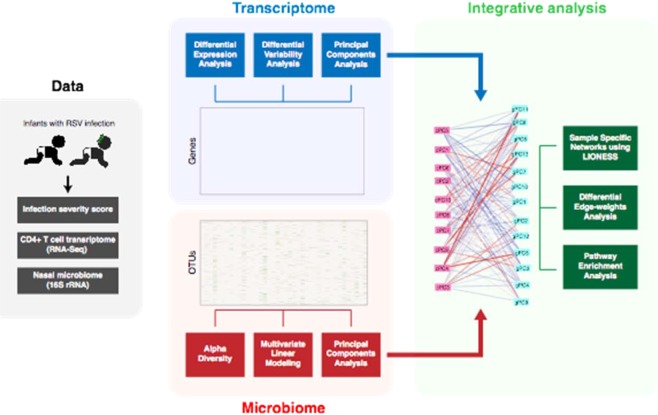
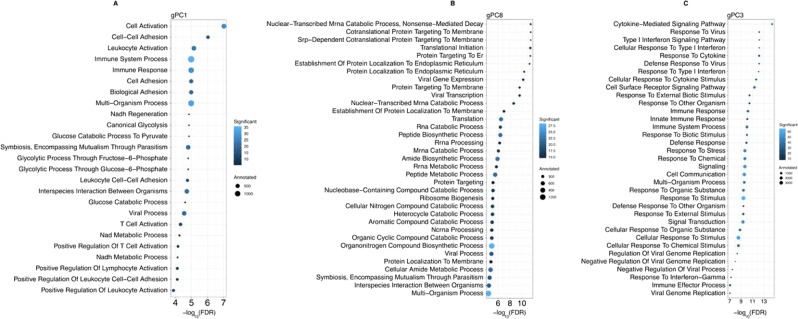
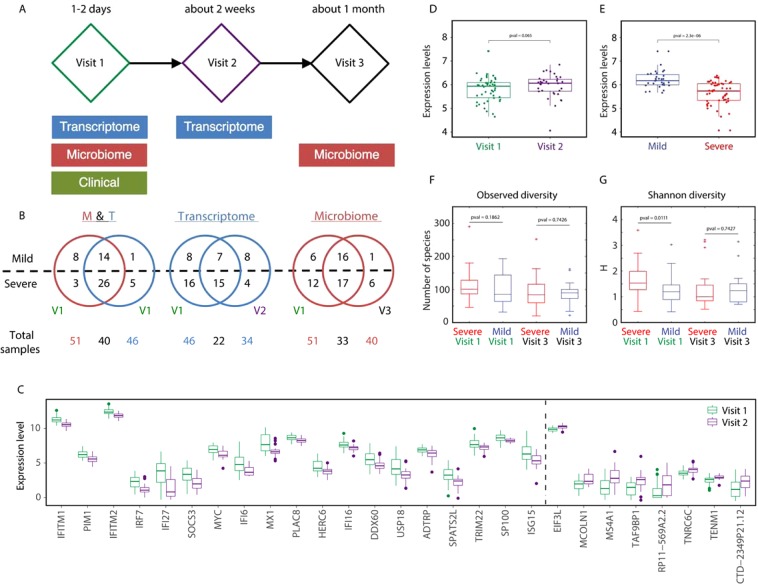
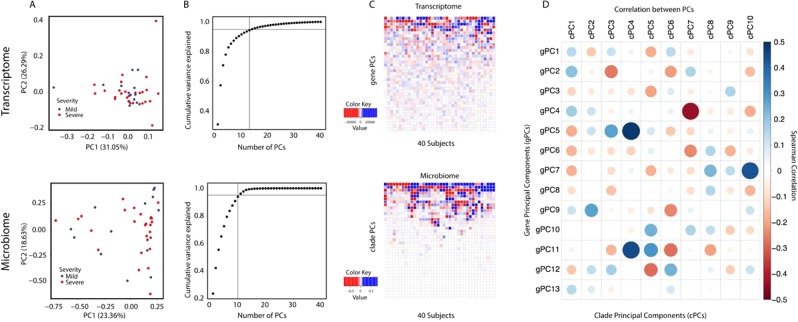
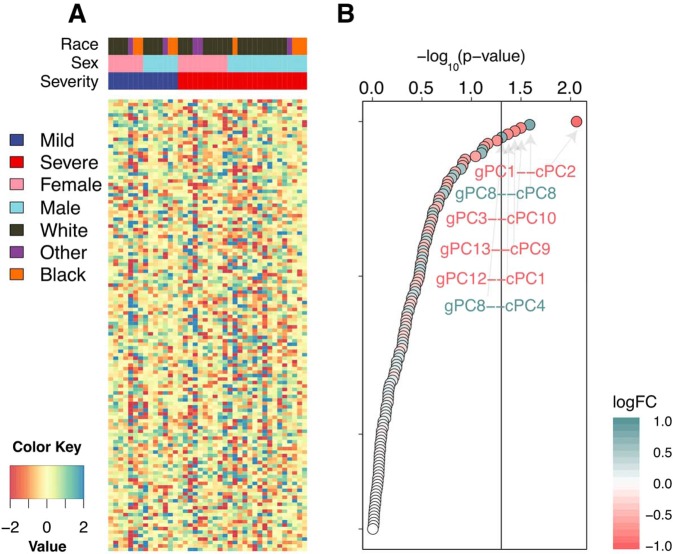
Respiratory syncytial virus (RSV) is a major cause of lower respiratory tract infections and hospital visits during infancy and childhood. Although risk factors for RSV infection have been identified, the role of microbial species in the respiratory tract is only partially known. We aimed to understand the impact of interactions between the nasal microbiome and host transcriptome on the severity and clinical outcomes of RSV infection. We used 16 S rRNA sequencing to characterize the nasal microbiome of infants with RSV infection. We used RNA sequencing to interrogate the transcriptome of CD4 T cells obtained from the same set of infants. After dimension reduction through principal component (PC) analysis, we performed an integrative analysis to identify significant co-variation between microbial clade and gene expression PCs. We then employed LIONESS (Linear Interpolation to Obtain Network Estimates for Single Samples) to estimate the clade-gene association patterns for each infant. Our network-based integrative analysis identified several clade-gene associations significantly related to the severity of RSV infection. The microbial taxa with the highest loadings in the implicated clade PCs included Moraxella, Corynebacterium, Streptococcus, Haemophilus influenzae, and Staphylococcus. Interestingly, many of the genes with the highest loadings in the implicated gene PCs are encoded in mitochondrial DNA, while others are involved in the host immune response. This study on microbiome-transcriptome interactions provides insights into how the host immune system mounts a response against RSV and specific infectious agents in nasal microbiota.
呼吸道合胞病毒(RSV)是婴儿和儿童下呼吸道感染和住院的主要原因。虽然已经确定了 RSV 感染的危险因素,但呼吸道微生物物种的作用仅部分已知。我们旨在了解鼻腔微生物组与宿主转录组之间的相互作用对 RSV 感染严重程度和临床结果的影响。我们使用 16S rRNA 测序来描述 RSV 感染婴儿的鼻腔微生物组。我们使用 RNA 测序来检测来自同一组婴儿的 CD4 T 细胞的转录组。通过主成分(PC)分析进行降维后,我们进行了综合分析,以确定微生物群系和基因表达 PC 之间的显著共变。然后,我们使用 LIONESS(Linear Interpolation to Obtain Network Estimates for Single Samples)来估计每个婴儿的群系-基因关联模式。我们基于网络的综合分析确定了几个与 RSV 感染严重程度显著相关的群系-基因关联。在涉及的群系 PC 中具有最高负荷的微生物类群包括莫拉氏菌、棒状杆菌、链球菌、流感嗜血杆菌和葡萄球菌。有趣的是,在涉及的基因 PC 中具有最高负荷的许多基因都编码在线粒体 DNA 中,而其他基因则参与宿主免疫反应。这项关于微生物组-转录组相互作用的研究提供了关于宿主免疫系统如何针对 RSV 和鼻腔微生物群中的特定传染性病原体产生反应的见解。