Sutherland R T, Srinivas R, Burd S C, Leibfried D, Wilson A C, Wineland D J, Allcock D T C, Slichter D H, Libby S B
Physics Division, Physical and Life Sciences, Lawrence Livermore National Laboratory, Livermore, CA 94550, United States of America.
Time and Frequency Division, National Institute of Standards and Technology, Boulder, CO 80305, United States of America.
New J Phys. 2019;21. doi: 10.1088/1367-2630/ab0be5.
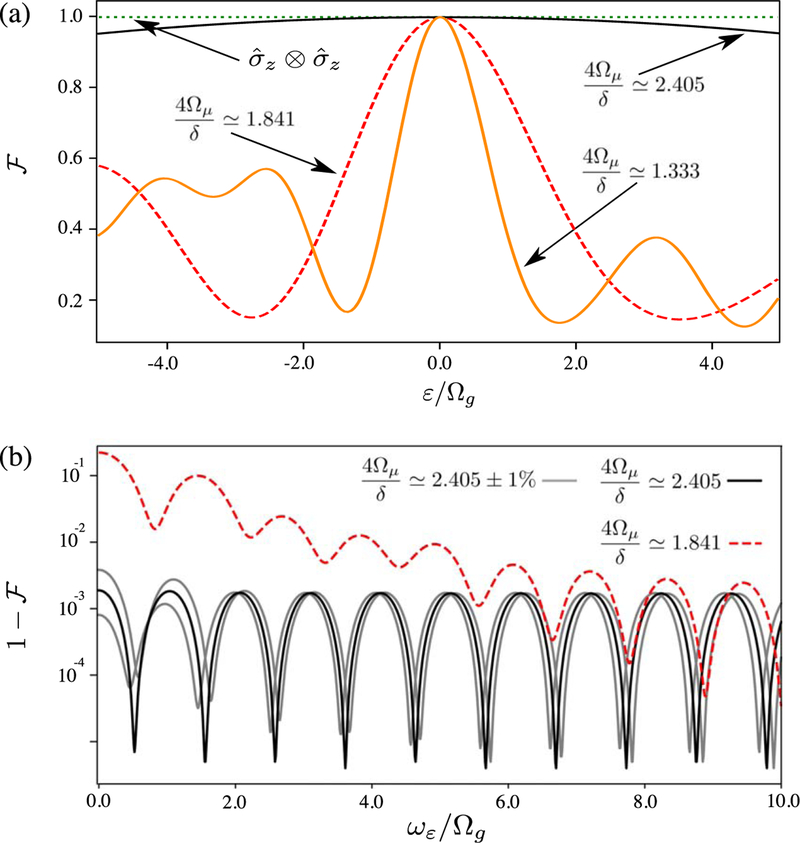
We present a general theory for laser-free entangling gates with trapped-ion hyperfine qubits, using either static or oscillating magnetic-field gradients combined with a pair of uniform microwave fields symmetrically detuned about the qubit frequency. By transforming into a 'bichromatic' interaction picture, we show that either or geometric phase gates can be performed. The gate basis is determined by selecting the microwave detuning. The driving parameters can be tuned to provide intrinsic dynamical decoupling from qubit frequency fluctuations. The gates can be implemented in a novel manner which eases experimental constraints. We present numerical simulations of gate fidelities assuming realistic parameters.
我们提出了一种用于囚禁离子超精细量子比特的无激光纠缠门的通用理论,该理论使用静态或振荡磁场梯度,并结合一对关于量子比特频率对称失谐的均匀微波场。通过转换到“双色”相互作用图像,我们表明可以执行(\pi)或(\pi/2)几何相位门。门基由选择微波失谐来确定。驱动参数可以进行调整,以提供与量子比特频率波动的固有动态解耦。(\pi/2)门可以以一种减轻实验约束的新颖方式实现。我们给出了假设实际参数的门保真度的数值模拟。