The Division of Chemical Biology and Medicinal Chemistry, College of Pharmacy, The University of Texas at Austin, 2409 University Avenue, Austin, TX 78712, USA.
Molecules. 2019 Sep 27;24(19):3507. doi: 10.3390/molecules24193507.
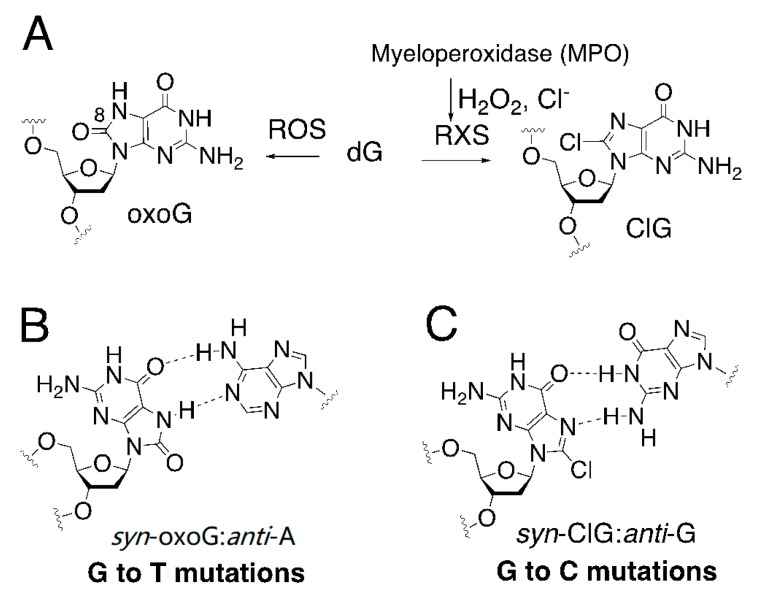
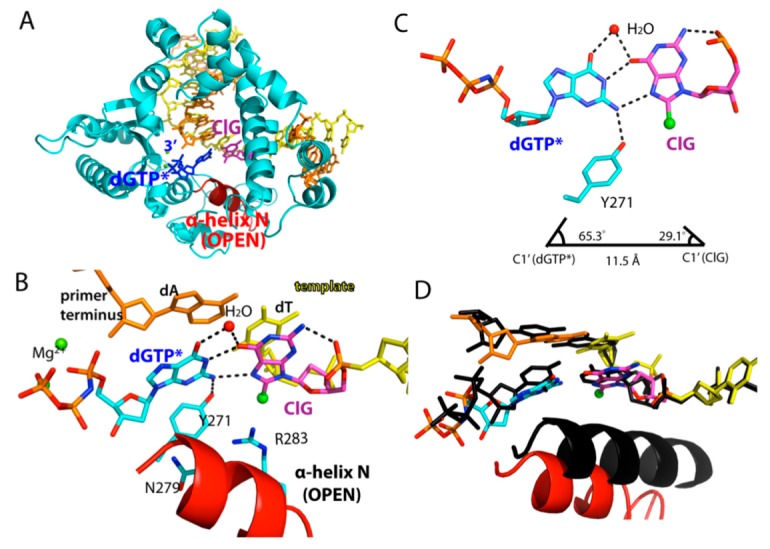
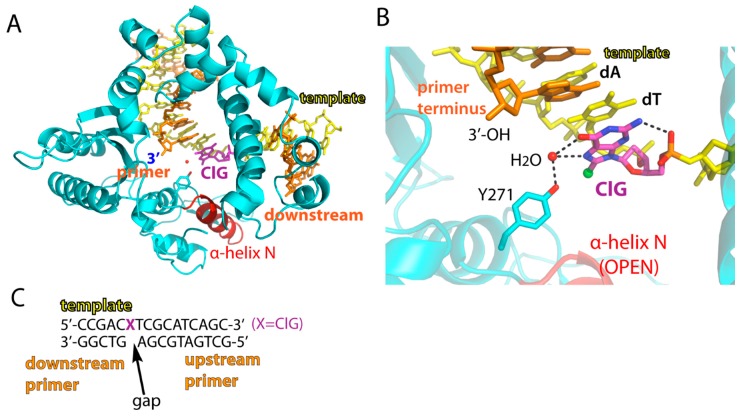
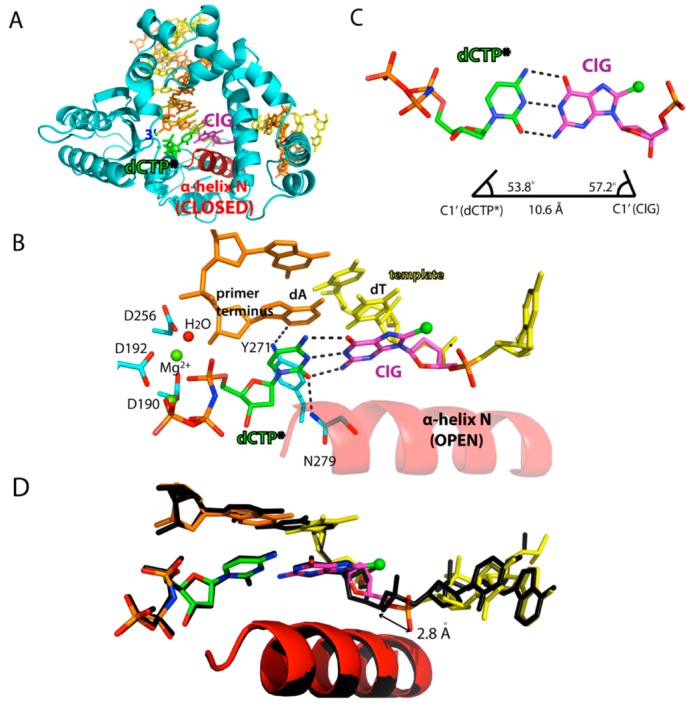
Chronic inflammation is closely associated with cancer development. One possible mechanism for inflammation-induced carcinogenesis is DNA damage caused by reactive halogen species, such as hypochlorous acid, which is released by myeloperoxidase to kill pathogens. Hypochlorous acid can attack genomic DNA to produce 8-chloro-2'-deoxyguanosine (ClG) as a major lesion. It has been postulated that ClG promotes mutagenic replication using its conformer; yet, the structural basis for ClG-induced mutagenesis is unknown. We obtained crystal structures and kinetics data for nucleotide incorporation past a templating ClG using human DNA polymerase β (polβ) as a model enzyme for high-fidelity DNA polymerases. The structures showed that ClG formed base pairs with incoming dCTP and dGTP using its and conformers, respectively. Kinetic studies showed that polβ incorporated dGTP only 15-fold less efficiently than dCTP, suggesting that replication across ClG is promutagenic. Two hydrogen bonds between -ClG and -dGTP and a water-mediated hydrogen bond appeared to facilitate mutagenic replication opposite the major halogenated guanine lesion. These results suggest that ClG in DNA promotes G to C transversion mutations by forming Hoogsteen base pairing between -ClG and -G during DNA synthesis.
慢性炎症与癌症的发展密切相关。炎症引起致癌的一种可能机制是活性卤素物种(如次氯酸)引起的 DNA 损伤,次氯酸由髓过氧化物酶释放以杀死病原体。次氯酸可以攻击基因组 DNA,产生 8-氯-2'-脱氧鸟苷(ClG)作为主要损伤。有人假设 ClG 通过其构象促进诱变复制;然而,ClG 诱导突变的结构基础尚不清楚。我们使用人 DNA 聚合酶β(polβ)作为高保真 DNA 聚合酶的模型酶,获得了在模板 ClG 上进行核苷酸掺入的晶体结构和动力学数据。这些结构表明,ClG 分别使用其 和 构象与进入的 dCTP 和 dGTP 形成碱基对。动力学研究表明,polβ 掺入 dGTP 的效率仅比 dCTP 低 15 倍,表明 ClG 跨越的复制具有促突变性。-ClG 和 -dGTP 之间的两个氢键和一个通过水分子介导的氢键似乎有利于在主要卤化鸟嘌呤损伤的对面进行诱变复制。这些结果表明,DNA 中的 ClG 通过在 DNA 合成过程中在 -ClG 和 -G 之间形成 Hoogsteen 碱基配对,促进 G 到 C 的颠换突变。