Synaptic Immunopathology Lab, Department of Systems Medicine, Tor Vergata University, Rome, Italy.
Synaptic Immunopathology Lab, IRCCS San Raffaele Pisana, Rome, Italy.
Front Immunol. 2019 Sep 13;10:2197. doi: 10.3389/fimmu.2019.02197. eCollection 2019.
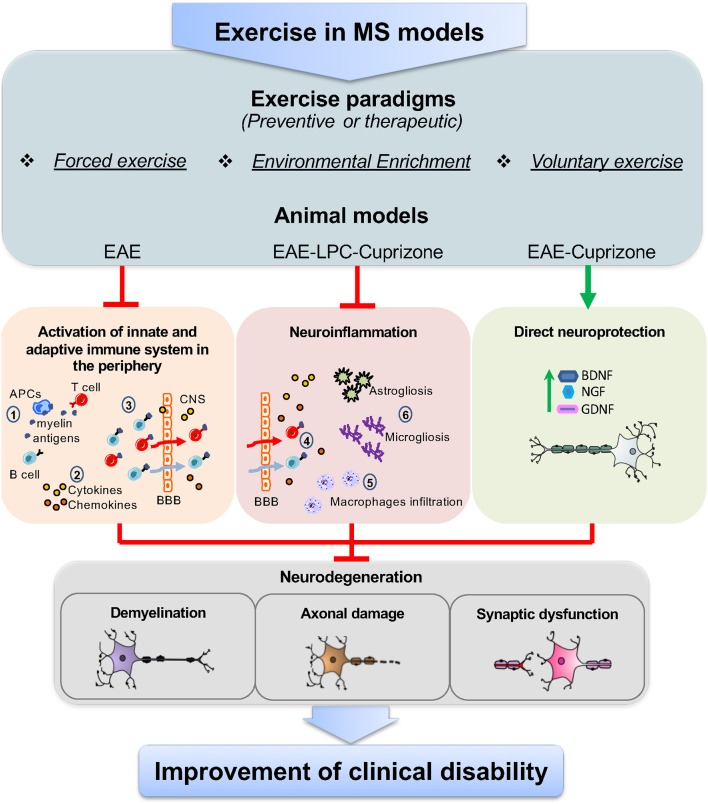
Multiple Sclerosis (MS) is a demyelinating and neurodegenerative disease. Though a specific antigen has not been identified, it is widely accepted that MS is an autoimmune disorder characterized by myelin-directed immune attack. Pharmacological treatments for MS are based on immunomodulatory or immunosuppressant drugs, designed to attenuate or dampen the immune reaction, to improve neurological functions. Recently, rehabilitation has gained increasing attention in the scientific community dealing with MS. Engagement of people with MS in exercise programs has been associated with a number of functional improvements in mobility, balance, and motor coordination. Moreover, several studies indicate the effectiveness of exercise against fatigue and mood disorders that are frequently associated with the disease. However, whether exercise acts like an immunomodulatory therapy is still an unresolved question. A good tool to address this issue is provided by the study of the immunomodulatory effects of exercise in an animal model of MS, including the experimental autoimmune encephalomyelitis (EAE), the Theiler's virus induced-demyelinating disease (TMEV-IDD) and toxic-demyelinating models, cuprizone (CPZ), and lysolecithin (LPC). So far, despite the availability of different animal models, most of the pre-clinical data have been gained in EAE and to a lesser extent in CPZ and LPC. These studies have highlighted beneficial effects of exercise, suggesting the modulation of both the innate and the adaptive immune response in the peripheral blood as well as in the brain. In the present paper, starting from the biological differences among MS animal models in terms of immune system involvement, we revise the literature regarding the effects of exercise in EAE, CPZ, and LPC, and critically highlight the advantages of either model, including the so-far unexplored TMEV-IDD, to address the immune effects of exercise in MS.
多发性硬化症(MS)是一种脱髓鞘和神经退行性疾病。虽然尚未确定特定的抗原,但人们普遍认为 MS 是一种自身免疫性疾病,其特征是髓鞘导向的免疫攻击。MS 的药物治疗基于免疫调节或免疫抑制药物,旨在减轻或抑制免疫反应,改善神经功能。最近,康复在处理 MS 的科学界中受到越来越多的关注。MS 患者参与运动计划与运动、平衡和运动协调等多种功能的改善有关。此外,几项研究表明运动对疲劳和情绪障碍的有效性,这些障碍常与该疾病有关。然而,运动是否像免疫调节疗法一样发挥作用,仍然是一个悬而未决的问题。解决这个问题的一个很好的工具是在 MS 的动物模型中研究运动的免疫调节作用,包括实验性自身免疫性脑脊髓炎(EAE)、Theiler 病毒诱导的脱髓鞘疾病(TMEV-IDD)和毒性脱髓鞘模型、杯状蛋白(CPZ)和溶血卵磷脂(LPC)。到目前为止,尽管有不同的动物模型可用,但大多数临床前数据都是在 EAE 中获得的,在 CPZ 和 LPC 中获得的则较少。这些研究强调了运动的有益作用,表明运动对周围血液以及大脑中的固有和适应性免疫反应都有调节作用。在本文中,我们从 MS 动物模型在免疫系统参与方面的生物学差异出发,复习了关于 EAE、CPZ 和 LPC 中运动作用的文献,并批判性地突出了每种模型的优势,包括迄今为止尚未探索的 TMEV-IDD,以解决 MS 中运动的免疫作用。