Natinsky Benjamin S, Lu Shengtao, Copeland Emma D, Quintana Jason C, Liu Chong
Department of Chemistry and Biochemistry, University of California, Los Angeles, California 90025, United States.
ACS Cent Sci. 2019 Sep 25;5(9):1584-1590. doi: 10.1021/acscentsci.9b00625. Epub 2019 Aug 1.
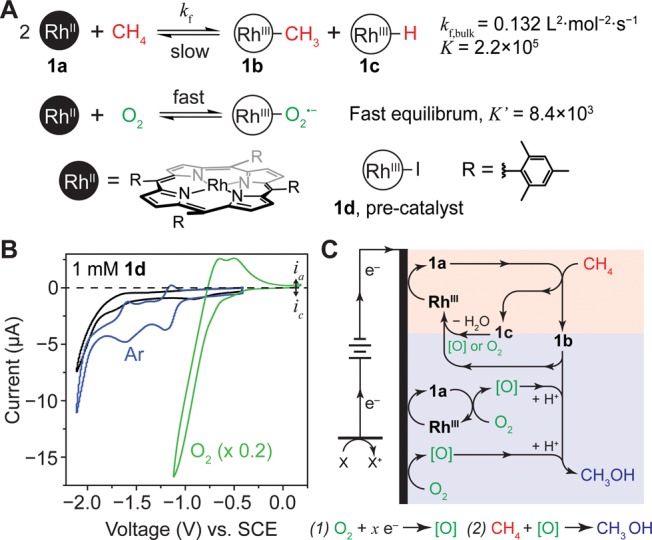
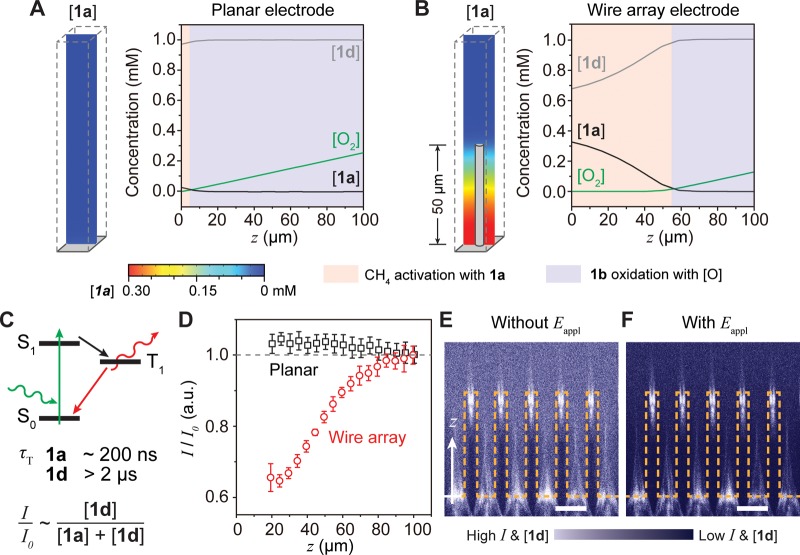
Direct chemical synthesis from methane and air under ambient conditions is attractive yet challenging. Low-valent organometallic compounds are known to activate methane, but their electron-rich nature seems incompatible with O and prevents catalytic air oxidation. We report selective oxidation of methane to methanol with an O-sensitive metalloradical as the catalyst and air as the oxidant at room temperature and ambient pressure. The incompatibility between C-H activation and O oxidation is reconciled by electrochemistry and nanomaterials, with which a concentration gradient of O within the nanowire array spatially segregated incompatible steps in the catalytic cycle. An unexpected 220 000-fold increase of the apparent reaction rate constants within the nanowire array leads to a turnover number up to 52 000 within 24 h. The synergy between nanomaterials and organometallic chemistry warrants a new catalytic route for CH functionalization.
在环境条件下由甲烷和空气直接进行化学合成具有吸引力但也具有挑战性。已知低价有机金属化合物可活化甲烷,但其富电子性质似乎与氧不相容,从而阻碍了催化空气氧化反应。我们报道了在室温及常压下,以对氧敏感的金属自由基为催化剂、空气为氧化剂,将甲烷选择性氧化为甲醇。碳氢键活化与氧氧化之间的不相容性通过电化学和纳米材料得以解决,借助纳米线阵列中氧的浓度梯度在空间上分离了催化循环中不相容的步骤。纳米线阵列内表观反应速率常数意外地增加了220000倍,导致在24小时内周转数高达52000。纳米材料与有机金属化学之间的协同作用为碳氢官能团化提供了一条新的催化途径。