McIntyre Kirsty Marie, Bolton Frederick J, Christley Rob M, Cleary Paul, Deja Elizabeth, Durie Ann E, Diggle Peter J, Hughes Dyfrig A, de Lusignan Simon, Orton Lois, Radford Alan D, Elliot Alex J, Smith Gillian E, Snape Darlene A, Stanistreet Debbi, Vivancos Roberto, Winstanley Craig, O'Brien Sarah J
Department of Epidemiology and Population Health, Institute of Infection and Global Health, University of Liverpool, Neston, United Kingdom.
National Institute for Health Research Health Protection Research Unit in Gastrointestinal Infections, Liverpool, United Kingdom.
JMIR Res Protoc. 2019 Sep 26;8(9):e13941. doi: 10.2196/13941.
Diarrheal disease, which affects 1 in 4 people in the United Kingdom annually, is the most common cause of outbreaks in community and health care settings. Traditional surveillance methods tend to detect point-source outbreaks of diarrhea and vomiting; they are less effective at identifying low-level and intermittent food supply contamination. Furthermore, it can take up to 9 weeks for infections to be confirmed, reducing slow-burn outbreak recognition, potentially impacting hundreds or thousands of people over wide geographical areas. There is a need to address fundamental problems in traditional diarrheal disease surveillance because of underreporting and subsequent unconfirmed infection by patients and general practitioners (GPs); varying submission practices and selective testing of samples in laboratories; limitations in traditional microbiological diagnostics, meaning that the timeliness of sample testing and etiology of most cases remains unknown; and poorly integrated human and animal surveillance systems, meaning that identification of zoonoses is delayed or missed.
This study aims to detect anomalous patterns in the incidence of gastrointestinal disease in the (human) community; to target sampling; to test traditional diagnostic methods against rapid, modern, and sensitive molecular and genomic microbiology methods that identify and characterize responsible pathogens rapidly and more completely; and to determine the cost-effectiveness of rapid, modern, sensitive molecular and genomic microbiology methods.
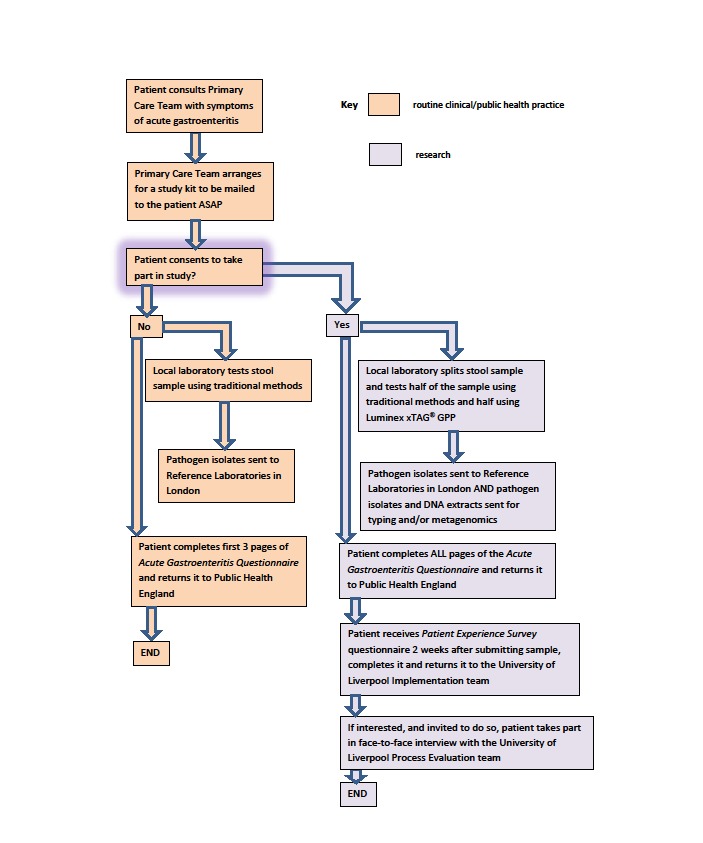
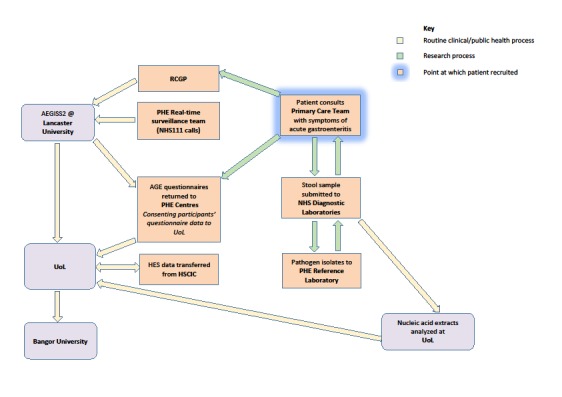
Syndromic surveillance will be used to aid identification of anomalous patterns in microbiological events based on temporal associations, demographic similarities among patients and animals, and changes in trends in acute gastroenteritis cases using a point process statistical model. Stool samples will be obtained from patients' consulting GPs, to improve the timeliness of cluster detection and characterize the pathogens responsible, allowing health protection professionals to investigate and control outbreaks quickly, limiting their size and impact. The cost-effectiveness of the proposed system will be examined using formal cost-utility analysis to inform decisions on national implementation.
The project commenced on April 1, 2013. Favorable approval was obtained from the Research Ethics Committee on June 15, 2015, and the first patient was recruited on October 13, 2015, with 1407 patients recruited and samples processed using traditional laboratory techniques as of March 2017.
The overall aim of this study is to create a new One Health paradigm for detecting and investigating diarrhea and vomiting in the community in near-real time, shifting from passive human surveillance and management of laboratory-confirmed infection toward an integrated, interdisciplinary enhanced surveillance system including management of people with symptoms.
INTERNATIONAL REGISTERED REPORT IDENTIFIER (IRRID): DERR1-10.2196/13941.
腹泻病每年影响英国四分之一的人口,是社区和医疗保健机构疫情爆发的最常见原因。传统监测方法往往能检测到腹泻和呕吐的点源疫情;但在识别低水平和间歇性食品供应污染方面效果较差。此外,感染确诊可能需要长达9周的时间,这降低了对缓慢爆发疫情的识别能力,可能会影响广泛地理区域内的数百或数千人。由于患者和全科医生(GP)报告不足以及随后未确诊的感染;实验室样本提交做法各异和选择性检测;传统微生物诊断存在局限性,这意味着大多数病例的样本检测及时性和病因仍不明确;以及人类和动物监测系统整合不佳,这意味着人畜共患病的识别被延迟或遗漏,因此有必要解决传统腹泻病监测中的根本问题。
本研究旨在检测(人类)社区胃肠道疾病发病率的异常模式;确定采样目标;将传统诊断方法与快速、现代且灵敏的分子和基因组微生物学方法进行对比,这些方法能快速且更全面地识别和表征致病病原体;并确定快速、现代、灵敏的分子和基因组微生物学方法的成本效益。
症状监测将用于基于时间关联、患者与动物之间的人口统计学相似性以及使用点过程统计模型的急性肠胃炎病例趋势变化,来辅助识别微生物事件中的异常模式。将从咨询全科医生的患者处获取粪便样本,以提高聚集性检测的及时性并表征致病病原体,使卫生防护专业人员能够迅速调查和控制疫情,限制其规模和影响。将使用正式的成本效用分析来检查所提议系统的成本效益,为国家实施决策提供依据。
该项目于2013年4月1日启动。2015年6月15日获得研究伦理委员会的批准,2015年10月13日招募了首位患者,截至2017年3月,共招募了1407名患者,并使用传统实验室技术对样本进行了处理。
本研究的总体目标是创建一种新的“同一健康”范式,用于近乎实时地检测和调查社区中的腹泻和呕吐情况,从被动的人类监测和对实验室确诊感染的管理,转向一个综合的、跨学科的强化监测系统,包括对有症状人群的管理。
国际注册报告识别码(IRRID):DERR1-10.2196/13941。