Instituto de Ciencias Agrarias, Consejo Superior de Investigaciones Científicas, 28006 Madrid, Spain.
Departamento de Medicina Preventiva, Salud Pública y Microbiología, Facultad de Medicina, Universidad Autónoma de Madrid, 28029 Madrid, Spain.
Biomolecules. 2019 Oct 2;9(10):558. doi: 10.3390/biom9100558.
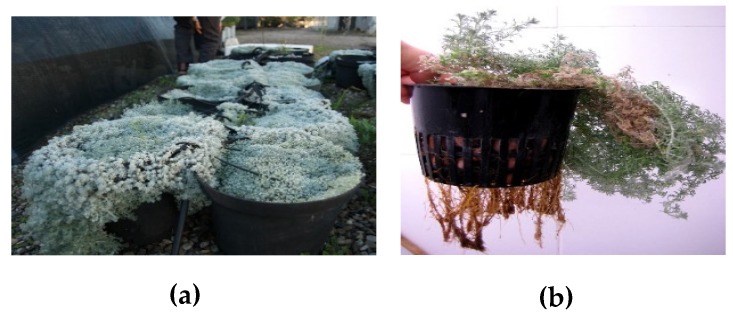
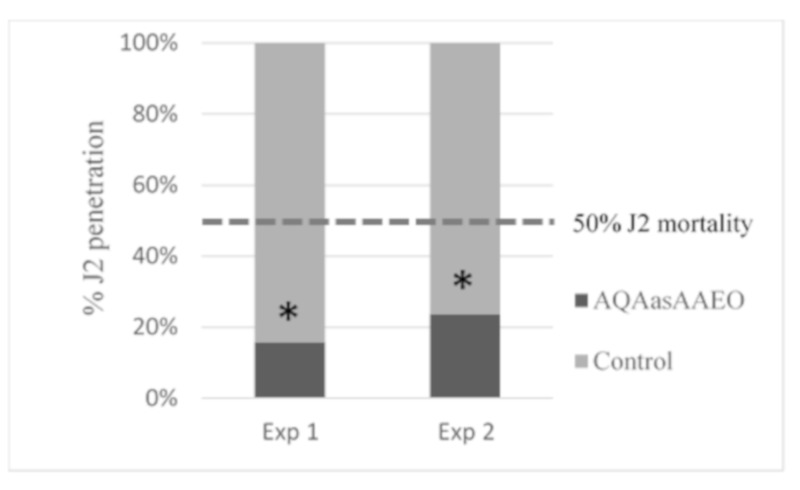
Given the importance of the genus as a source of valuable natural products, the rare plant subspecies endemic to the Iberian Peninsula, has been experimentally cultivated in the greenhouse and aeroponically, to produce biomass for essential oil (EO) extraction. The chemical composition of the EOs was analyzed, and their plant protection (insects: , and ; plants: and ; fungi: and nematode: ) and antiparasitic (, and antiplasmodial by the ferriprotoporphyrin biocrystallization inhibition test) properties were studied, in addition to the hydrolate by-product. The EOs showed a 1,8-cineole and camphor profile, with quantitative and qualitative chemical differences between the cultivation methods. These oils had moderate insect antifeedant, antifungal, and phytotoxic effects; were trypanocidel; and exhibited moderate phytomonacidal effects, while the hydrolate showed a strong nematicidal activity. Both EOs were similarly antifeedant; the EO from the greenhouse plants (flowering stage) was more biocidal (antifungal, nematicidal, and phytotoxic) than the EO from the aeroponic plants (growing stage), which was more antiparasitic. The major components of the oils (1,8-cineole and camphor), or their 1:1 combination, did not explain any of these effects. We can conclude that these EOs have potential applications as insect antifeedants, and as antifungal or antiparasitic agents, depending on the cultivation method, and that the hydrolate byproduct is a potent nematicidal.
鉴于该属作为有价值天然产物的重要来源,这种原产于伊比利亚半岛的特有珍稀植物亚种已在温室和气培条件下进行了实验性种植,以生产用于提取精油(EO)的生物量。分析了 EO 的化学成分,并研究了其植物保护(昆虫: 、 、 ;植物: 、 ;真菌: 、 ;线虫: )和抗寄生虫(、 和通过亚铁原卟啉生物结晶抑制试验的抗疟原虫)特性,此外还研究了水蒸馏副产物。EO 呈现 1,8-桉叶油醇和樟脑特征,其化学组成在培养方法上存在定量和定性差异。这些油对昆虫具有中度拒食、抗真菌和植物毒性作用;对锥虫具有杀活力;并表现出中度的植物杀伤作用,而水蒸馏物则具有强烈的杀线虫活性。两种 EO 均具有类似的拒食作用;温室植物(开花期)的 EO 比气培植物(生长阶段)的 EO 具有更强的生物杀灭作用(抗真菌、杀线虫和植物毒性),而后者具有更强的抗寄生虫作用。油的主要成分(1,8-桉叶油醇和樟脑)或它们 1:1 的组合并不能解释这些作用中的任何一种。我们可以得出结论,这些 EO 具有作为昆虫拒食剂的潜力,并且根据培养方法,还具有作为抗真菌或抗寄生虫剂的潜力,而水蒸馏物副产物是一种有效的杀线虫剂。