Kim Yoonjung, Shin Saeam, Kim Boyeon, Lee Kyung-A
Department of Laboratory Medicine, Yonsei University College of Medicine, Seoul, Republic of Korea.
Cancer Cell Int. 2019 Oct 1;19:251. doi: 10.1186/s12935-019-0978-8. eCollection 2019.
Exosomal nucleic acid (exoNA) is a feasible target to improve the sensitivity of mutation testing in non-small cell lung cancer patients with limited cell-free DNA (cfDNA) mutant copies. However, the type and size of target exoNA related to the sensitivity of mutation testing has not been explored extensively.
The type and size of target exoNA related to the sensitivity of mutation testing was evaluated using ddPCR. A total of 47 plasma samples was tested using short-length exoTNA (exosomal DNA and RNA) and cfDNA.
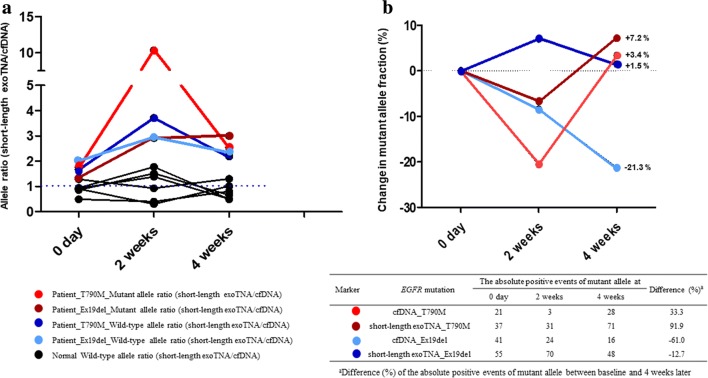
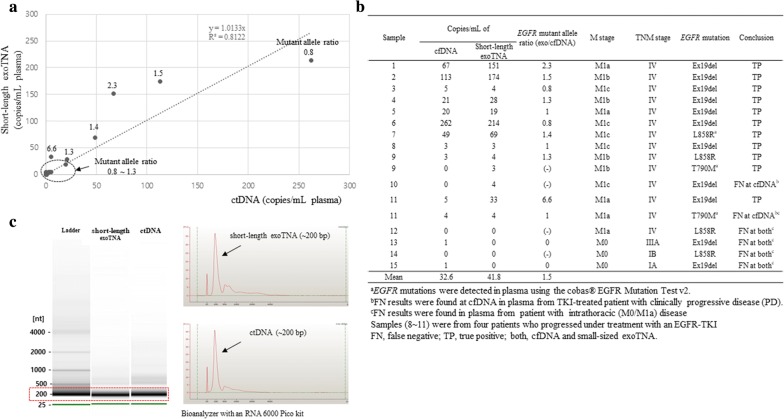
The sensitivity of short-length exoTNA (76.5%) was higher than that of cfDNA (64.7%) for detecting mutations in NSCLC patients. In -mutant NSCLC patients with intrathoracic disease (M0/M1a) or cases with low-copy T790M, the positive rate was 63.6% ( = 7/11) and 45.5% ( = 5/11) for short-length exoTNA and cfDNA, respectively. On average, the number absolute mutant copies of short-length exoTNA were 1.5 times higher than that of cfDNA. The mutant allele copies (Ex19del and T790M) in short-length exoTNA were relatively well preserved at 4 weeks after storage. The difference (%) in absolute mutant allele copies (Ex19del) between 0 days and 4 weeks after storage was - 61.0% for cfDNA.
Target nucleic acids and their size distribution may be critical considerations for selecting an extraction method and a detection assay. A short-length exoTNA (200 bp) contained more detectable tumor-derived nucleic acids than exoDNA (~ 200 bp length or a full-length) or cfDNA. Therefore, a short-length exoTNA as a sensitive biomarker might be useful to detect mutants for NSCLC patients with low copy number of the mutation target.
外泌体核酸(exoNA)是提高游离DNA(cfDNA)突变拷贝数有限的非小细胞肺癌患者突变检测灵敏度的一个可行靶点。然而,与突变检测灵敏度相关的目标exoNA的类型和大小尚未得到广泛研究。
使用数字PCR评估与突变检测灵敏度相关的目标exoNA的类型和大小。共对47份血浆样本进行了短片段外泌体核酸(exosomal DNA和RNA,即exoTNA)和cfDNA检测。
对于检测非小细胞肺癌患者的突变,短片段exoTNA的灵敏度(76.5%)高于cfDNA(64.7%)。在患有胸内疾病(M0/M1a)的EGFR突变非小细胞肺癌患者或低拷贝T790M病例中,短片段exoTNA和cfDNA的阳性率分别为63.6%(n = 7/11)和45.5%(n = 5/11)。平均而言,短片段exoTNA的绝对突变拷贝数比cfDNA高1.5倍。短片段exoTNA中的突变等位基因拷贝(Ex19del和T790M)在储存4周后相对保存良好。cfDNA在储存0天和4周后绝对突变等位基因拷贝(Ex19del)的差异(%)为-61.0%。
目标核酸及其大小分布可能是选择提取方法和检测分析方法时的关键考虑因素。短片段exoTNA(200 bp)比外泌体DNA(~200 bp长度或全长)或cfDNA含有更多可检测到的肿瘤来源核酸。因此,短片段exoTNA作为一种敏感的生物标志物,可能有助于检测突变靶点拷贝数低的非小细胞肺癌患者的EGFR突变。