Liu Yiwen, Ma Minglei, Yu Jie, Ping Fan, Zhang Huabing, Li Wei, Xu Lingling, Li Yuxiu
Department of Endocrinology, Key Laboratory of Endocrinology, Ministry of Health, Peking Union Medical College Hospital, Peking Union Medical College, Chinese Academy of Medical Sciences, Beijing 100730, China.
Int J Endocrinol. 2019 Sep 9;2019:8406438. doi: 10.1155/2019/8406438. eCollection 2019.
Previous studies have revealed dysregulated circulating microRNAs (miRNAs) in patients with type 1 diabetes (T1D). Here, we explored the serum levels of , , , and in patients with autoimmune diabetes (T1D and latent autoimmune diabetes of adults (LADA)) compared with type 2 diabetes (T2D) and nondiabetic individuals.
The serum levels of , , , and in patients with T1D ( = 29), LADA ( = 16), and T2D ( = 31) and in nondiabetic individuals ( = 19) were determined by quantitative real-time polymerase chain reaction, and receiver-operating characteristic (ROC) curves were evaluated to determine the discriminatory performances of these four miRNAs. Furthermore, target genes and pathways potentially modulated by these four miRNAs were predicted by bioinformatics analysis to investigate the possible functions of these miRNAs in autoimmune diabetes. Subsequently, multiple logistic regression analysis was performed to identify independent predictors for autoimmune diabetes, and a nomogram was established.
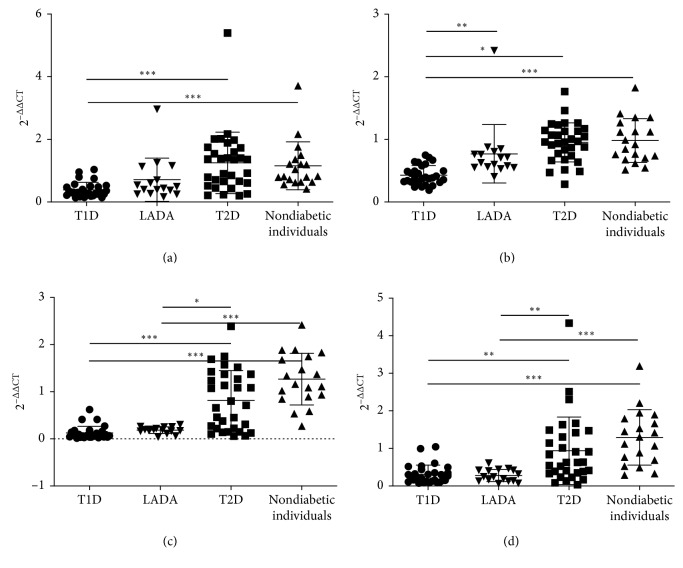
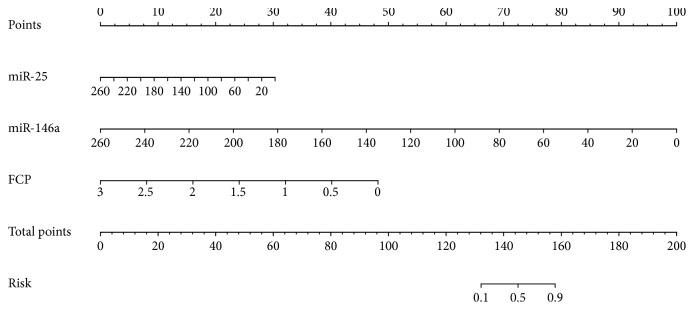
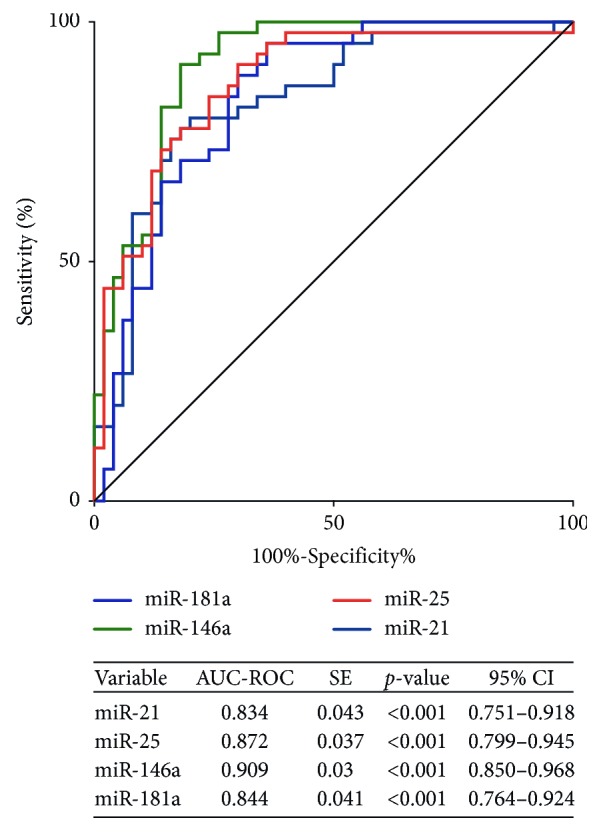
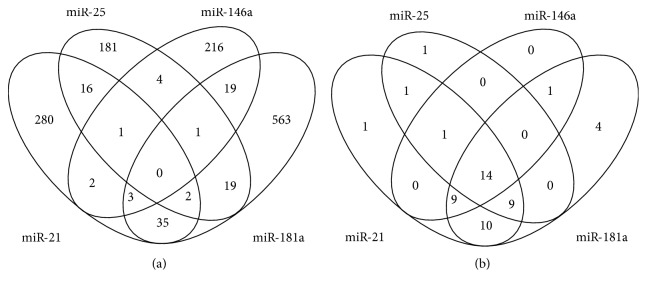
, , , and were significantly downregulated in the serum of patients with autoimmune diabetes compared with those in T2D patients and nondiabetic individuals ( < 0.001). The areas under the ROC curves of these four miRNAs were greater than 0.80 ( < 0.001). Bioinformatics analysis suggested that , , , and regulated multiple genes in pathways associated with immunity, inflammatory responses, hyperglycemia, and metabolism, which are involved in the pathogenesis of autoimmune diabetes. Multiple logistic regression analysis identified (odds ratio (OR): 0.001, < 0.05), (OR: 0.136, < 0.05), and fasting C-peptide levels (OR: 0.064, < 0.05) as independent predictors of autoimmune diabetes.
and may serve as potential circulating biomarkers and provide insights into the pathogenesis of autoimmune diabetes.
先前的研究已揭示1型糖尿病(T1D)患者体内循环微小RNA(miRNA)失调。在此,我们探究了自身免疫性糖尿病(T1D和成人隐匿性自身免疫性糖尿病(LADA))患者与2型糖尿病(T2D)患者及非糖尿病个体相比,血清中 、 、 和 的水平。
设计、患者与测量:通过定量实时聚合酶链反应测定T1D患者(n = 29)、LADA患者(n = 16)、T2D患者(n = 31)及非糖尿病个体(n = 19)血清中 、 、 和 的水平,并评估受试者工作特征(ROC)曲线以确定这四种miRNA的鉴别性能。此外,通过生物信息学分析预测这四种miRNA可能调控的靶基因和通路,以研究这些miRNA在自身免疫性糖尿病中的可能功能。随后,进行多因素逻辑回归分析以确定自身免疫性糖尿病的独立预测因素,并建立列线图。
与T2D患者和非糖尿病个体相比,自身免疫性糖尿病患者血清中 、 、 和 显著下调(P < 0.001)。这四种miRNA的ROC曲线下面积均大于0.80(P < 0.001)。生物信息学分析表明, 、 、 和 调控与免疫、炎症反应、高血糖和代谢相关通路中的多个基因,这些通路参与自身免疫性糖尿病的发病机制。多因素逻辑回归分析确定 (比值比(OR):0.001,P < 0.05)、 (OR:0.136,P < 0.05)和空腹C肽水平(OR:0.064,P < 0.05)为自身免疫性糖尿病的独立预测因素。
和 可能作为潜在的循环生物标志物,并为自身免疫性糖尿病的发病机制提供见解。