Department of Physical Medicine and Rehabilitation, National Taiwan University Hospital, Bei-Hu Branch, Taipei, Taiwan.
Graduate Institute of Rehabilitation Science, College of Medicine, Chang Gung University, Tao-Yuan, Taiwan.
BMC Geriatr. 2021 Jan 30;21(1):86. doi: 10.1186/s12877-021-02040-0.
Age-related sarcopenia meaningfully increases the risks of functional limitations and mortality in the older adults. Although circulating microRNAs (c-miRNAs) are associated with aging-related cellular senescence and inflammation, the relationships between c-miRNAs and sarcopenia in the older adults remain unclear. This study investigates whether circulating myo-miRNAs and inflammation-related miRNAs are associated with sarcopenia in the older adults.
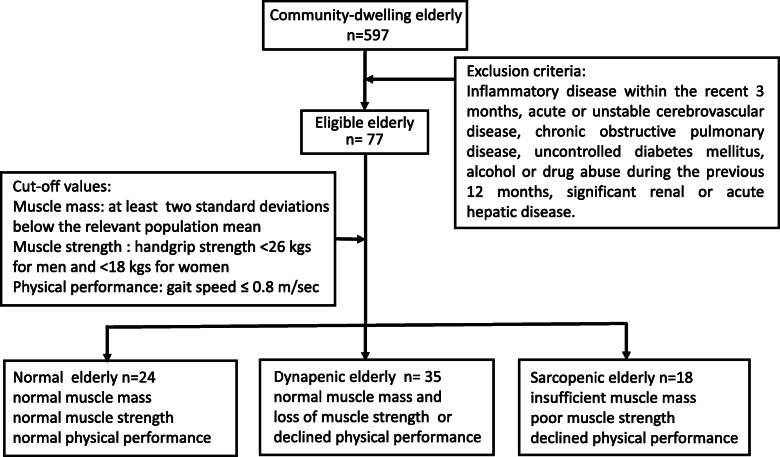
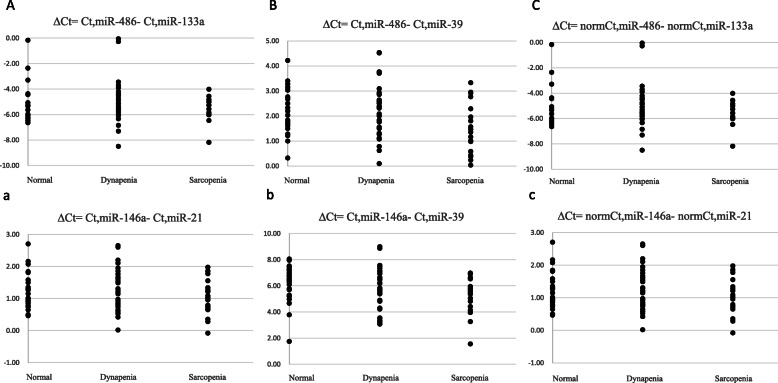
This investigation recruited 77 eligible subjects (41 males and 36 females) from 597 community-dwelling older adults, and then divided them into normal (n = 24), dynapenic (loss of muscular function without mass, n = 35), and sarcopenic groups (loss of muscular function with mass, n = 18). Moreover, myo- (c-miRNA-133a and c-miRNA-486) and inflammation- (c-miRNA-21 and c-miRNA-146a) related miRNAs, as well as, inflammatory-related cytokine and peroxide levels in plasma were determined using quantitative polymerase chain reaction and ELISA, respectively.
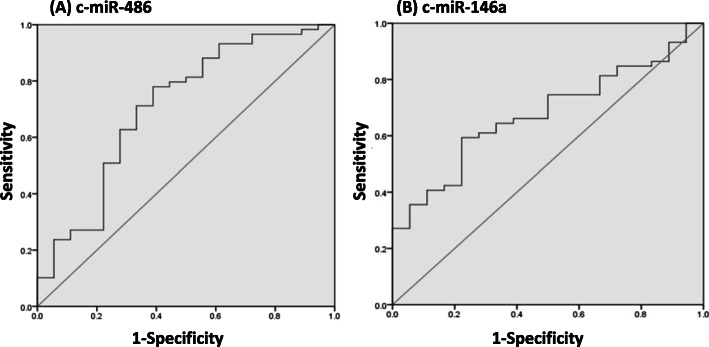
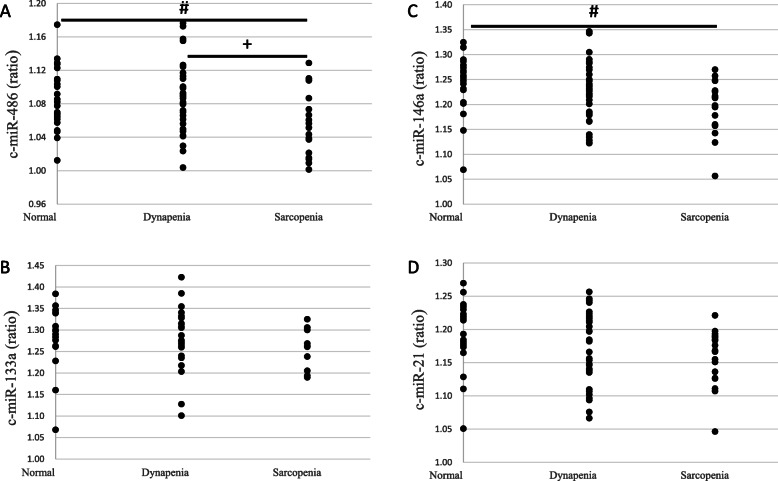
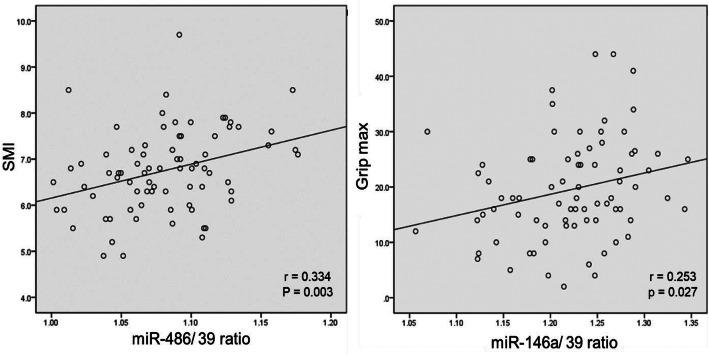
Sarcopenic group exhibited lesser skeletal muscle mass index (SMI), handgrip strength, and gait speed, as well as, lower c-miR-486 and c-miR-146a levels, compared to those of normal and dynapenic groups. Moreover, c-miR-486 level was positively related to SMI (r = 0.334, P = 0.003), whereas c-miR-146a level was positively associated with SMI (r = 0.240, P = 0.035) and handgrip strength (r = 0.253, P = 0.027). In the receiver operating characteristic analysis for predicting sarcopenia, the area under the curve in c-miR-486 was 0.708 (95% confidence interval: 0.561-0.855, P = 0.008) and c-miR-146a was 0.676 (95% CI: 0.551-0.801, P = 0.024). However, no significant relationships were observed between SMI/handgrip strength/gait speed and plasma myeloperoxidase/interleukin-1훽/interleukin-6 levels.
Myo-miRNA (c-miR-486) and inflammation-related miRNA (c-miR-146a) are superior to inflammatory peroxide/cytokines in plasma for serving as critical biomarkers of age-related sarcopenia.
与年龄相关的肌肉减少症显著增加了老年人功能受限和死亡的风险。虽然循环 microRNAs(c-miRNAs)与衰老相关的细胞衰老和炎症有关,但 c-miRNAs 与老年人肌肉减少症之间的关系仍不清楚。本研究调查了循环肌源性 miRNAs 和炎症相关 miRNAs 是否与老年人的肌肉减少症有关。
本研究从 597 名社区居住的老年人中招募了 77 名符合条件的受试者(41 名男性和 36 名女性),并将他们分为正常组(n=24)、动力减少组(肌肉功能丧失而无质量减少,n=35)和肌肉减少症组(肌肉功能丧失伴质量减少,n=18)。此外,使用定量聚合酶链反应和 ELISA 分别测定了肌源性(c-miRNA-133a 和 c-miRNA-486)和炎症相关(c-miRNA-21 和 c-miRNA-146a)miRNAs 以及血浆中炎症相关细胞因子和过氧化物水平。
与正常组和动力减少组相比,肌肉减少症组的骨骼肌质量指数(SMI)、握力和步态速度较低,c-miR-486 和 c-miR-146a 水平也较低。此外,c-miR-486 水平与 SMI 呈正相关(r=0.334,P=0.003),而 c-miR-146a 水平与 SMI(r=0.240,P=0.035)和握力(r=0.253,P=0.027)呈正相关。在 c-miR-486 预测肌肉减少症的受试者工作特征分析中,曲线下面积为 0.708(95%置信区间:0.561-0.855,P=0.008),c-miR-146a 为 0.676(95%CI:0.551-0.801,P=0.024)。然而,SMI/握力/步态速度与血浆髓过氧化物酶/白细胞介素-1β/白细胞介素-6 水平之间没有显著关系。
肌源性 miRNA(c-miR-486)和炎症相关 miRNA(c-miR-146a)优于血浆中的炎症过氧化物/细胞因子,可作为与年龄相关的肌肉减少症的关键生物标志物。