• 文献检索
  • 文档翻译
  • 深度研究
  • 学术资讯
  • Suppr Zotero 插件Zotero 插件
  • 邀请有礼
  • 套餐&价格
  • 历史记录
应用&插件
Suppr Zotero 插件Zotero 插件浏览器插件Mac 客户端Windows 客户端微信小程序
定价
高级版会员购买积分包购买API积分包
服务
文献检索文档翻译深度研究API 文档MCP 服务
关于我们
关于 Suppr公司介绍联系我们用户协议隐私条款
关注我们

Suppr 超能文献

核心技术专利:CN118964589B侵权必究
粤ICP备2023148730 号-1Suppr @ 2026

文献检索

告别复杂PubMed语法,用中文像聊天一样搜索,搜遍4000万医学文献。AI智能推荐,让科研检索更轻松。

立即免费搜索

文件翻译

保留排版,准确专业,支持PDF/Word/PPT等文件格式,支持 12+语言互译。

免费翻译文档

深度研究

AI帮你快速写综述,25分钟生成高质量综述,智能提取关键信息,辅助科研写作。

立即免费体验

从社交媒体挖掘处方药物滥用监测信息:综述与以数据为中心的框架建议。

Mining social media for prescription medication abuse monitoring: a review and proposal for a data-centric framework.

机构信息

Department of Biomedical Informatics, Emory University School of Medicine, Atlanta, Georgia, USA.

College of Arts and Sciences, University of Pennsylvania, Philadelphia, Pennsylvania, USA.

出版信息

J Am Med Inform Assoc. 2020 Feb 1;27(2):315-329. doi: 10.1093/jamia/ocz162.

DOI:10.1093/jamia/ocz162
PMID:31584645
原文链接:https://pmc.ncbi.nlm.nih.gov/articles/PMC7025330/
Abstract

OBJECTIVE

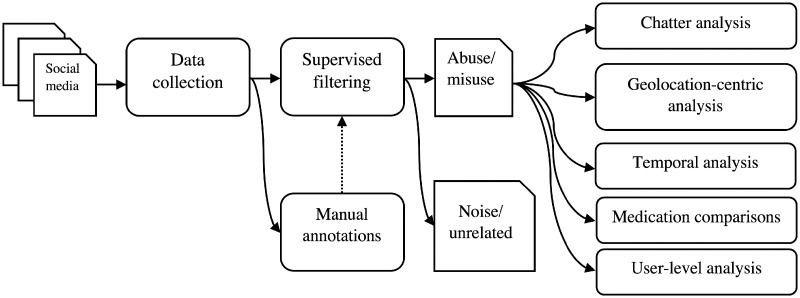
Prescription medication (PM) misuse and abuse is a major health problem globally, and a number of recent studies have focused on exploring social media as a resource for monitoring nonmedical PM use. Our objectives are to present a methodological review of social media-based PM abuse or misuse monitoring studies, and to propose a potential generalizable, data-centric processing pipeline for the curation of data from this resource.

MATERIALS AND METHODS

We identified studies involving social media, PMs, and misuse or abuse (inclusion criteria) from Medline, Embase, Scopus, Web of Science, and Google Scholar. We categorized studies based on multiple characteristics including but not limited to data size; social media source(s); medications studied; and primary objectives, methods, and findings.

RESULTS

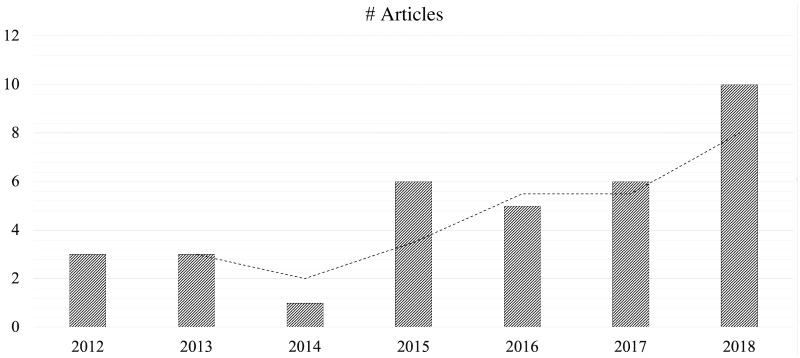
A total of 39 studies met our inclusion criteria, with 31 (∼79.5%) published since 2015. Twitter has been the most popular resource, with Reddit and Instagram gaining popularity recently. Early studies focused mostly on manual, qualitative analyses, with a growing trend toward the use of data-centric methods involving natural language processing and machine learning.

DISCUSSION

There is a paucity of standardized, data-centric frameworks for curating social media data for task-specific analyses and near real-time surveillance of nonmedical PM use. Many existing studies do not quantify human agreements for manual annotation tasks or take into account the presence of noise in data.

CONCLUSION

The development of reproducible and standardized data-centric frameworks that build on the current state-of-the-art methods in data and text mining may enable effective utilization of social media data for understanding and monitoring nonmedical PM use.

摘要

目的

处方药物(PM)的滥用是一个全球性的主要健康问题,最近有许多研究都集中在探索社交媒体作为监测非医疗 PM 使用的资源。我们的目标是对基于社交媒体的 PM 滥用或误用监测研究进行方法学综述,并提出一个潜在的可推广的数据中心处理管道,用于从该资源中整理数据。

材料与方法

我们从 Medline、Embase、Scopus、Web of Science 和 Google Scholar 中确定了涉及社交媒体、PM 和滥用或误用的研究(纳入标准)。我们根据多种特征对研究进行分类,包括但不限于数据大小、社交媒体来源、研究的药物以及主要目标、方法和发现。

结果

共有 39 项研究符合我们的纳入标准,其中 31 项(约 79.5%)发表于 2015 年之后。Twitter 是最受欢迎的资源,Reddit 和 Instagram 最近也越来越受欢迎。早期的研究主要集中在手动、定性分析上,现在越来越倾向于使用涉及自然语言处理和机器学习的数据中心方法。

讨论

针对特定任务的分析和非医疗 PM 使用的近实时监测,缺乏用于整理社交媒体数据的标准化、数据中心框架。许多现有的研究没有量化手动注释任务中的人工一致性,也没有考虑到数据中的噪声。

结论

开发可重现和标准化的数据中心框架,这些框架建立在数据和文本挖掘的当前最新方法之上,可能会使社交媒体数据能够有效地用于理解和监测非医疗 PM 使用。
https://cdn.ncbi.nlm.nih.gov/pmc/blobs/2bc7/7025330/ff80eed30592/ocz162f2.jpg
https://cdn.ncbi.nlm.nih.gov/pmc/blobs/2bc7/7025330/6206606013d9/ocz162f1.jpg
https://cdn.ncbi.nlm.nih.gov/pmc/blobs/2bc7/7025330/ff80eed30592/ocz162f2.jpg
https://cdn.ncbi.nlm.nih.gov/pmc/blobs/2bc7/7025330/6206606013d9/ocz162f1.jpg
https://cdn.ncbi.nlm.nih.gov/pmc/blobs/2bc7/7025330/ff80eed30592/ocz162f2.jpg

相似文献

1
Mining social media for prescription medication abuse monitoring: a review and proposal for a data-centric framework.从社交媒体挖掘处方药物滥用监测信息:综述与以数据为中心的框架建议。
J Am Med Inform Assoc. 2020 Feb 1;27(2):315-329. doi: 10.1093/jamia/ocz162.
2
Social Media Mining for Toxicovigilance: Automatic Monitoring of Prescription Medication Abuse from Twitter.用于药物警戒的社交媒体挖掘:通过推特自动监测处方药滥用情况
Drug Saf. 2016 Mar;39(3):231-40. doi: 10.1007/s40264-015-0379-4.
3
Text classification models for the automatic detection of nonmedical prescription medication use from social media.社交媒体中非医疗处方药物使用的自动检测的文本分类模型。
BMC Med Inform Decis Mak. 2021 Jan 26;21(1):27. doi: 10.1186/s12911-021-01394-0.
4
Promoting Reproducible Research for Characterizing Nonmedical Use of Medications Through Data Annotation: Description of a Twitter Corpus and Guidelines.通过数据标注促进用于表征药物非医疗用途的可重复研究:Twitter语料库描述及指南
J Med Internet Res. 2020 Feb 26;22(2):e15861. doi: 10.2196/15861.
5
Machine Learning and Natural Language Processing for Geolocation-Centric Monitoring and Characterization of Opioid-Related Social Media Chatter.基于机器学习和自然语言处理的地理定位中心监测和特征描述阿片类药物相关社交媒体聊天。
JAMA Netw Open. 2019 Nov 1;2(11):e1914672. doi: 10.1001/jamanetworkopen.2019.14672.
6
Exploring trends of nonmedical use of prescription drugs and polydrug abuse in the Twittersphere using unsupervised machine learning.使用无监督机器学习探索推特圈中处方药非医疗用途和多药滥用的趋势。
Addict Behav. 2017 Feb;65:289-295. doi: 10.1016/j.addbeh.2016.08.019. Epub 2016 Aug 17.
7
Epidemiology from Tweets: Estimating Misuse of Prescription Opioids in the USA from Social Media.推特中的流行病学:通过社交媒体估算美国处方阿片类药物的滥用情况
J Med Toxicol. 2017 Dec;13(4):278-286. doi: 10.1007/s13181-017-0625-5. Epub 2017 Aug 22.
8
Results and Methodological Implications of the Digital Epidemiology of Prescription Drug References Among Twitter Users: Latent Dirichlet Allocation (LDA) Analyses.社交媒体中文药物信息的数字流行病学研究结果与方法学启示:潜在狄利克雷分配模型(LDA)分析。
J Med Internet Res. 2023 Jul 28;25:e48405. doi: 10.2196/48405.
9
SOCIAL MEDIA MINING SHARED TASK WORKSHOP.社交媒体挖掘共享任务研讨会
Pac Symp Biocomput. 2016;21:581-92.
10
Scaling Up Research on Drug Abuse and Addiction Through Social Media Big Data.通过社交媒体大数据扩大药物滥用和成瘾研究
J Med Internet Res. 2017 Oct 31;19(10):e353. doi: 10.2196/jmir.6426.

引用本文的文献

1
Monitoring the opioid epidemic via social media discussions.通过社交媒体讨论监测阿片类药物流行情况。
NPJ Digit Med. 2025 May 15;8(1):284. doi: 10.1038/s41746-025-01642-x.
2
Social media as a source of drug safety information in the paediatric population.社交媒体作为儿科人群药物安全信息的来源。
Br J Clin Pharmacol. 2025 Jun;91(6):1760-1770. doi: 10.1111/bcp.16392. Epub 2025 Feb 3.
3
Growing pains with kratom: experiences discussed in subreddits contrast with satisfaction expressed in surveys.kratom带来的成长烦恼:在论坛上讨论的经历与调查中表达的满意度形成对比。

本文引用的文献

1
Social Media Based Analysis of Opioid Epidemic Using Reddit.基于Reddit的社交媒体对阿片类药物流行情况的分析
AMIA Annu Symp Proc. 2018 Dec 5;2018:867-876. eCollection 2018.
2
Can online self-reports assist in real-time identification of influenza vaccination uptake? A cross-sectional study of influenza vaccine-related tweets in the USA, 2013-2017.在线自我报告能否有助于实时识别流感疫苗接种情况?2013-2017 年美国与流感疫苗相关推文的横断面研究。
BMJ Open. 2019 Jan 15;9(1):e024018. doi: 10.1136/bmjopen-2018-024018.
3
An unsupervised and customizable misspelling generator for mining noisy health-related text sources.
Front Pharmacol. 2024 Jun 14;15:1412397. doi: 10.3389/fphar.2024.1412397. eCollection 2024.
4
First-hand accounts of structural stigma toward people who use opioids on Reddit.Reddit 上关于对使用阿片类药物者进行结构性污名化的第一手资料。
Soc Sci Med. 2024 Apr;347:116772. doi: 10.1016/j.socscimed.2024.116772. Epub 2024 Mar 16.
5
Large-Scale Social Media Analysis Reveals Emotions Associated with Nonmedical Prescription Drug Use.大规模社交媒体分析揭示与非医疗用途处方药使用相关的情绪。
Health Data Sci. 2022;2022. doi: 10.34133/2022/9851989. Epub 2022 Apr 27.
6
Social media and internet search data to inform drug utilization: A systematic scoping review.用于药物利用信息的社交媒体和互联网搜索数据:一项系统性综述。
Front Digit Health. 2023 Mar 20;5:1074961. doi: 10.3389/fdgth.2023.1074961. eCollection 2023.
7
Consumer-Generated Discourse on Cannabis as a Medicine: Scoping Review of Techniques.消费者生成的关于大麻作为药物的论述:技术范围综述。
J Med Internet Res. 2022 Nov 16;24(11):e35974. doi: 10.2196/35974.
8
Spontaneously generated online patient experience data - how and why is it being used in health research: an umbrella scoping review.自发产生的在线患者体验数据——它是如何以及为何被用于健康研究:一项伞式范围综述。
BMC Med Res Methodol. 2022 May 14;22(1):139. doi: 10.1186/s12874-022-01610-z.
9
Characterizing and Identifying the Prevalence of Web-Based Misinformation Relating to Medication for Opioid Use Disorder: Machine Learning Approach.描述和识别与阿片类药物使用障碍药物治疗相关的网络错误信息的流行情况:机器学习方法。
J Med Internet Res. 2021 Dec 22;23(12):e30753. doi: 10.2196/30753.
10
COVID-19 Pandemic Impact on Substance Misuse: A Social Media Listening, Mixed Method Analysis.新冠疫情对药物滥用的影响:一项社交媒体倾听混合方法分析
Brain Sci. 2021 Jul 9;11(7):907. doi: 10.3390/brainsci11070907.
一种用于挖掘噪声健康相关文本源的无监督和可定制的拼写错误生成器。
J Biomed Inform. 2018 Dec;88:98-107. doi: 10.1016/j.jbi.2018.11.007. Epub 2018 Nov 13.
4
Data and systems for medication-related text classification and concept normalization from Twitter: insights from the Social Media Mining for Health (SMM4H)-2017 shared task.从 Twitter 上获取药物相关文本分类和概念规范化的数据和系统:来自社交媒体挖掘健康(SMM4H)-2017 共享任务的见解。
J Am Med Inform Assoc. 2018 Oct 1;25(10):1274-1283. doi: 10.1093/jamia/ocy114.
5
Detection and Analysis of Drug Misuses. A Study Based on Social Media Messages.药物滥用的检测与分析。一项基于社交媒体信息的研究。
Front Pharmacol. 2018 Jul 26;9:791. doi: 10.3389/fphar.2018.00791. eCollection 2018.
6
At-a-glance - What can social media tell us about the opioid crisis in Canada?一眼看尽 - 社交媒体能告诉我们加拿大的阿片类药物危机有哪些情况?
Health Promot Chronic Dis Prev Can. 2018 Jun;38(6):263-267. doi: 10.24095/hpcdp.38.6.08.
7
Mining Patients' Narratives in Social Media for Pharmacovigilance: Adverse Effects and Misuse of Methylphenidate.挖掘社交媒体中患者叙述以进行药物警戒:哌甲酯的不良反应和误用
Front Pharmacol. 2018 May 24;9:541. doi: 10.3389/fphar.2018.00541. eCollection 2018.
8
Candyflipping and Other Combinations: Identifying Drug-Drug Combinations from an Online Forum.摇头丸与其他组合:从一个在线论坛中识别药物组合。
Front Psychiatry. 2018 Apr 30;9:135. doi: 10.3389/fpsyt.2018.00135. eCollection 2018.
9
Opioid Discussion in the Twittersphere.社交媒体上的阿片类药物讨论。
Subst Use Misuse. 2018 Nov 10;53(13):2132-2139. doi: 10.1080/10826084.2018.1458319. Epub 2018 Apr 16.
10
Representations of Codeine Misuse on Instagram: Content Analysis.Instagram上可待因滥用的呈现:内容分析
JMIR Public Health Surveill. 2018 Mar 20;4(1):e22. doi: 10.2196/publichealth.8144.