Swine Virology Immunology Unit, Ploufragan-Plouzané-Niort Laboratory, ANSES, BP53, 22440, Ploufragan, France.
Bretagne Loire University, Cité internationale, 1 place Paul Ricoeur, CS 54417, 35044, Rennes, France.
Vet Res. 2019 Oct 7;50(1):77. doi: 10.1186/s13567-019-0699-y.
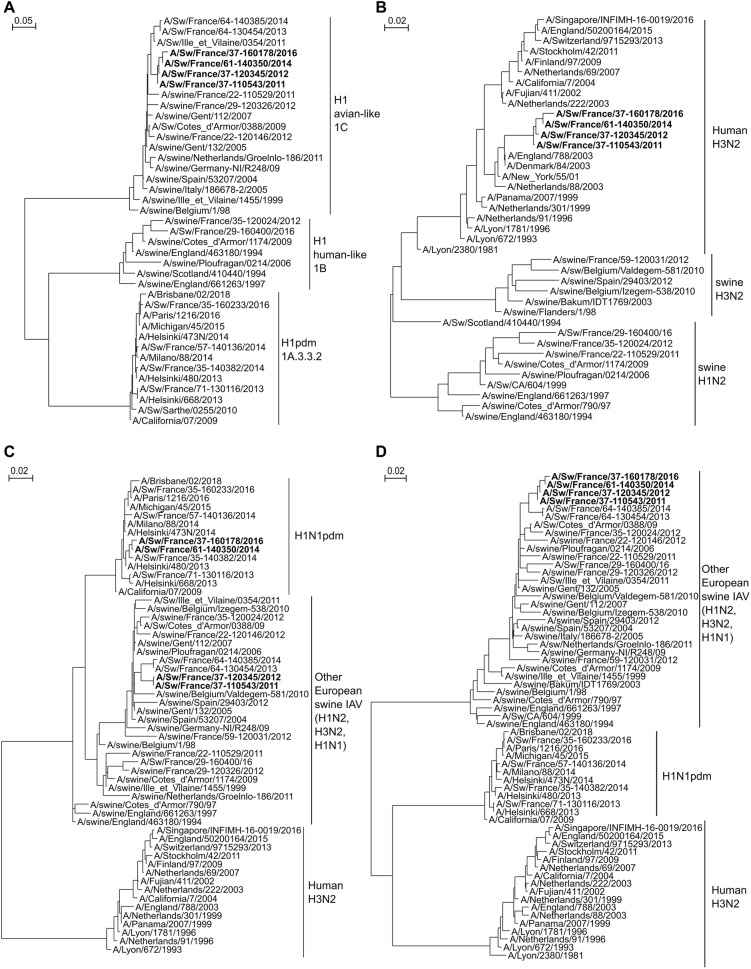
This report describes the detection of a triple reassortant swine influenza A virus of H1N2 subtype. It evolved from an avian-like swine H1N1 that first acquired the N2 segment from a seasonal H3N2, then the M segment from a 2009 pandemic H1N1, in two reassortments estimated to have occurred 10 years apart. This study illustrates how recurrent influenza infections increase the co-infection risk and facilitate evolutionary jumps by successive gene exchanges. It recalls the importance of appropriate biosecurity measures inside holdings to limit virus persistence and interspecies transmissions, which both contribute to the emergence of new potentially zoonotic viruses.
本报告描述了一种三重重配猪流感 A 病毒 H1N2 亚型的检测。它由一种类似禽流感的猪 H1N1 进化而来,该病毒首先从季节性 H3N2 中获得 N2 片段,然后从 2009 年大流行 H1N1 中获得 M 片段,这两次重组估计相隔 10 年。本研究说明了反复的流感感染如何通过连续的基因交换增加共感染风险并促进进化跳跃。它提醒人们注意养殖场内适当的生物安全措施的重要性,以限制病毒的持续存在和种间传播,这两者都有助于新的潜在人畜共患病病毒的出现。