Florkow Mateusz C, Zijlstra Frank, Willemsen Koen, Maspero Matteo, van den Berg Cornelis A T, Kerkmeijer Linda G W, Castelein René M, Weinans Harrie, Viergever Max A, van Stralen Marijn, Seevinck Peter R
Image Sciences Institute, University Medical Center Utrecht, Utrecht, Netherlands.
Department of Orthopedics, University Medical Center Utrecht, Utrecht, Netherlands.
Magn Reson Med. 2020 Apr;83(4):1429-1441. doi: 10.1002/mrm.28008. Epub 2019 Oct 8.
To study the influence of gradient echo-based contrasts as input channels to a 3D patch-based neural network trained for synthetic CT (sCT) generation in canine and human populations.
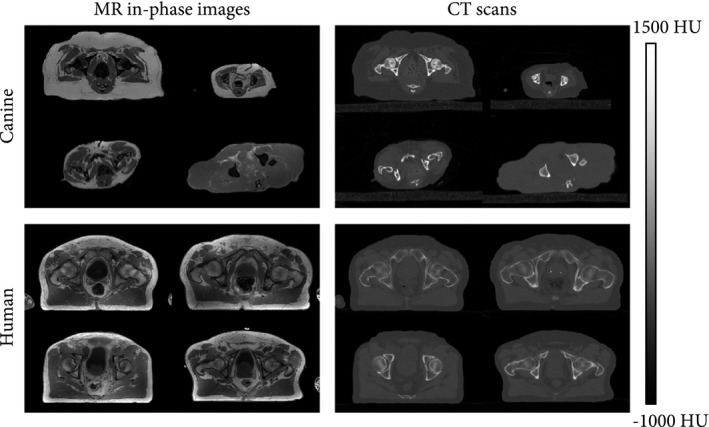
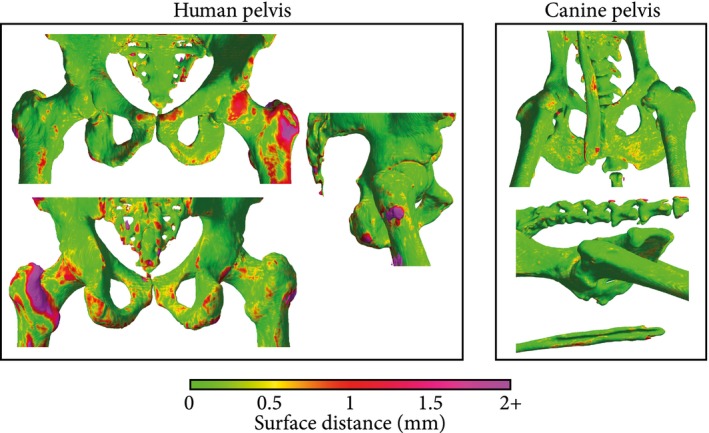
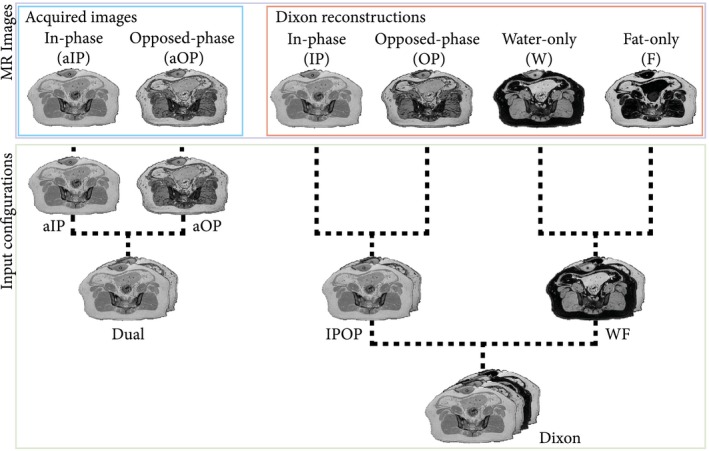
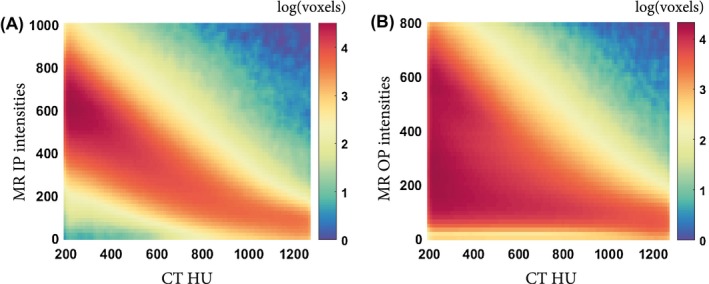
Magnetic resonance images and CT scans of human and canine pelvic regions were acquired and paired using nonrigid registration. Magnitude MR images and Dixon reconstructed water, fat, in-phase and opposed-phase images were obtained from a single T -weighted multi-echo gradient-echo acquisition. From this set, 6 input configurations were defined, each containing 1 to 4 MR images regarded as input channels. For each configuration, a UNet-derived deep learning model was trained for synthetic CT generation. Reconstructed Hounsfield unit maps were evaluated with peak SNR, mean absolute error, and mean error. Dice similarity coefficient and surface distance maps assessed the geometric fidelity of bones. Repeatability was estimated by replicating the training up to 10 times.
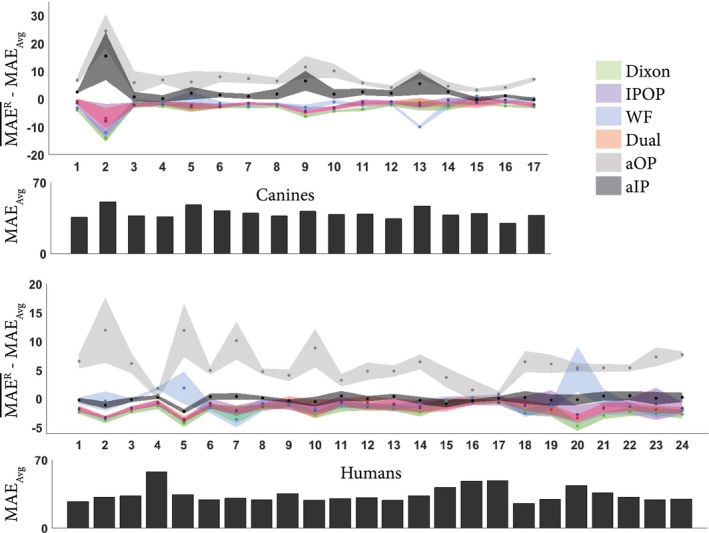
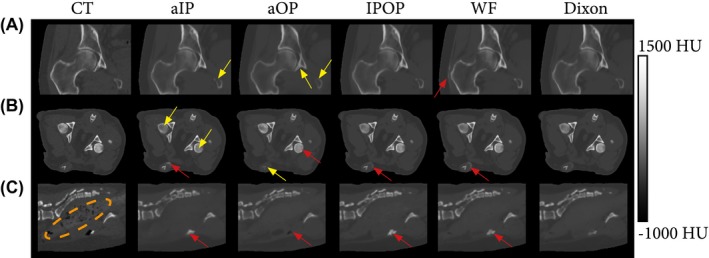
Seventeen canines and 23 human subjects were included in the study. Performance and repeatability of single-channel models were dependent on the TE-related water-fat interference with variations of up to 17% in mean absolute error, and variations of up to 28% specifically in bones. Repeatability, Dice similarity coefficient, and mean absolute error were statistically significantly better in multichannel models with mean absolute error ranging from 33 to 40 Hounsfield units in humans and from 35 to 47 Hounsfield units in canines.
Significant differences in performance and robustness of deep learning models for synthetic CT generation were observed depending on the input. In-phase images outperformed opposed-phase images, and Dixon reconstructed multichannel inputs outperformed single-channel inputs.
研究基于梯度回波的对比图像作为输入通道对在犬类和人类群体中训练用于生成合成CT(sCT)的基于3D补丁的神经网络的影响。
获取人类和犬类盆腔区域的磁共振图像和CT扫描图像,并使用非刚性配准进行配对。通过单次T加权多回波梯度回波采集获得幅度磁共振图像以及狄克逊重建的水、脂肪、同相和反相图像。从该组图像中定义了6种输入配置,每种配置包含1至4幅磁共振图像作为输入通道。对于每种配置,训练一个源自UNet的深度学习模型用于生成合成CT。使用峰值信噪比、平均绝对误差和平均误差对重建的亨氏单位图进行评估。使用骰子相似系数和表面距离图评估骨骼的几何保真度。通过重复训练多达10次来估计重复性。
该研究纳入了17只犬和23名人类受试者。单通道模型的性能和重复性取决于与TE相关的水脂干扰,平均绝对误差变化高达17%,特别是在骨骼中变化高达28%。多通道模型的重复性、骰子相似系数和平均绝对误差在统计学上显著更好,人类的平均绝对误差范围为33至40亨氏单位,犬类为35至47亨氏单位。
观察到用于合成CT生成的深度学习模型在性能和稳健性方面存在显著差异,具体取决于输入。同相图像优于反相图像,狄克逊重建的多通道输入优于单通道输入。