Physics Department, Stanford University, 382 Via Pueblo Mall, Stanford, CA, 94305, USA.
Faculty of Physics, University of Vienna, A-1090, Vienna, Austria.
Nat Commun. 2019 Oct 8;10(1):4561. doi: 10.1038/s41467-019-12535-5.
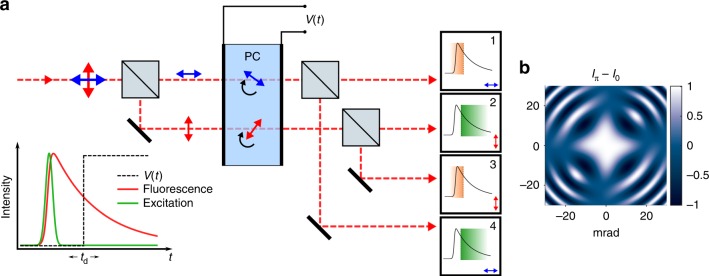
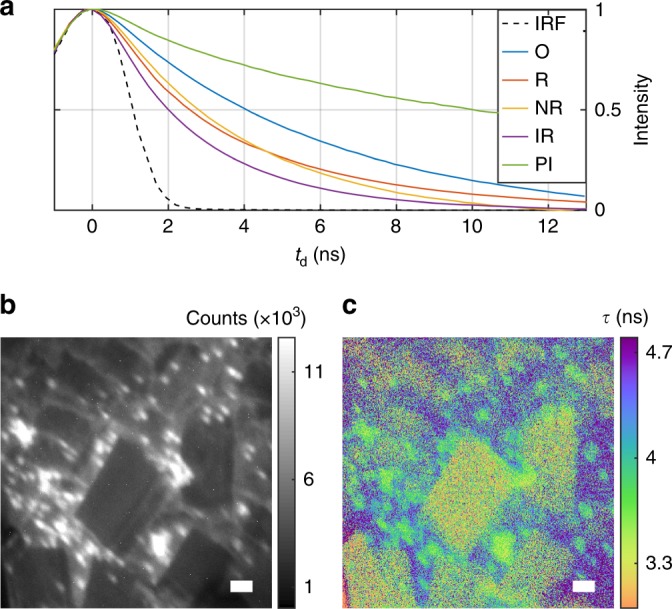
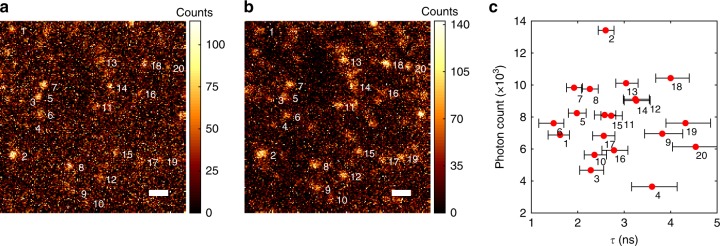
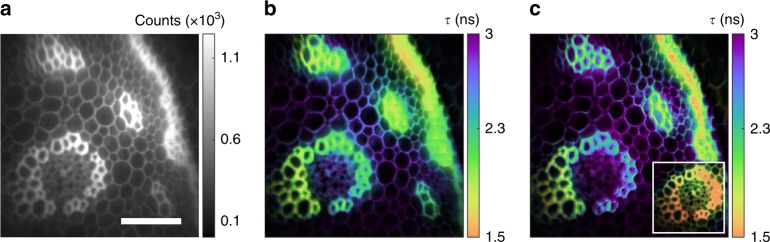
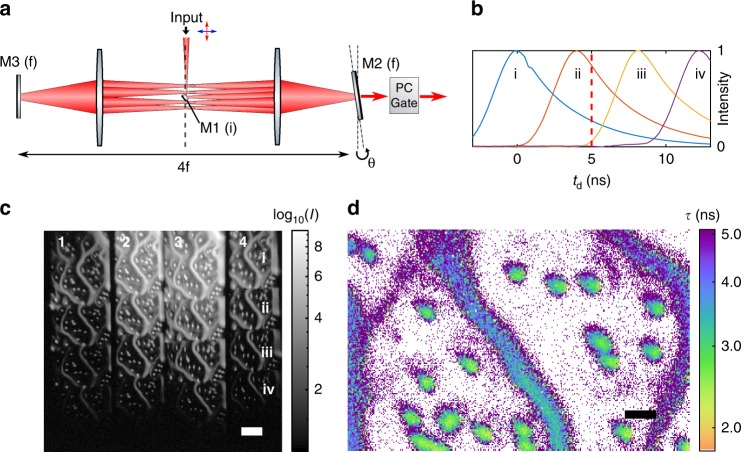
Nanosecond temporal resolution enables new methods for wide-field imaging like time-of-flight, gated detection, and fluorescence lifetime. The optical efficiency of existing approaches, however, presents challenges for low-light applications common to fluorescence microscopy and single-molecule imaging. We demonstrate the use of Pockels cells for wide-field image gating with nanosecond temporal resolution and high photon collection efficiency. Two temporal frames are obtained by combining a Pockels cell with a pair of polarizing beam-splitters. We show multi-label fluorescence lifetime imaging microscopy (FLIM), single-molecule lifetime spectroscopy, and fast single-frame FLIM at the camera frame rate with 10-10 times higher throughput than single photon counting. Finally, we demonstrate a space-to-time image multiplexer using a re-imaging optical cavity with a tilted mirror to extend the Pockels cell technique to multiple temporal frames. These methods enable nanosecond imaging with standard optical systems and sensors, opening a new temporal dimension for wide-field low-light microscopy.
纳秒时间分辨率使飞行时间、门控检测和荧光寿命等宽场成像新方法成为可能。然而,现有的方法的光学效率给荧光显微镜和单分子成像中常见的低光应用带来了挑战。我们展示了用电光晶体进行宽场图像选通的方法,其时间分辨率可达纳秒级,同时具有高光子收集效率。通过将电光晶体与一对偏振分束器相结合,可以获得两个时间帧。我们展示了多标记荧光寿命成像显微镜(FLIM)、单分子寿命光谱学,以及在相机帧率下的快速单帧 FLIM,其吞吐量比单光子计数高 10-10 倍。最后,我们演示了一种使用带有倾斜反射镜的再成像光学腔的空间到时间图像复用器,将电光晶体技术扩展到多个时间帧。这些方法使得使用标准光学系统和传感器进行纳秒成像成为可能,为宽场低光显微镜开辟了一个新的时间维度。