Univ Lyon, Université Claude Bernard Lyon 1, INSERM 1052, CNRS 5286, Centre Léon Bérard, Centre de recherche en cancérologie de Lyon, 69008 Lyon, France.
Institut de Biopathologie moléculaire, Centre de Bio-Pathologie Est, Groupement hospitalier Est, Hospices Civils de Lyon, 69500 Bron, France.
Int J Mol Sci. 2019 Oct 8;20(19):4959. doi: 10.3390/ijms20194959.
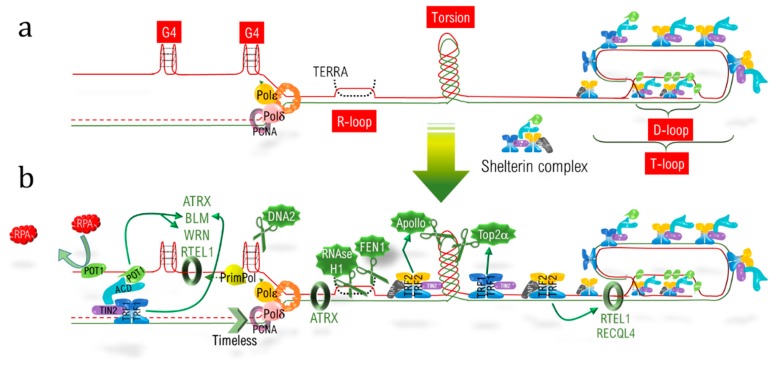
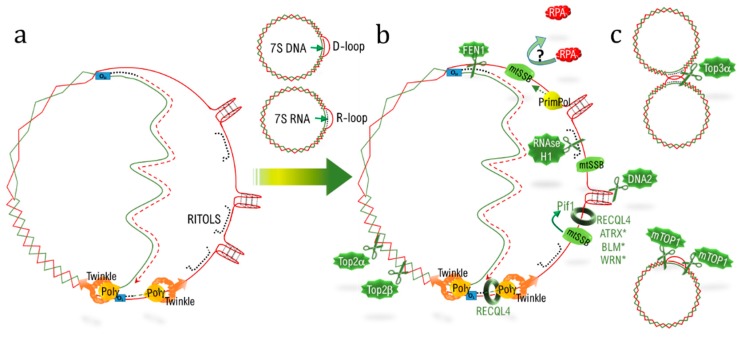
Senescence is defined as a stress-induced durable cell cycle arrest. We herein revisit the origin of two of these stresses, namely mitochondrial metabolic compromise, associated with reactive oxygen species (ROS) production, and replicative senescence, activated by extreme telomere shortening. We discuss how replication stress-induced DNA damage of telomeric DNA (telDNA) and mitochondrial DNA (mtDNA) can be considered a common origin of senescence in vitro, with consequences on ageing in vivo. Unexpectedly, mtDNA and telDNA share common features indicative of a high degree of replicative stress, such as G-quadruplexes, D-loops, RNA:DNA heteroduplexes, epigenetic marks, or supercoiling. To avoid these stresses, both compartments use similar enzymatic strategies involving, for instance, endonucleases, topoisomerases, helicases, or primases. Surprisingly, many of these replication helpers are active at both telDNA and mtDNA (e.g., RNAse H1, FEN1, DNA2, RecQ helicases, Top2α, Top2β, TOP3A, DNMT1/3a/3b, SIRT1). In addition, specialized telomeric proteins, such as TERT (telomerase reverse transcriptase) and TERC (telomerase RNA component), or TIN2 (shelterin complex), shuttle from telomeres to mitochondria, and, by doing so, modulate mitochondrial metabolism and the production of ROS, in a feedback manner. Hence, mitochondria and telomeres use common weapons and cooperate to resist/prevent replication stresses, otherwise producing common consequences, namely senescence and ageing.
衰老被定义为一种应激诱导的持久细胞周期停滞。在此,我们重新审视了其中两种应激的起源,即与活性氧(ROS)产生相关的线粒体代谢受损,以及由极端端粒缩短激活的复制性衰老。我们讨论了复制应激如何导致端粒 DNA(telDNA)和线粒体 DNA(mtDNA)的 DNA 损伤,可以被视为体外衰老的共同起源,对体内衰老有影响。出乎意料的是,mtDNA 和 telDNA 具有高度复制应激的共同特征,例如 G-四联体、D 环、RNA:DNA 杂合双链、表观遗传标记或超螺旋。为了避免这些应激,这两个隔室都使用类似的酶策略,例如内切核酸酶、拓扑异构酶、解旋酶或引发酶。令人惊讶的是,许多这些复制辅助因子在 telDNA 和 mtDNA 上都具有活性(例如,RNAse H1、FEN1、DNA2、RecQ 解旋酶、Top2α、Top2β、TOP3A、DNMT1/3a/3b、SIRT1)。此外,专门的端粒蛋白,如 TERT(端粒酶逆转录酶)和 TERC(端粒酶 RNA 成分)或 TIN2(庇护素复合物),从端粒穿梭到线粒体,并通过这种方式,以反馈方式调节线粒体代谢和 ROS 的产生。因此,线粒体和端粒使用共同的武器并合作来抵抗/预防复制应激,否则会产生共同的后果,即衰老和老化。