Bo Marco, Arru Giannina, Niegowska Magdalena, Erre Gian Luca, Manchia Piera Angela, Sechi Leonardo A
Department of Biomedical Sciences, Section of Microbiology and Virology, University of Sassari, Viale San Pietro 43b, 07100 Sassari, Italy.
Department of Clinical, Surgical and Experimental Medicine, Neurological Clinic, University of Sassari, Viale San Pietro 8, 07100 Sassari, Italy.
Microorganisms. 2019 Oct 8;7(10):423. doi: 10.3390/microorganisms7100423.
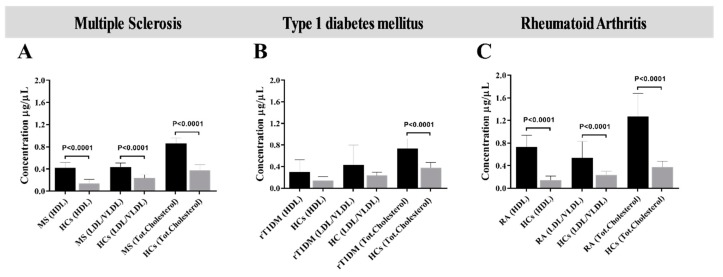
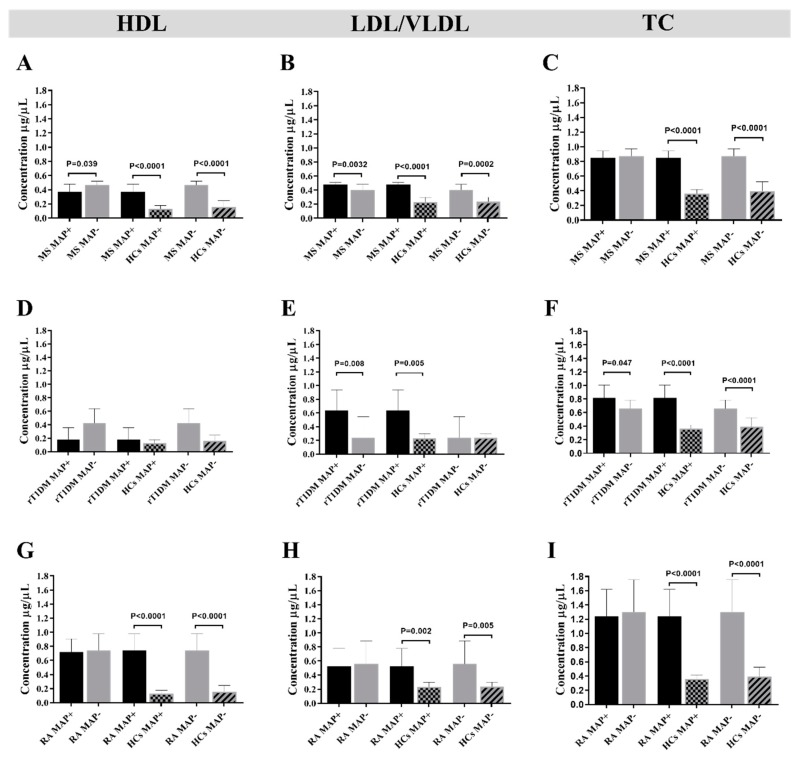
Environmental factors such as bacterial infections may play an important role in the development of autoimmune diseases. subsp. (MAP) is an obligate pathogen of ruminants able to use the host's cholesterol for survival into macrophages and has been associated with multiple sclerosis (MS), type 1 diabetes (T1DM) and rheumatoid arthritis (RA) through a molecular mimicry mechanism. Here, we aimed at investigating the correlation between humoral reactivity against MAP and serum lipoprotein levels in subjects at T1DM risk (rT1DM) grouped by geographical background and in patients affected by MS or RA. Our results showed significant differences in HDL, LDL/VLDL and Total Cholesterol (TC) levels between patients and healthy controls ( < 0.0001). Patients positive to anti-MAP Abs (MAP+) had lower HDL levels in comparison with Abs negative (MAP-) subjects, while opposite trends were found for LDL/VLDL concentrations ( < 0.05). TC levels varied between MAP+ and MAP- patients in all three assessed diseases. These findings suggest the implication of anti-MAP Abs in fluctuations of lipoprotein levels highlighting a possible link with cardiovascular disease. Further studies will be needed to confirm these results in larger groups.
诸如细菌感染等环境因素可能在自身免疫性疾病的发展中起重要作用。副结核分枝杆菌(MAP)是反刍动物的专性病原体,能够利用宿主的胆固醇在巨噬细胞中存活,并通过分子模拟机制与多发性硬化症(MS)、1型糖尿病(T1DM)和类风湿性关节炎(RA)相关联。在此,我们旨在研究按地理背景分组的T1DM风险受试者(rT1DM)以及MS或RA患者中针对MAP的体液反应性与血清脂蛋白水平之间的相关性。我们的结果显示,患者与健康对照之间的高密度脂蛋白(HDL)、低密度脂蛋白/极低密度脂蛋白(LDL/VLDL)和总胆固醇(TC)水平存在显著差异(P<0.0001)。抗MAP抗体阳性(MAP+)的患者与抗体阴性(MAP-)的受试者相比,HDL水平较低,而LDL/VLDL浓度则呈现相反趋势(P<0.05)。在所有三种评估的疾病中,MAP+和MAP-患者的TC水平各不相同。这些发现表明抗MAP抗体与脂蛋白水平波动有关,突出了与心血管疾病的可能联系。需要进一步的研究在更大的群体中证实这些结果。