Department of Biomedical Engineering, The University of Texas at Austin, Austin, TX, USA.
McKetta Department of Chemical Engineering, The University of Texas at Austin, Austin, TX, USA.
Sci Adv. 2019 Sep 27;5(9):eaax7946. doi: 10.1126/sciadv.aax7946. eCollection 2019 Sep.
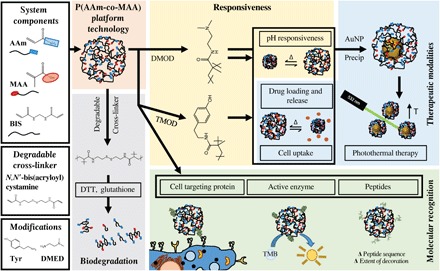
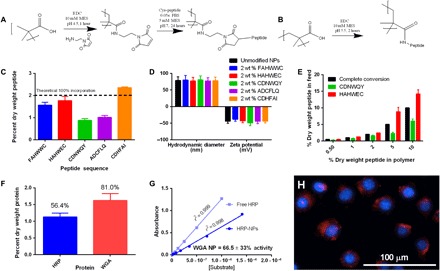
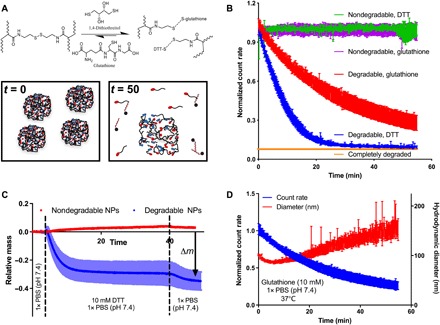
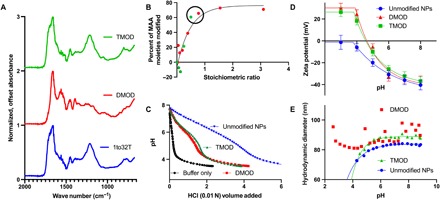
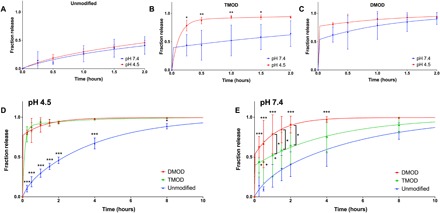
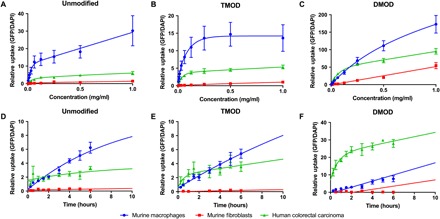
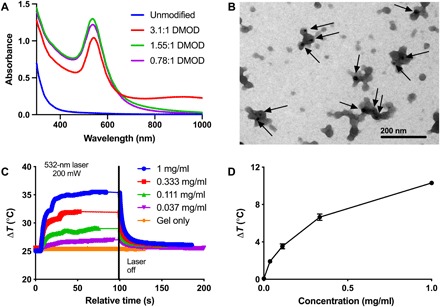
Formulations and devices for precision medicine applications must be tunable and multiresponsive to treat heterogeneous patient populations in a calibrated and individual manner. We engineered modular poly(acrylamide-co-methacrylic acid) copolymers, cross-linked into multiresponsive nanogels with either a nondegradable or degradable disulfide cross-linker, that were customized via orthogonal chemistries to target biomarkers of an individual patient's disease or deliver multiple therapeutic modalities. Upon modification with functional small molecules, peptides, or proteins, these nanomaterials delivered methylene blue with environmental responsiveness, transduced visible light for photothermal therapy, acted as a functional enzyme, or promoted uptake by cells. In addition to quantifying the nanogels' composition, physicochemical characteristics, and cytotoxicity, we used a QCM-D method for characterizing nanomaterial degradation and a high-throughput assay for cellular uptake. In conclusion, we generated a tunable nanogel composition for precision medicine applications and new quantitative protocols for assessing the bioactivity of similar platforms.
用于精准医学应用的配方和设备必须是可调的和多响应的,以以校准和个体化的方式治疗异质的患者群体。我们设计了模块化的聚丙烯酰胺共甲基丙烯酸共聚物,用不可降解或可降解的二硫键交联剂交联成多响应纳米凝胶,可以通过正交化学方法定制,以针对个体患者疾病的生物标志物或提供多种治疗模式。通过与功能小分子、肽或蛋白质进行修饰,这些纳米材料在环境响应时递送亚甲蓝,转化可见光用于光热治疗,充当功能性酶,或促进细胞摄取。除了量化纳米凝胶的组成、物理化学特性和细胞毒性外,我们还使用 QCM-D 方法来表征纳米材料的降解,以及高通量测定细胞摄取。总之,我们为精准医学应用生成了一种可调的纳米凝胶组成,并为评估类似平台的生物活性制定了新的定量方案。