The ithree institute, University of Technology Sydney, Ultimo, NSW 2007, Australia.
Communicable Diseases Branch, Health Protection NSW, St Leonards, NSW 2065, Australia.
Microb Genom. 2019 Oct;5(10). doi: 10.1099/mgen.0.000306.
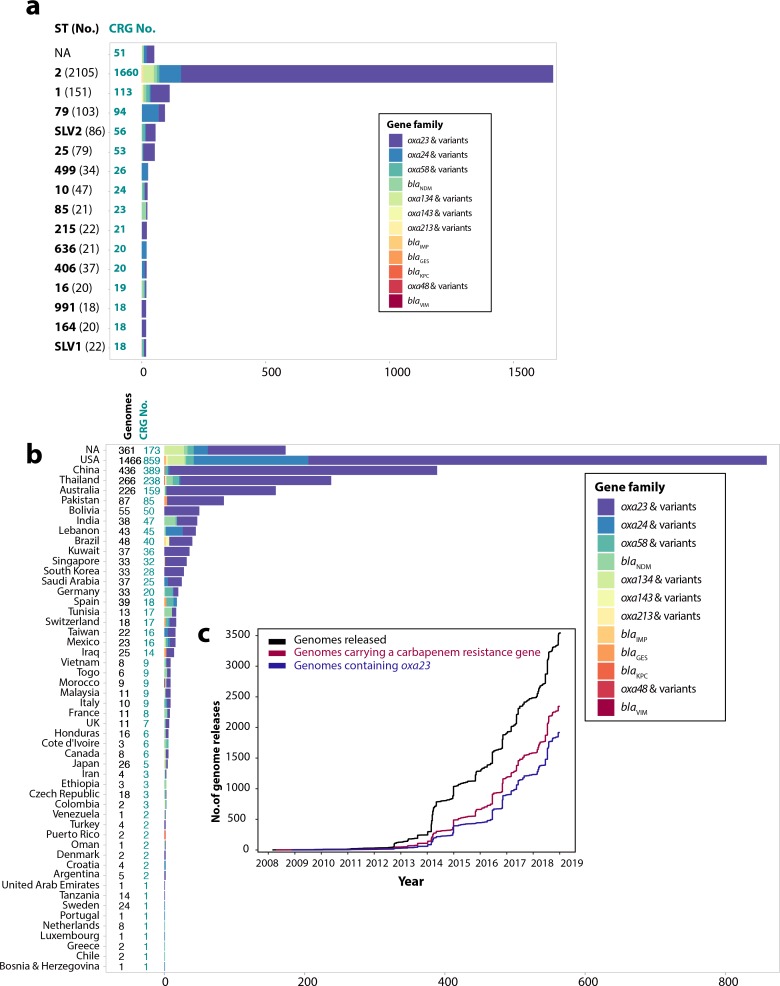
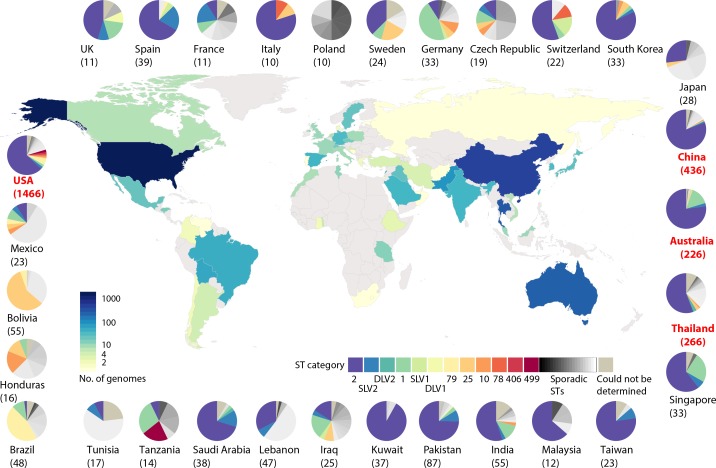
is a nosocomial pathogen that has emerged as a global threat because of high levels of resistance to many antibiotics, particularly those considered to be last-resort antibiotics, such as carbapenems. Although alterations in the efflux pump and outer membrane proteins can cause carbapenem resistance, the main mechanism is the acquisition of carbapenem-hydrolyzing oxacillinase-encoding genes. Of these, is by far the most widespread in most countries, while and appear to be dominant in specific regions. Historically, much of the global spread of carbapenem resistance has been due to the dissemination of two major clones, known as global clones 1 and 2, although new lineages are now common in some parts of the world. The analysis of all publicly available genome sequences performed here indicates that ST2, ST1, ST79 and ST25 account for over 71 % of all genomes sequenced to date, with ST2 by far the most dominant type and the most widespread carbapenem resistance determinant globally, regardless of clonal type. Whilst this highlights the global spread of ST1 and ST2, and the dominance of in both clones, it could also be a result of preferential selection of carbapenem-resistant strains, which mainly belong to the two major clones. Furthermore, ~70 % of the sequenced strains have been isolated from five countries, namely the USA, PR China, Australia, Thailand and Pakistan, with only a limited number from other countries. These genomes are a vital resource, but it is currently difficult to draw an accurate global picture of this important superbug, highlighting the need for more comprehensive genome sequence data and genomic analysis.
是一种医院病原体,由于对许多抗生素,尤其是被认为是最后手段的抗生素(如碳青霉烯类)的高水平耐药性,已成为全球威胁。虽然外排泵和外膜蛋白的改变可导致碳青霉烯类耐药,但主要机制是获得碳青霉烯水解的 oxacillinase 编码基因。在这些基因中, 迄今为止在大多数国家最为广泛,而 和 似乎在特定地区占主导地位。从历史上看,全球碳青霉烯类耐药性的传播主要归因于两种主要克隆体的传播,称为全球克隆体 1 和 2,尽管新的谱系现在在世界某些地区很常见。这里对所有公开可用的基因组序列进行的分析表明,ST2、ST1、ST79 和 ST25 占迄今为止测序的所有基因组的 71%以上,其中 ST2 是迄今为止最主要的类型, 是全球最广泛的碳青霉烯类耐药决定因素,无论克隆类型如何。虽然这突显了 ST1 和 ST2 的全球传播,以及 在两个克隆体中的主导地位,但这也可能是由于对碳青霉烯类耐药菌株的优先选择,这些菌株主要属于两个主要克隆体。此外,~70%的测序菌株来自五个国家,即美国、中国、澳大利亚、泰国和巴基斯坦,而来自其他国家的菌株数量有限。这些基因组是一个重要的资源,但目前很难准确描绘出这种重要的超级细菌的全球图景,这突显了需要更多全面的基因组序列数据和基因组分析。