School of Medicine, Research and Innovation Centre of the Faculty of Health Sciences, Universidad Peruana de Ciencias Aplicadas, 15067, Lima, Peru.
ISGlobal, Hospital Clínic - Universitat de Barcelona, 08036, Barcelona, Spain.
Emerg Microbes Infect. 2018 Jul 4;7(1):119. doi: 10.1038/s41426-018-0127-9.
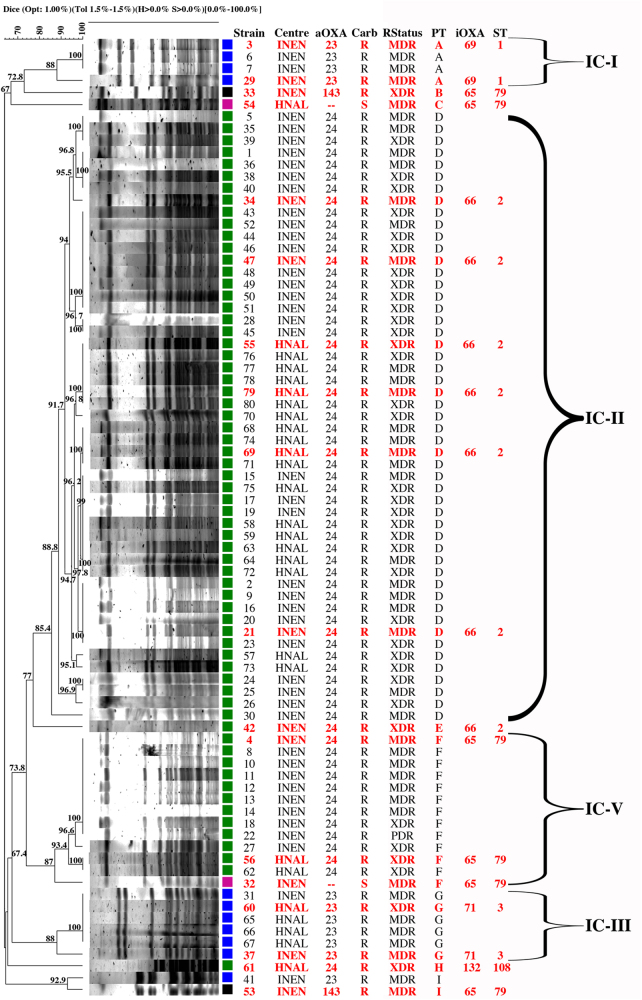
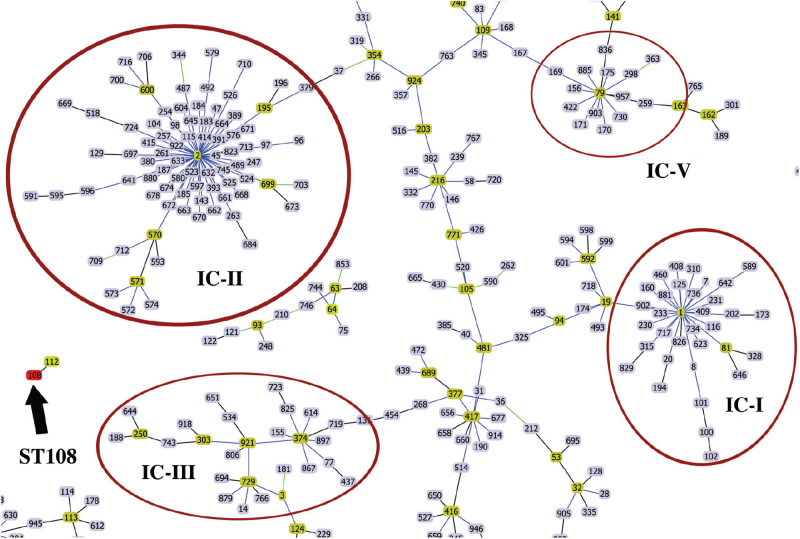
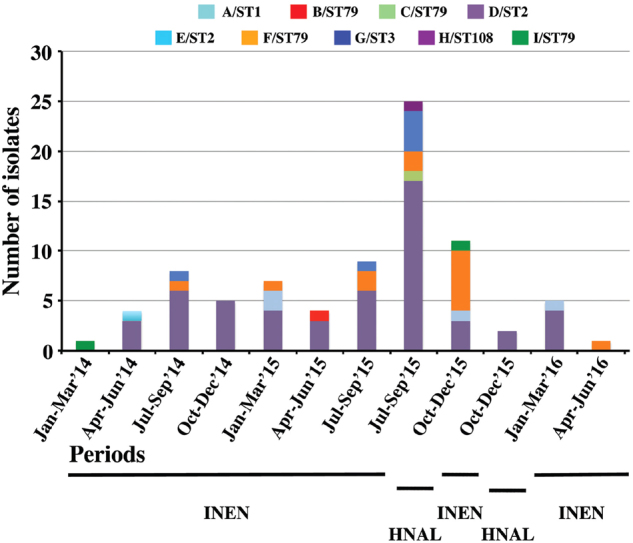
Carbapenem-resistant Acinetobacter baumannii is the top-ranked pathogen in the World Health Organization priority list of antibiotic-resistant bacteria. It emerged as a global pathogen due to the successful expansion of a few epidemic lineages, or international clones (ICs), producing acquired class D carbapenemases (OXA-type). During the past decade, however, reports regarding IC-I isolates in Latin America are scarce and are non-existent for IC-II and IC-III isolates. This study evaluates the molecular mechanisms of carbapenem resistance and the epidemiology of 80 non-duplicate clinical samples of A. baumannii collected from February 2014 through April 2016 at two tertiary care hospitals in Lima. Almost all isolates were carbapenem-resistant (97.5%), and susceptibility only remained high for colistin (95%). Pulsed-field gel electrophoresis showed two main clusters spread between both hospitals: cluster D containing 51 isolates (63.8%) associated with sequence type 2 (ST2) and carrying OXA-72, and cluster F containing 13 isolates (16.3%) associated with ST79 and also carrying OXA-72. ST2 and ST79 were endemic in at least one of the hospitals. ST1 and ST3 OXA-23-producing isolates were also identified. They accounted for sporadic hospital isolates. Interestingly, two isolates carried the novel OXA-253 variant of OXA-143 together with an upstream novel insertion sequence (ISAba47). While the predominant A. baumannii lineages in Latin America are linked to ST79, ST25, ST15, and ST1 producing OXA-23 enzymes, we report the emergence of highly resistant ST2 (IC-II) isolates in Peru producing OXA-72 and the first identification of ST3 isolates (IC-III) in Latin America, both considered a serious threat to public health worldwide.
耐碳青霉烯鲍曼不动杆菌是世界卫生组织优先考虑的抗药性细菌病原体名单中排名最高的病原体。由于少数流行谱系或国际克隆(IC)成功扩张,产生获得性 D 类碳青霉烯酶(OXA 型),它已成为一种全球性病原体。然而,在过去的十年中,关于拉丁美洲的 IC-I 分离株的报告很少,而关于 IC-II 和 IC-III 分离株的报告则没有。本研究评估了 80 份来自利马两家三级护理医院的非重复临床鲍曼不动杆菌分离株的分子机制和流行病学,这些分离株于 2014 年 2 月至 2016 年 4 月收集。几乎所有分离株均对碳青霉烯类药物具有耐药性(97.5%),仅对多粘菌素的敏感性较高(95%)。脉冲场凝胶电泳显示两个主要的集群在两家医院之间传播:集群 D 包含 51 个分离株(63.8%),与序列型 2(ST2)相关,携带 OXA-72,集群 F 包含 13 个分离株(16.3%),与 ST79 相关,也携带 OXA-72。ST2 和 ST79 在至少一家医院中是地方性的。还鉴定出 ST1 和 ST3 产 OXA-23 的分离株。它们占散发性医院分离株的比例。有趣的是,两个分离株携带新型 OXA-253 变体的 OXA-143 以及上游新型插入序列(ISAba47)。虽然拉丁美洲主要的鲍曼不动杆菌谱系与 ST79、ST25、ST15 和产 OXA-23 酶的 ST1 相关,但我们报告了在秘鲁出现的高耐药 ST2(IC-II)分离株,该分离株产 OXA-72,以及拉丁美洲首次鉴定出的 ST3 分离株(IC-III),这两者都被认为是对全球公共卫生的严重威胁。