The iThree Institute, University of Technology Sydney, Ultimo, New South Wales, Australia.
Laboratoire Microbiologie Santé et Environnement (LMSE), Doctoral School of Science & Technology, Faculty of Public Health, Lebanese University, Tripoli, Lebanon.
Microbiol Spectr. 2022 Feb 23;10(1):e0174521. doi: 10.1128/spectrum.01745-21. Epub 2022 Jan 12.
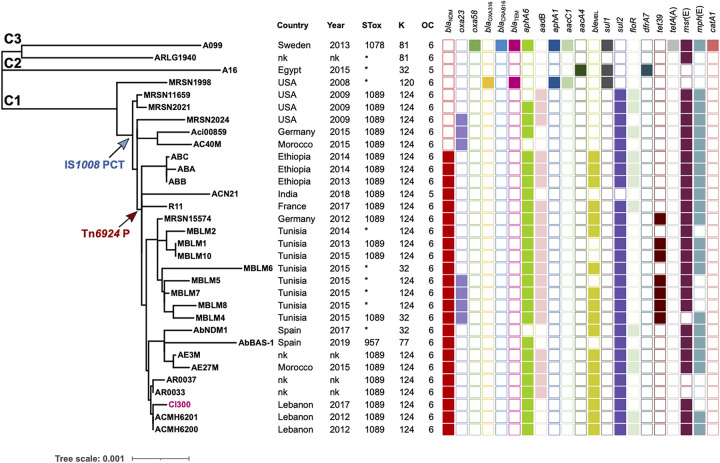
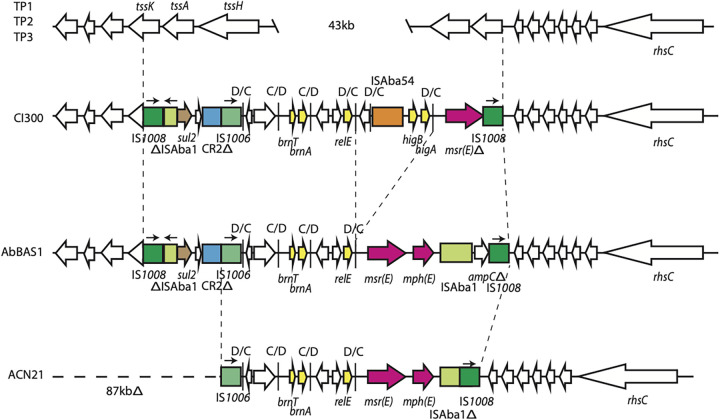
Carbapenem resistance in Acinetobacter baumannii is primarily due to the global spread of two main clones that carry , , and However, new carbapenem-resistant clones are emerging that are also resistant to a wide range of antibiotics. Strains belonging to ST85 (Institut Pasteur) carry the metallo-β-lactamase carbapenem resistance gene. Here, we completed the genome sequence of an ST85 strain, Cl300, recovered in 2015 in Lebanon, using a combination of Illumina MiSeq and Oxford Nanopore sequencing and a hybrid assembly approach. Cl300 is highly resistant to meropenem and amikacin, and consistent with this, a copy of the carbapenem and 14 copies of the amikacin resistance genes were found in the genome. Cl300 also contains the sulfonamide and the (E) macrolide resistance genes. All copies and are in a novel 76-kb Tn family transposon designated Tn. Like Tn, Tn is bounded by 29-bp inverted repeats with additional TnsB binding sites at each end. Several variants of Tn were found in a set of diverse strains, including ST85 strains as well as members of global clones 1 and 2. and (E) are in a 13.0-kb pseudocompound transposon (PCT) bounded by IS. ST85s represent a diverse group of strains, particularly in their antibiotic resistance gene content and the K and OC surface polysaccharide loci. Acquisition of Tn by members of global clones indicates the significance of this transposon in spreading two clinically significant resistance genes, and . To date, efforts to study the resistance mechanisms of carbapenem-resistant Acinetobacter baumannii have been largely focused on the two major globally distributed clones (GC1 and GC2). ST85 is an emerging sequence type, and unlike other clones, it is associated with the carriage of the gene. Here, we completed the genome sequence of an ST85 strain and showed that and 14 copies of the amikacin resistance genes are in Tn, a novel Tn family transposon. Analysis of all publicly available ST85s predicted that all strains in the main lineage carry a variant of Tn. Variants of Tn were also found in other clones, including GC1 and GC2. Tn is an important mobile element given that it carries two clinically important resistance genes ( and ) and has spread to other clones. Therefore, outbreaks caused by ST85s should be studied and tracked.
鲍曼不动杆菌的碳青霉烯耐药性主要是由于两个主要克隆的全球传播所致,这两个克隆携带 、 和 。然而,新的碳青霉烯耐药克隆也正在出现,并且对广泛的抗生素具有耐药性。属于 ST85(巴斯德研究所)的菌株携带 金属β-内酰胺酶碳青霉烯耐药基因。在这里,我们使用 Illumina MiSeq 和 Oxford Nanopore 测序以及混合组装方法,完成了 2015 年在黎巴嫩分离的 ST85 菌株 Cl300 的基因组序列。Cl300 对美罗培南和阿米卡星高度耐药,与此一致,在基因组中发现了 碳青霉烯和 14 个 阿米卡星耐药基因的拷贝。Cl300 还含有磺胺和(E)大环内酯类抗生素耐药基因。所有 和 都在一个新的 76kbTn 家族转座子 Tn 中,Tn 由 29bp 反向重复序列组成,两端各有一个额外的 TnsB 结合位点。在一组不同的菌株中发现了几种 Tn 变体,包括 ST85 菌株以及全球克隆 1 和 2 的成员。 和 (E)在一个由 IS 边界的 13.0kb 假复合转座子(PCT)中。ST85 代表了一组多样化的菌株,特别是在其抗生素耐药基因的内容和 K 和 OC 表面多糖基因座方面。全球克隆成员获得 Tn 表明该转座子在传播两种临床上重要的耐药基因 和 方面的重要性。迄今为止,对碳青霉烯耐药鲍曼不动杆菌耐药机制的研究主要集中在两个主要的全球分布克隆(GC1 和 GC2)上。ST85 是一种新兴的序列型,与其他克隆不同,它与 基因的携带有关。在这里,我们完成了 ST85 菌株的基因组序列,并表明 和 14 个 阿米卡星耐药基因位于 Tn 中,这是一个新的 Tn 家族转座子。对所有公开可用的 ST85s 的分析表明,主谱系中的所有菌株都携带 Tn 的变体。在其他克隆中也发现了 Tn 的变体,包括 GC1 和 GC2。由于 Tn 携带两种临床上重要的耐药基因( 和 ),并且已经传播到其他克隆,因此它是一个重要的可移动元件。因此,应研究和跟踪由 ST85 引起的暴发。