Ribaldone Davide Giuseppe, Caviglia Gian Paolo, Abdulle Amina, Pellicano Rinaldo, Ditto Maria Chiara, Morino Mario, Fusaro Enrico, Saracco Giorgio Maria, Bugianesi Elisabetta, Astegiano Marco
Department of Surgical Sciences, University of Turin, 10124 Turin, Italy.
Department of Medical Sciences, University of Turin, 10124 Turin, Italy.
J Clin Med. 2019 Oct 9;8(10):1646. doi: 10.3390/jcm8101646.
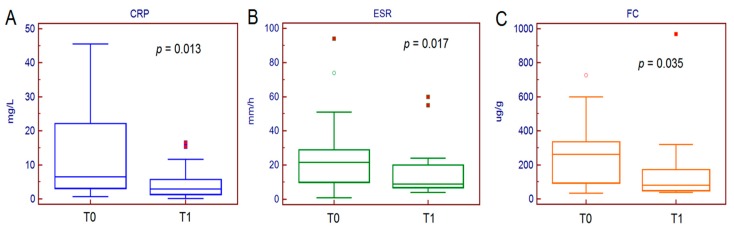
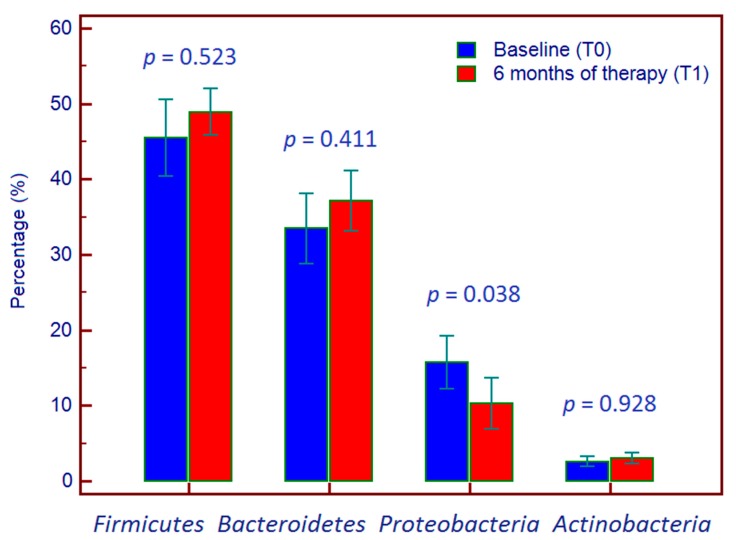
The response to treatment with biologic drugs, in patients with Crohn's disease, could be associated with changes in gut microbiota composition. The aim of our study was to analyse the modification of microbiota during adalimumab therapy in patients with Crohn's disease. We performed a prospective study in patients with Crohn's disease analysing gut microbiota before start of adalimumab therapy (T0) and after six months of therapy (T1). Among the 20 included patients, the phylum fell from 15.7 ± 3.5% at T0 to 10.3 ± 3.4% at T1 ( = 0.038). Furthermore, the trend in relation to therapeutic success was analysed. Regarding bacterial phyla, decreased in patients in whom therapeutic success was obtained, passing from a value of 15.8% (± 4.6%) to 6.8 ± 3.1% ( = 0.049), while in non-responder patients, percentages did not change (T0 = 15.6 ± 5.7%, T1 = 16.8 ± 7.6%, = 0.890). Regarding the family, in patients with normalization of C reactive protein six 6 months of adalimumab therapy, it increased from 16.6 ± 3.1% at T0 to 23.9 ± 2.6% at T1 ( = 0.049). In conclusion, in patients who respond to Adalimumab therapy by decreasing inflammation, there is a trend of intestinal eubiosis being restored.
克罗恩病患者使用生物药物治疗的反应可能与肠道微生物群组成的变化有关。我们研究的目的是分析阿达木单抗治疗期间克罗恩病患者微生物群的改变。我们对克罗恩病患者进行了一项前瞻性研究,分析了阿达木单抗治疗开始前(T0)和治疗六个月后(T1)的肠道微生物群。在纳入的20名患者中,该门在T0时为15.7±3.5%,在T1时降至10.3±3.4%(P = 0.038)。此外,分析了与治疗成功相关的趋势。关于细菌门,在获得治疗成功的患者中减少,从15.8%(±4.6%)降至6.8±3.1%(P = 0.049),而在无反应患者中,百分比没有变化(T0 = 15.6±5.7%,T1 = 16.8±7.6%,P = 0.890)。关于该菌科,在阿达木单抗治疗六个月后C反应蛋白恢复正常的患者中,它从T0时的16.6±3.1%增加到T1时的23.9±2.6%(P = 0.049)。总之,在通过减轻炎症对阿达木单抗治疗有反应的患者中,存在肠道微生态恢复的趋势。