Wellcome Trust Centre for Cell-Matrix Research, School of Biological Sciences, Faculty of Biology, Medicine and Health, University of Manchester, Manchester Academic Health Science Centre, Manchester M13 9PT, UK.
MRC Laboratory for Molecular Cell Biology, University College London, London WC1E 6BT, UK; Institute for the Physics of Living Systems, University College London, London WC1E 6BT, UK.
Dev Cell. 2019 Nov 18;51(4):460-475.e10. doi: 10.1016/j.devcel.2019.09.006. Epub 2019 Oct 10.
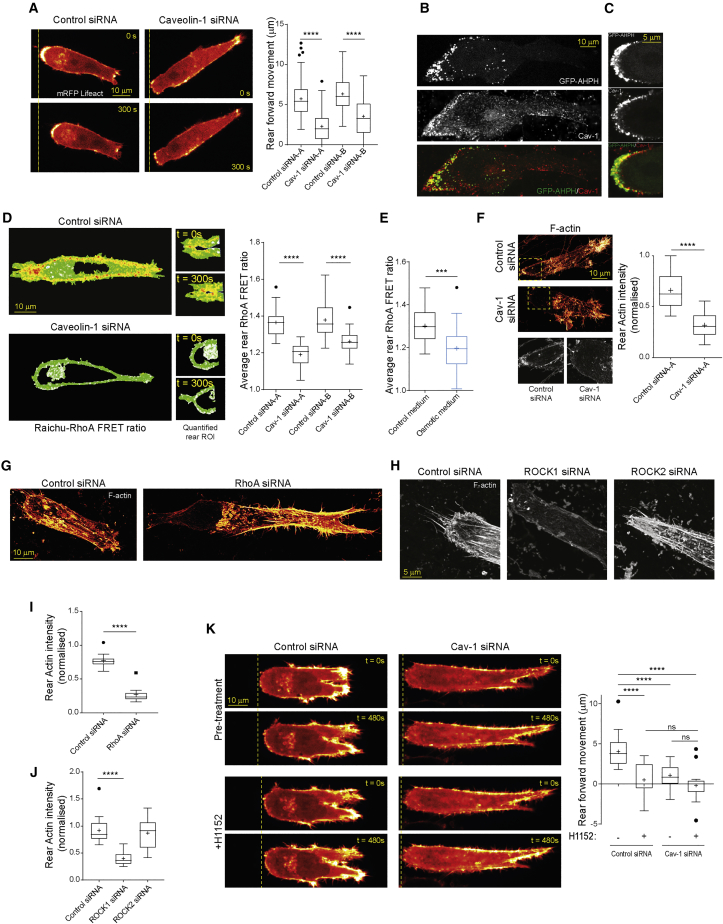
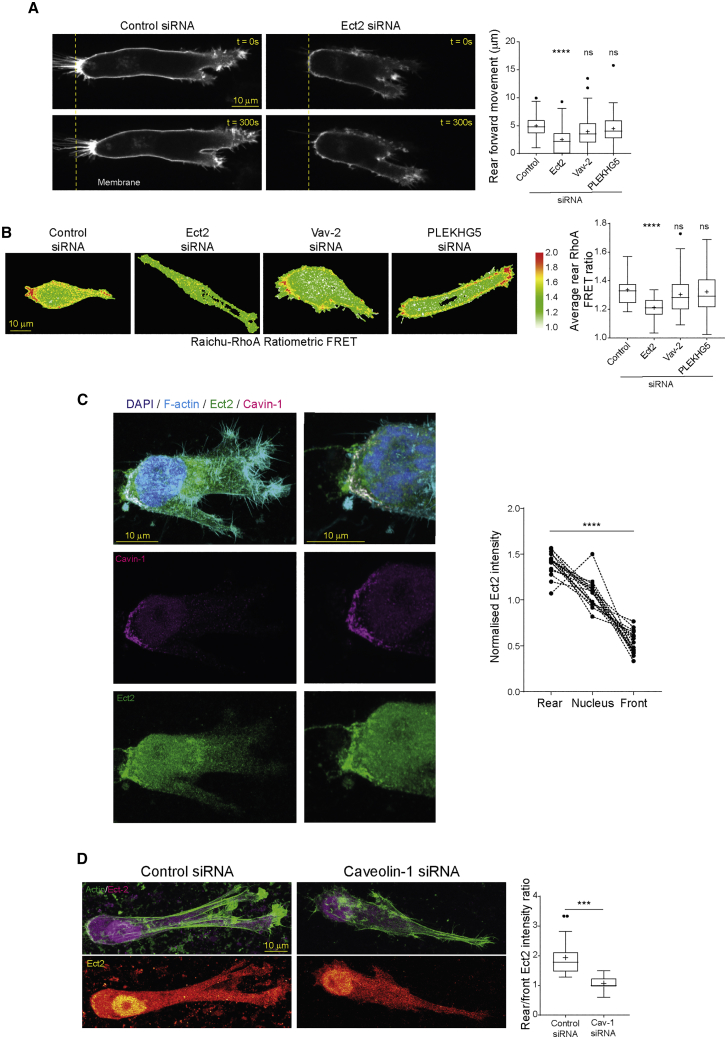
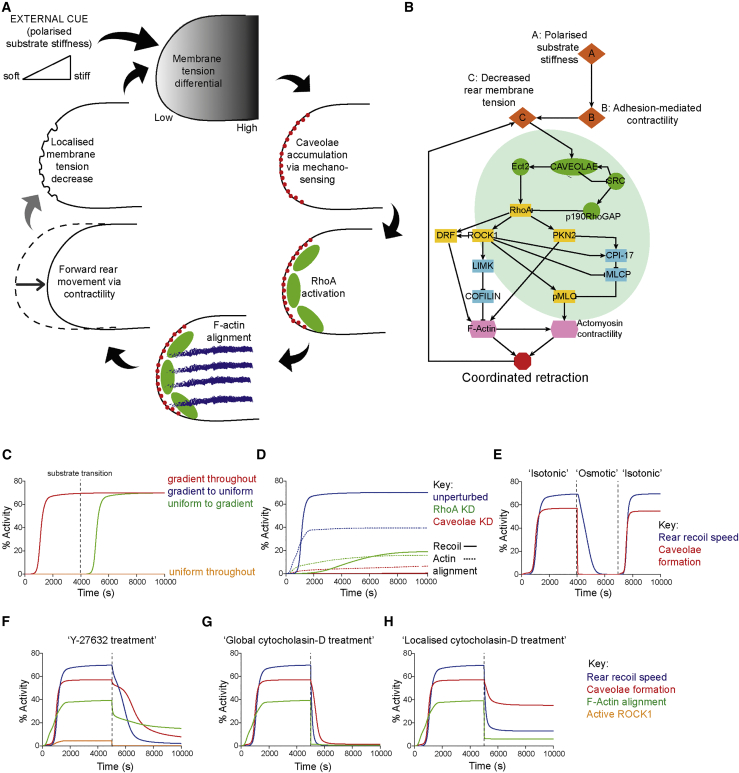
In development, wound healing, and cancer metastasis, vertebrate cells move through 3D interstitial matrix, responding to chemical and physical guidance cues. Protrusion at the cell front has been extensively studied, but the retraction phase of the migration cycle is not well understood. Here, we show that fast-moving cells guided by matrix cues establish positive feedback control of rear retraction by sensing membrane tension. We reveal a mechanism of rear retraction in 3D matrix and durotaxis controlled by caveolae, which form in response to low membrane tension at the cell rear. Caveolae activate RhoA-ROCK1/PKN2 signaling via the RhoA guanidine nucleotide exchange factor (GEF) Ect2 to control local F-actin organization and contractility in this subcellular region and promote translocation of the cell rear. A positive feedback loop between cytoskeletal signaling and membrane tension leads to rapid retraction to complete the migration cycle in fast-moving cells, providing directional memory to drive persistent cell migration in complex matrices.
在发育、伤口愈合和癌症转移过程中,脊椎动物细胞通过 3D 细胞外基质移动,响应化学和物理导向线索。细胞前缘的突出已被广泛研究,但迁移周期的回缩阶段还不太清楚。在这里,我们表明,受基质线索引导的快速移动细胞通过感知膜张力建立了对后部回缩的正反馈控制。我们揭示了一种在 3D 基质中通过 caveolae 控制的后回缩机制,caveolae 响应细胞后部的低膜张力而形成。Caveolae 通过 RhoA 鸟嘌呤核苷酸交换因子(GEF)Ect2 激活 RhoA-ROCK1/PKN2 信号通路,控制该亚细胞区域的局部 F-肌动蛋白组织和收缩性,并促进细胞后部的易位。细胞骨架信号和膜张力之间的正反馈循环导致快速回缩,从而完成快速移动细胞的迁移周期,为在复杂基质中驱动持续的细胞迁移提供定向记忆。