
肉桂醛对生物膜的抗菌活性
Antimicrobial Activity of Cinnamaldehyde on Biofilms.
作者信息
He Zhiyan, Huang Zhengwei, Jiang Wei, Zhou Wei
机构信息
Laboratory of Oral Microbiota and Systemic Diseases, Shanghai Key Laboratory of Stomatology and Shanghai Research Institute of Stomatology, Shanghai Ninth People's Hospital, College of Stomatology, Shanghai Jiao Tong University School of Medicine, Shanghai, China.
National Clinical Research Center for Oral Diseases, Shanghai Key Laboratory of Stomatology and Shanghai Research Institute of Stomatology, Shanghai, China.
出版信息
Front Microbiol. 2019 Sep 25;10:2241. doi: 10.3389/fmicb.2019.02241. eCollection 2019.
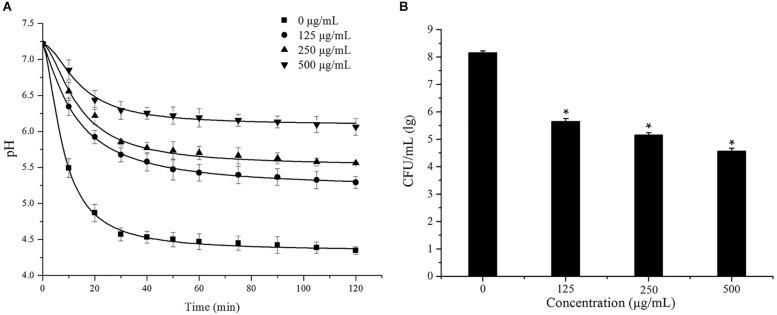
is considered the most relevant bacteria in the transition of non-pathogenic commensal oral microbiota to biofilms which contribute to the dental caries process. The present study aimed to evaluate the antimicrobial activity of a natural plant product, cinnamaldehyde against biofilms. Minimum inhibitory concentrations (MIC), minimal bactericidal concentration (MBC), and growth curves were determined to assess its antimicrobial effect against planktonic . The biofilm biomass and metabolism with different concentrations of cinnamaldehyde and different incubation time points were assessed using the crystal violet and MTT assays. The biofilms were visualized using confocal laser scanning microscopy (CLSM). Bacterial cell surface hydrophobicity, aggregation, acid production, and acid tolerance were evaluated after cinnamaldehyde treatment. The gene expression of virulence-related factors (, , , , , , , and ) was investigated by real-time PCR. The MIC and MBC of cinnamaldehyde against planktonic were 1000 and 2000 μg/mL, respectively. The results showed that cinnamaldehyde can decrease biofilm biomass and metabolism at sub-MIC concentrations. CLSM images revealed that the biofilm-covered surface areas decreased with increasing concentrations of cinnamaldehyde. Cinnamaldehyde increased cell surface hydrophobicity, reduced aggregation, inhibited acid production, and acid tolerance. Genes expressions in the biofilms were down-regulated in the presence of cinnamaldehyde. Therefore, our data demonstrated that cinnamaldehyde at sub-MIC level suppressed the microbial activity on biofilm by modulating hydrophobicity, aggregation, acid production, acid tolerance, and virulence gene expression.
被认为是在非致病性共生口腔微生物群向生物膜转变过程中最相关的细菌,这些生物膜会导致龋齿过程。本研究旨在评估天然植物产物肉桂醛对生物膜的抗菌活性。测定了最低抑菌浓度(MIC)、最低杀菌浓度(MBC)和生长曲线,以评估其对浮游菌的抗菌效果。使用结晶紫和MTT法评估不同浓度肉桂醛和不同孵育时间点的生物膜生物量和代谢情况。使用共聚焦激光扫描显微镜(CLSM)观察生物膜。在肉桂醛处理后,评估细菌细胞表面疏水性、聚集性、产酸和耐酸性。通过实时PCR研究毒力相关因子(、、、、、、、和)的基因表达。肉桂醛对浮游菌的MIC和MBC分别为1000和2000μg/mL。结果表明,肉桂醛在亚MIC浓度下可降低生物膜生物量和代谢。CLSM图像显示,随着肉桂醛浓度的增加,生物膜覆盖的表面积减小。肉桂醛增加细胞表面疏水性,减少聚集,抑制产酸和耐酸性。在肉桂醛存在下,生物膜中的基因表达下调。因此,我们的数据表明,亚MIC水平的肉桂醛通过调节疏水性、聚集性、产酸、耐酸性和毒力基因表达来抑制生物膜上的微生物活性。


 Zotero 插件