Wood Katelyn N, Murray Kevin R, Greaves Danielle K, Hughson Richard L
Schlegel-University of Waterloo Research Institute for Aging, Waterloo, ON Canada.
NPJ Microgravity. 2019 Oct 11;5:22. doi: 10.1038/s41526-019-0082-3. eCollection 2019.
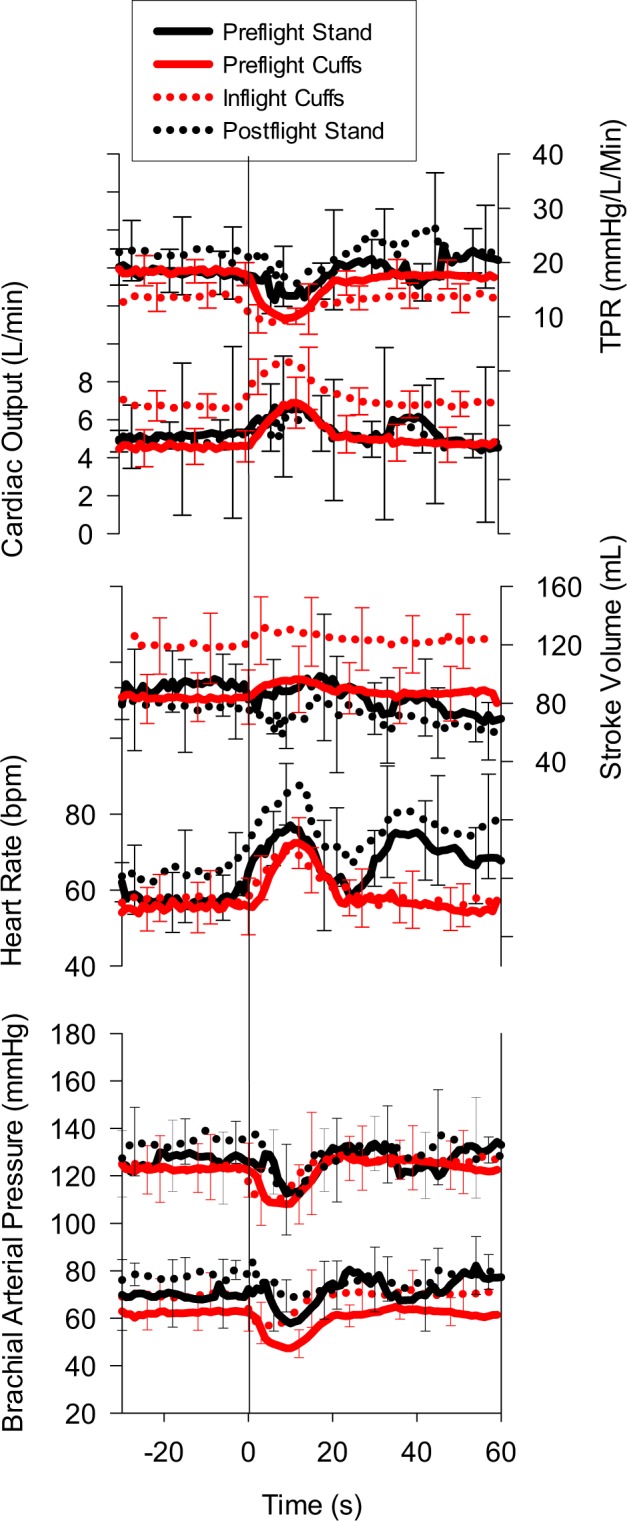
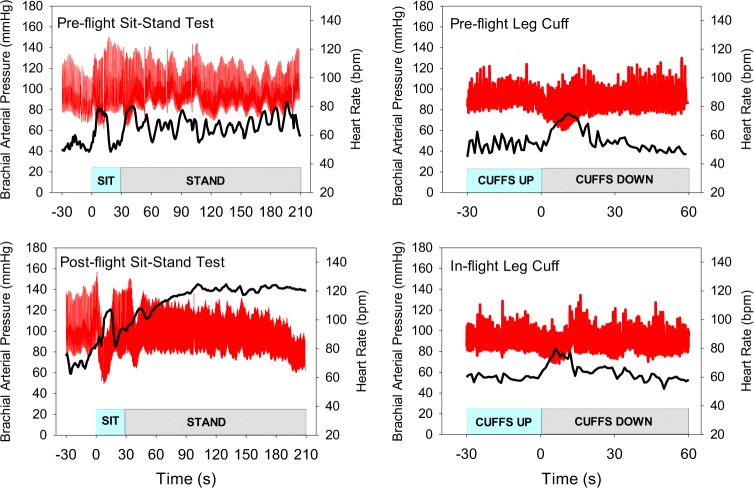
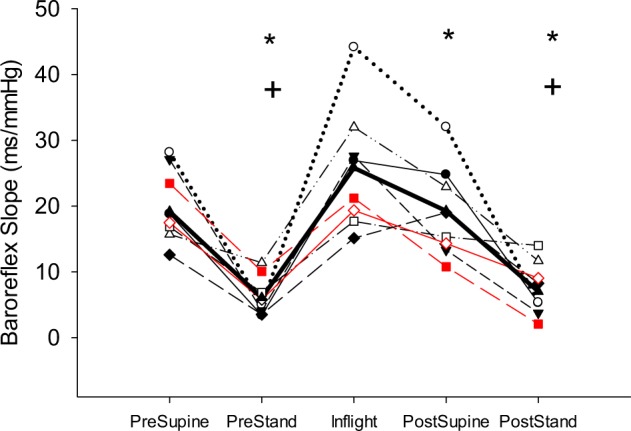
Landing day symptoms from orthostatic hypotension after prolonged spaceflight can be debilitating, but severity of these symptoms can be unpredictable and highly individual. We tested the hypothesis that an impaired baroreflex response to an inflight leg cuff test could predict orthostatic intolerance on return to Earth. Eight male astronauts (44 ± 7 years of age (mean ± SD); mean mission length: 167 ± 12 days) participated in a standardized supine-to-sit-to-stand test (5 min-30s-3 min) pre- and postflight, and a 3 min thigh cuff occlusion test pre- and inflight with continuous monitoring of heart rate and arterial blood pressure. The arterial baroreflex was not changed inflight as shown by similar reductions in mean arterial pressure (MAP) response to leg cuff deflation (preflight -19 ± 2 mmHg vs. inflight -18 ± 5 mmHg). With the sit/stand test, the nadir of MAP was lower postflight (-17 ± 9 mmHg) than preflight (-11 ± 6 mmHg, < 0.05). A greater increase in heart rate (25 ± 7; 16 ± 3 bpm) and decrease in stroke volume (-24 ± 11; -6 ± 4 mL) occurred with sit/stand postflight than leg cuffs inflight ( < 0.001). Inflight testing was influenced by elevated cardiac output resulting in a smaller drop in total peripheral resistance. Two of eight subjects exhibited orthostatic hypotension during the postflight stand test; their responses were not predicted by the inflight leg cuff deflation test. These results suggest that the baroreflex response examined by inflight leg cuff deflation was not a reliable indicator of postflight stand responses.
长时间太空飞行后因体位性低血压产生的着陆日症状可能使人虚弱,但这些症状的严重程度难以预测且因人而异。我们检验了这样一个假设:飞行中腿部袖带测试时压力反射反应受损可预测返回地球后的体位不耐受情况。8名男性宇航员(年龄44±7岁(均值±标准差);平均任务时长:167±12天)在飞行前和飞行后参加了标准化的仰卧-坐立-站立测试(5分钟-30秒-3分钟),并在飞行前和飞行中进行了3分钟的大腿袖带阻断测试,同时持续监测心率和动脉血压。如对腿部袖带放气时平均动脉压(MAP)的类似下降所示(飞行前-19±2 mmHg vs.飞行中-18±5 mmHg),飞行中动脉压力反射未发生变化。在坐立/站立测试中,MAP的最低点在飞行后(-17±9 mmHg)低于飞行前(-11±6 mmHg,P<0.05)。与飞行中腿部袖带测试相比,飞行后坐立/站立时心率增加幅度更大(25±7;16±3次/分钟),每搏输出量下降幅度更大(-24±11;-6±4 mL)(P<0.001)。飞行中的测试受到心输出量升高的影响,导致总外周阻力下降幅度较小。8名受试者中有2名在飞行后站立测试中出现体位性低血压;飞行中腿部袖带放气测试无法预测他们的反应。这些结果表明,通过飞行中腿部袖带放气检查的压力反射反应不是飞行后站立反应的可靠指标。