Kayali Seyma, Yildirim Fatma Tuba
Department of Pediatric Cardiology, University of Health Sciences, Kecioren Training and Research Hospital, Ankara, Turkey.
Department of Pediatrics, Sorgun State Hospital, Yozgat, Turkey.
North Clin Istanb. 2018 Sep 3;6(3):236-241. doi: 10.14744/nci.2018.40360. eCollection 2019.
The aim of the present study was to determine the effects of a well-controlled endurance training program on cardiac functions and structures in healthy children and to define whether training hours per week and type of sports affect the training-induced cardiovascular response.
Echocardiographic recordings were obtained in 126 children who systematically participated in sports training for at least 1 year (study group), and the results were compared with the values obtained in 62 normal children who did not actively engage in any sports activity (control group). The two groups were comparable for age, sex, and body mass index. Study group participants were divided into two groups according to the duration of physical activity (training hours per week, <8 h and >8 h) and five groups according to the cardiovascular demand of sports type. Clinical examination, resting electrocardiogram, two-dimensional, M-mode, and Doppler echocardiography were obtained in all participants.
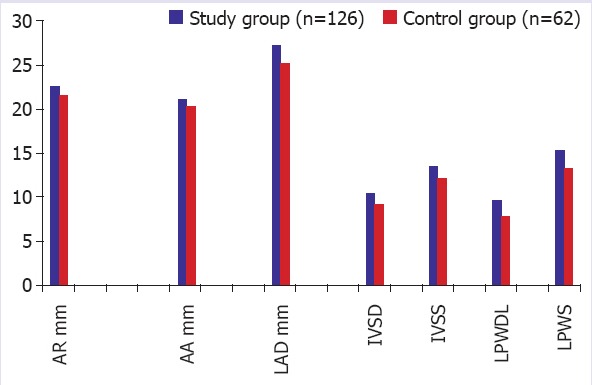
Left ventricle wall dimensions, left atrial diameters, and aortic measurements were significantly higher in the study group. The mean mitral E/A ratio was also significantly higher in the training group than in untrained subjects (p<0.001). Echocardiographic measurements were similar between different sports type participants in the study group. However, aortic root diameter, left atrial diameter, and left ventricle posterior wall diastolic thickness were higher in children training >8 h/week than in children training <8 h/week in the study group.
The present study showed that the echocardiographic parameters of children participating in regular sports training activities statistically significantly exceeded the parameters of untrained controls. These parameters were mostly dependent on the duration of training hours per week.
本研究旨在确定一项控制良好的耐力训练计划对健康儿童心脏功能和结构的影响,并确定每周训练时长和运动类型是否会影响训练引起的心血管反应。
对126名系统参加体育训练至少1年的儿童(研究组)进行超声心动图记录,并将结果与62名未积极参加任何体育活动的正常儿童(对照组)所获得的值进行比较。两组在年龄、性别和体重指数方面具有可比性。研究组参与者根据体育活动时长(每周训练小时数,<8小时和>8小时)分为两组,并根据运动类型的心血管需求分为五组。对所有参与者进行临床检查、静息心电图、二维、M型和多普勒超声心动图检查。
研究组的左心室壁尺寸、左心房直径和主动脉测量值显著更高。训练组的平均二尖瓣E/A比值也显著高于未训练者(p<0.001)。研究组中不同运动类型参与者的超声心动图测量结果相似。然而,在研究组中,每周训练>8小时的儿童的主动脉根部直径、左心房直径和左心室后壁舒张厚度高于每周训练<8小时的儿童。
本研究表明,参加常规体育训练活动的儿童的超声心动图参数在统计学上显著超过未训练对照组的参数。这些参数大多取决于每周的训练时长。