Weberruß Heidi, Engl Tobias, Baumgartner Lisa, Mühlbauer Frauke, Shehu Nerejda, Oberhoffer-Fritz Renate
Institute of Preventive Pediatrics, TUM Department of Sport and Health Sciences, Technical University of Munich, 80992 Munich, Germany.
Department of Pediatric Cardiology and Congenital Heart Disease, German Heart Center Munich, Technical University of Munich, 80636 Munich, Germany.
Rev Cardiovasc Med. 2022 Apr 7;23(4):129. doi: 10.31083/j.rcm2304129. eCollection 2022 Apr.
In young athletes, the level of competitiveness in sports is increasing, as well as frequency and intensity of exercise training. Adaptations of the cardiac system to this increased workload imposed by exercise has not yet been studied sufficiently. In adults, studies point towards a shift from the functional athlete's heart towards pathological cardiac remodelling, with ventricular arrythmia and impaired cardiac function, that is exercise-related. This systematic review investigates cardiac adaptations to exercise in junior athletes compared to inactive controls.
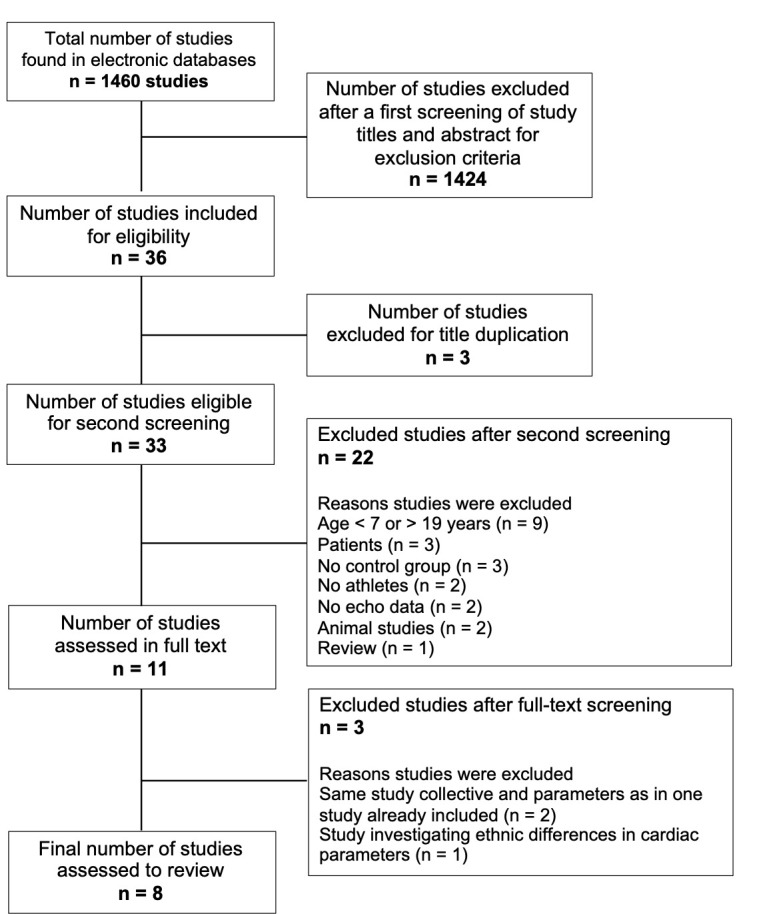
Three electronic databases (PubMed/Medline, ScienceDirect and Web of Science) were searched for studies assessing 2-dimensional transthoracic echocardiography (2D TTE) and 2-dimensional speckle tracking echocardiography (2D STE) parameters in junior athletes, aged 7-19 years, compared to inactive controls. Data was screened and extracted by two reviewers; study quality and risk of bias was assessed by three reviewers.
Eight out of 1460 studies met all inclusion criteria, with all studies reporting results on 2D TTE and six studies reporting results on 2D STE parameters in 540 (51 girls) junior athletes and 270 (18 girls) controls. There is evidence for structural cardiac adaptations of the left ventricle and both atria in junior athletes. Results regarding left ventricular function are controversial with a tendency to improved function in dynamic exercising athletes. Left ventricular mass and relative wall thickness point towards higher values in static exercising athletes.
Cardiac adaptations to exercise occur in children and adolescents. These adaptations are more pronounced in structural left ventricular parameters. Functional parameters are preserved or slightly improved in junior athletes but not impaired by exercise.
在年轻运动员中,体育比赛的竞争水平以及运动训练的频率和强度都在不断提高。心脏系统对运动带来的这种增加的工作量的适应性尚未得到充分研究。在成年人中,研究表明从功能性运动员心脏向病理性心脏重塑转变,伴有室性心律失常和心脏功能受损,这与运动有关。本系统评价调查了青少年运动员与不运动的对照组相比,运动对心脏的适应性。
检索了三个电子数据库(PubMed/Medline、ScienceDirect和Web of Science),以查找评估7至19岁青少年运动员与不运动对照组的二维经胸超声心动图(2D TTE)和二维斑点追踪超声心动图(2D STE)参数的研究。由两名审阅者筛选和提取数据;由三名审阅者评估研究质量和偏倚风险。
1460项研究中有8项符合所有纳入标准,所有研究均报告了540名(51名女孩)青少年运动员和270名(18名女孩)对照组的2D TTE结果,6项研究报告了2D STE参数结果。有证据表明青少年运动员的左心室和两个心房存在心脏结构适应性变化。关于左心室功能的结果存在争议,动态运动的运动员有功能改善的趋势。静态运动的运动员左心室质量和相对室壁厚度较高。
儿童和青少年会出现运动对心脏的适应性变化。这些适应性变化在左心室结构参数中更为明显。青少年运动员的功能参数得以保留或略有改善,但未因运动而受损。