Emerg Infect Dis. 2020 Jan;26(1):90-96. doi: 10.3201/eid2601.191085. Epub 2020 Jan 17.
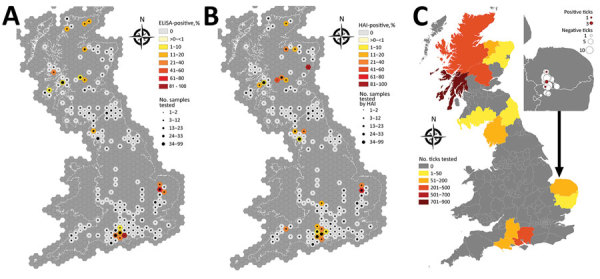
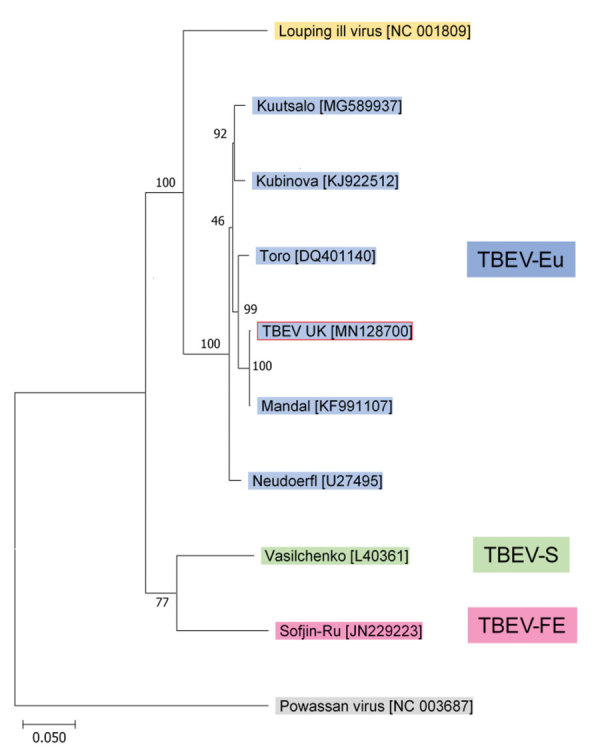
During February 2018-January 2019, we conducted large-scale surveillance for the presence and prevalence of tick-borne encephalitis virus (TBEV) and louping ill virus (LIV) in sentinel animals and ticks in the United Kingdom. Serum was collected from 1,309 deer culled across England and Scotland. Overall, 4% of samples were ELISA-positive for the TBEV serocomplex. A focus in the Thetford Forest area had the highest proportion (47.7%) of seropositive samples. Ticks collected from culled deer within seropositive regions were tested for viral RNA; 5 of 2,041 ticks tested positive by LIV/TBEV real-time reverse transcription PCR, all from within the Thetford Forest area. From 1 tick, we identified a full-length genomic sequence of TBEV. Thus, using deer as sentinels revealed a potential TBEV focus in the United Kingdom. This detection of TBEV genomic sequence in UK ticks has important public health implications, especially for undiagnosed encephalitis.
在 2018 年 2 月至 2019 年 1 月期间,我们在英国对带蜱脑炎病毒(TBEV)和鹿蝇热病毒(LIV)在监测动物和蜱中的存在和流行情况进行了大规模监测。从英格兰和苏格兰捕杀的 1309 只鹿中采集了血清。总体而言,有 4%的样本 ELISA 检测 TBEV 血清复合物呈阳性。塞特福德森林地区的一个焦点区域具有最高比例(47.7%)的血清阳性样本。从血清阳性地区捕杀的鹿中采集的蜱进行了病毒 RNA 检测;通过 LIV/TBEV 实时逆转录 PCR 检测,在 2041 只蜱中有 5 只呈阳性,均来自塞特福德森林地区。从 1 只蜱中,我们鉴定出了 TBEV 的全长基因组序列。因此,使用鹿作为监测动物揭示了英国 TBEV 可能的焦点区域。在英国蜱中检测到 TBEV 基因组序列具有重要的公共卫生意义,尤其是对于未确诊的脑炎。