Central Laboratory of The Fifth Affiliated Hospital of Harbin Medical University, Daqing, Heilongjiang 163711, P.R. China.
Department of Pathology, Harbin Medical University, Daqing, Heilongjiang 163319, P.R. China.
Oncol Rep. 2020 Jan;43(1):229-239. doi: 10.3892/or.2019.7390. Epub 2019 Oct 25.
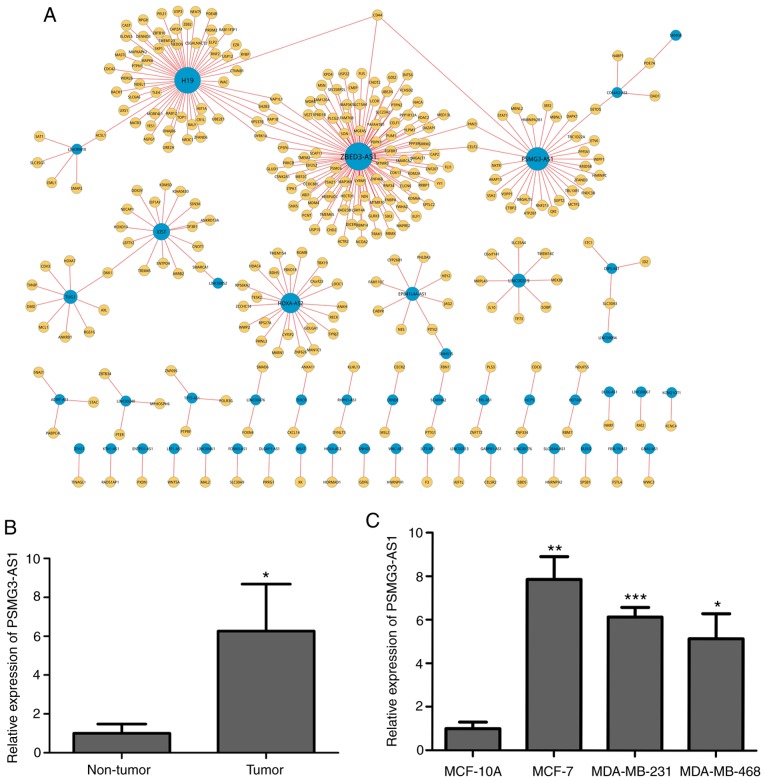
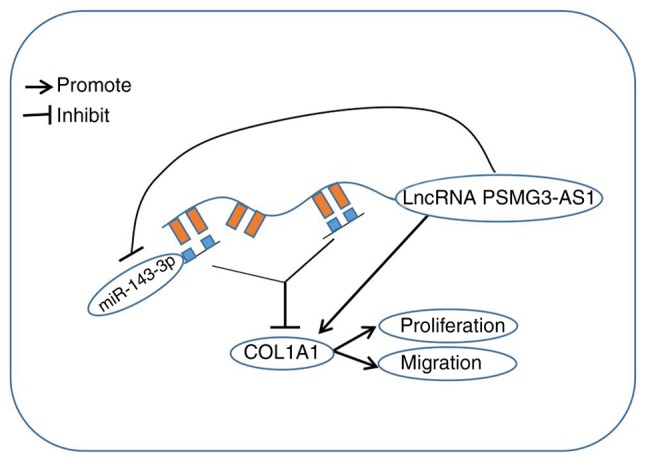
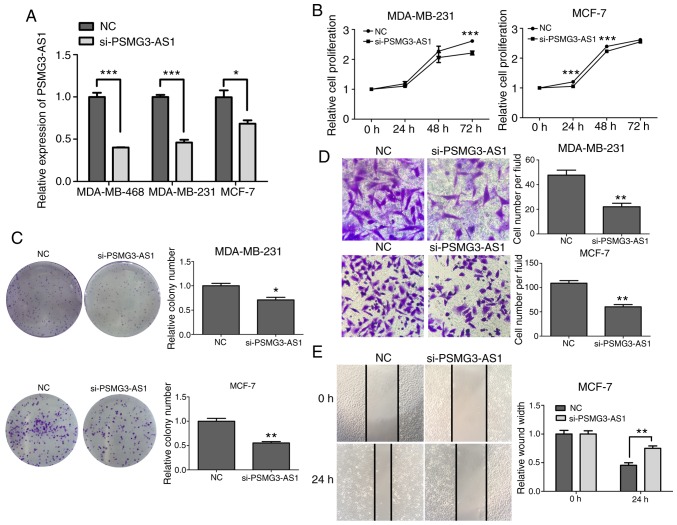
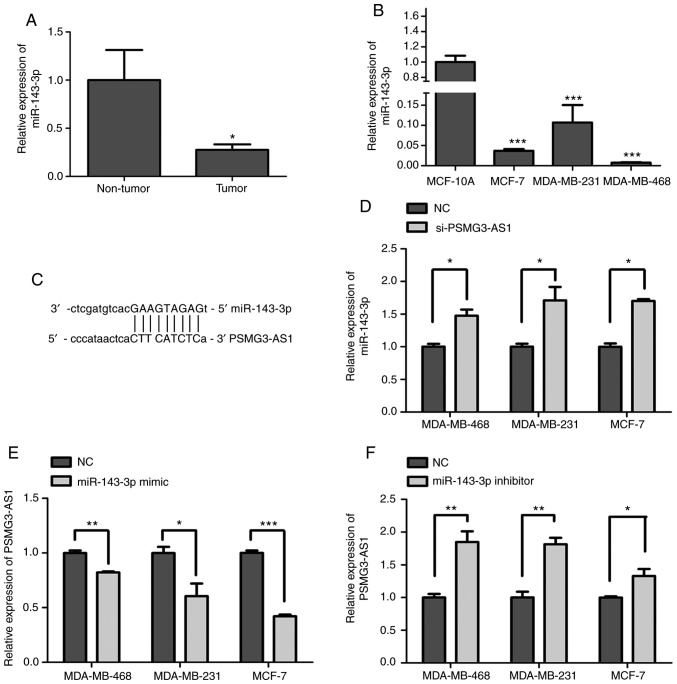
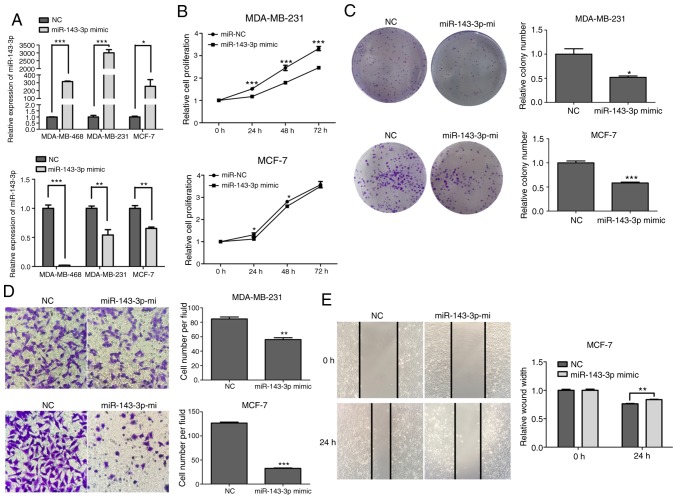
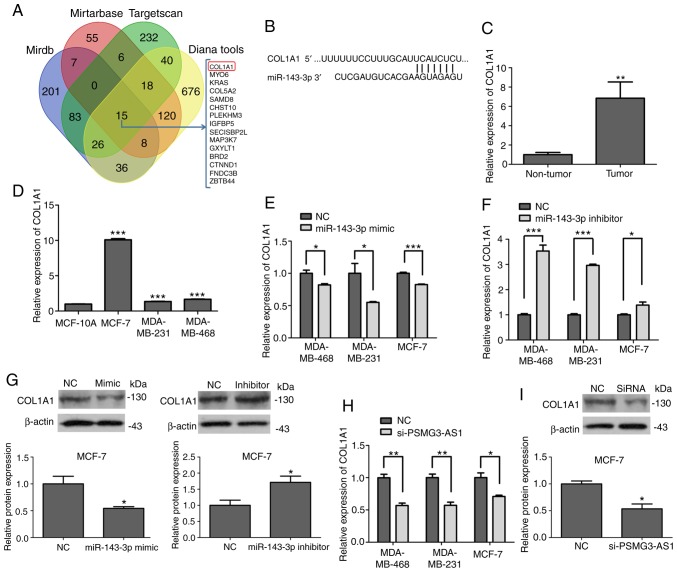
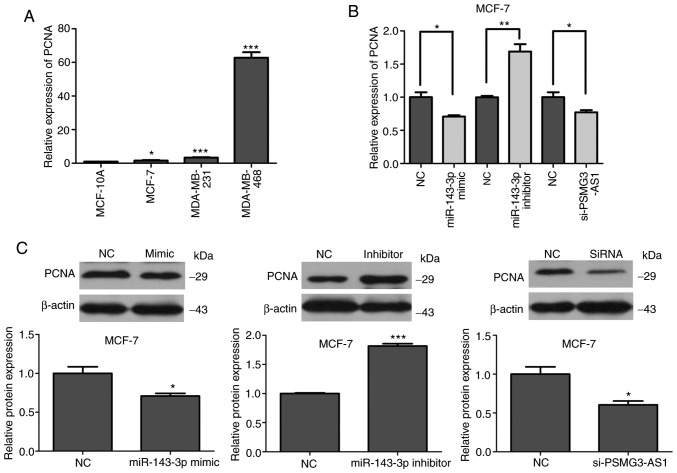
Long non‑coding RNAs (lncRNAs) are considered to be important regulators in breast cancer. In the present study, the potential mechanisms and functional roles of lncRNA PSMG3‑antisense (AS)1 were investigated in vivo and in vitro. The relative expression levels of lncRNA PSMG3‑AS1 and microRNA (miR)‑143‑3p were determined using reverse‑transcription quantitative PCR. The protein expression levels of collagen type 1 alpha 1 (COL1A1) and proliferating cell nuclear antigen (PCNA) were obtained using western blot analysis. Bioinformatics analysis was used to identify the relationship between PSMG3‑AS1, miR‑143‑3p and COL1A1. Colony forming and Cell Counting Kit‑8 assays were used to detect cell proliferation. Transwell and wound‑healing assays were used to determine cell migration. The results of the present study demonstrated that PSMG3‑AS1 expression was increased in breast cancer tumor tissues and cell lines, and that of miR‑143‑3p was decreased. Knockdown of PSMG3‑AS1 increased the level of miR‑143‑3p expression, which led to the mitigation of proliferation and migration capacity in breast carcinoma cells. Additionally, PSMG3‑AS1 knockdown was demonstrated to reduce the mRNA and protein expression levels of COL1A1. miR‑143‑3p mimic transfection reduced proliferation and migration in MDA‑MB‑231 and MCF‑7 cell lines. Furthermore, miR‑143‑3p inhibition significantly increased the proliferation and migration of breast cancer cells compared with the negative control group. The mRNA and protein expression levels of PCNA were reduced in the MCF‑7 cell line when transfected with miR‑143‑3p mimics and si‑PSMG3‑AS1. However, PCNA expression was increased in cells transfected with a miR‑143‑3p inhibitor. In conclusion, the results of the present study identified a novel lncRNA PSMG3‑AS1, which serves as a sponge for miR‑143‑3p in the pathogenesis of breast cancer. PSMG3‑AS1 may be used as a potential therapeutic target gene in breast cancer treatment.
长链非编码 RNA(lncRNA)被认为是乳腺癌的重要调控因子。在本研究中,研究人员在体内和体外研究了 lncRNA PSMG3-反义(AS)1 的潜在机制和功能作用。采用逆转录定量 PCR 测定 lncRNA PSMG3-AS1 和微小 RNA(miR)-143-3p 的相对表达水平。采用 Western blot 分析测定胶原蛋白 1 型α1(COL1A1)和增殖细胞核抗原(PCNA)的蛋白表达水平。采用生物信息学分析鉴定 PSMG3-AS1、miR-143-3p 和 COL1A1 之间的关系。采用集落形成和细胞计数试剂盒-8 检测细胞增殖。Transwell 和划痕愈合实验用于检测细胞迁移。本研究结果表明,PSMG3-AS1 在乳腺癌肿瘤组织和细胞系中的表达增加,而 miR-143-3p 的表达减少。PSMG3-AS1 敲低增加了 miR-143-3p 的表达水平,导致乳腺癌细胞增殖和迁移能力减弱。此外,PSMG3-AS1 敲低降低了 COL1A1 的 mRNA 和蛋白表达水平。miR-143-3p 模拟物转染降低了 MDA-MB-231 和 MCF-7 细胞系的增殖和迁移。此外,与阴性对照组相比,miR-143-3p 抑制剂转染显著增加了乳腺癌细胞的增殖和迁移。当用 miR-143-3p 模拟物和 si-PSMG3-AS1 转染 MCF-7 细胞系时,PCNA 的 mRNA 和蛋白表达水平降低。然而,当转染 miR-143-3p 抑制剂时,PCNA 表达增加。总之,本研究确定了一种新型 lncRNA PSMG3-AS1,它在乳腺癌的发病机制中作为 miR-143-3p 的海绵。PSMG3-AS1 可作为乳腺癌治疗的潜在治疗靶基因。