Chrast Lukas, Tratsiak Katsiaryna, Planas-Iglesias Joan, Daniel Lukas, Prudnikova Tatyana, Brezovsky Jan, Bednar David, Kuta Smatanova Ivana, Chaloupkova Radka, Damborsky Jiri
Loschmidt Laboratories, Department of Experimental Biology and RECETOX, Faculty of Science, Masaryk University, Kamenice 5/A13, 625 00 Brno, Czech Republic.
Institute of Chemistry and Biochemistry, Faculty of Science, University of South Bohemia Ceske Budejovice and Institute of Microbiology Academy of Sciences of the Czech Republic, Branisovska 1760, 370 05 Ceske Budejovice, Czech Republic.
Microorganisms. 2019 Oct 28;7(11):498. doi: 10.3390/microorganisms7110498.
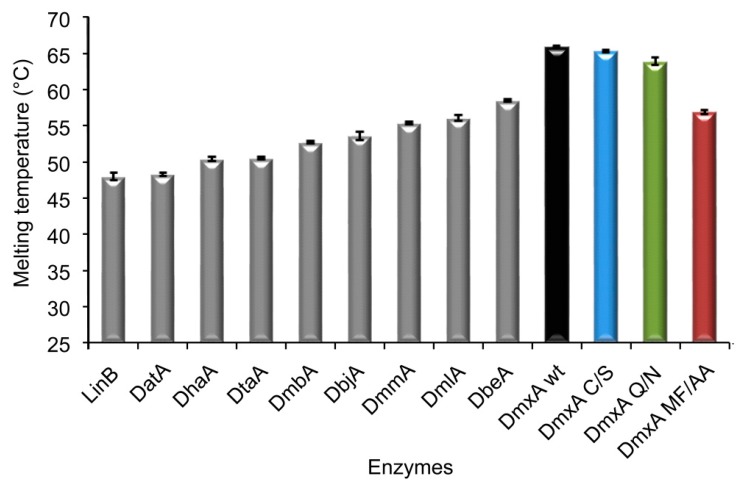
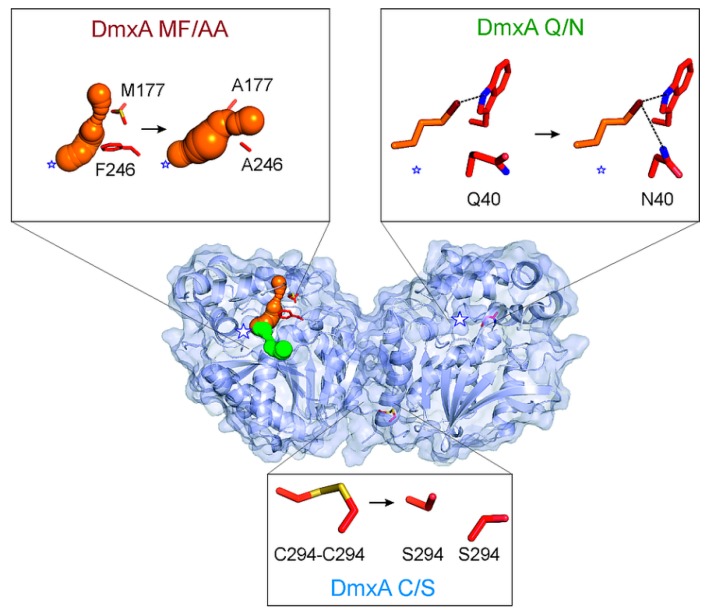
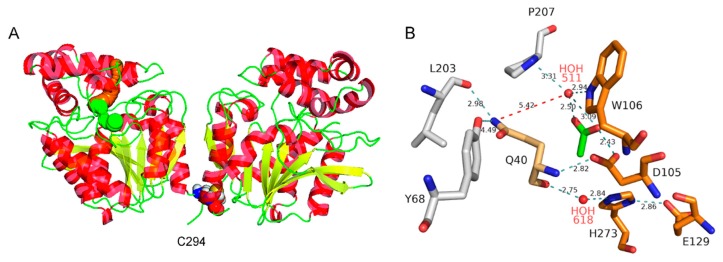
Haloalkane dehalogenases are enzymes with a broad application potential in biocatalysis, bioremediation, biosensing and cell imaging. The new haloalkane dehalogenase DmxA originating from the psychrophilic bacterium sp. ELB17 surprisingly possesses the highest thermal stability (apparent melting temperature = 65.9 °C) of all biochemically characterized wild type haloalkane dehalogenases belonging to subfamily II. The enzyme was successfully expressed and its crystal structure was solved at 1.45 Å resolution. DmxA structure contains several features distinct from known members of haloalkane dehalogenase family: (i) a unique composition of catalytic residues; (ii) a dimeric state mediated by a disulfide bridge; and (iii) narrow tunnels connecting the enzyme active site with the surrounding solvent. The importance of narrow tunnels in such paradoxically high stability of DmxA enzyme was confirmed by computational protein design and mutagenesis experiments.
卤代烷脱卤酶是一类在生物催化、生物修复、生物传感和细胞成像等领域具有广泛应用潜力的酶。源自嗜冷细菌ELB17的新型卤代烷脱卤酶DmxA令人惊讶地具有所有已进行生化表征的属于II亚家族的野生型卤代烷脱卤酶中最高的热稳定性(表观解链温度 = 65.9 °C)。该酶已成功表达,其晶体结构在1.45 Å分辨率下得到解析。DmxA的结构包含几个与卤代烷脱卤酶家族已知成员不同的特征:(i)催化残基的独特组成;(ii)由二硫键介导的二聚体状态;(iii)连接酶活性位点与周围溶剂的狭窄通道。通过计算蛋白质设计和诱变实验证实了狭窄通道在DmxA酶这种看似矛盾的高稳定性中的重要性。