Department of Chemistry, Indian Institute of Technology Kanpur, Kanpur, India.
Center for Laser and Photonics, Indian Institute of Technology Kanpur, Kanpur, India.
PLoS One. 2019 Oct 31;14(10):e0223688. doi: 10.1371/journal.pone.0223688. eCollection 2019.
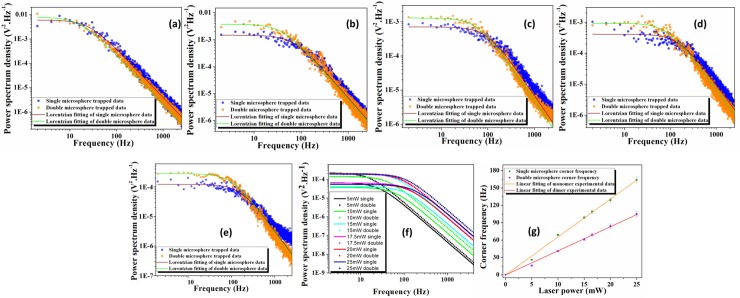
Insights into the morphology of nanoclusters would facilitate the design of nano-devices with improved optical, electrical, and magnetic responses. We have utilized optical gradient forces for the directed self-assembly of colloidal clusters using high-repetition-rate femtosecond laser pulses to delineate their structure and dynamics. We have ratified our experiments with theoretical models derived from the Langevin equation and defined the valid ranges of applicability. Our femtosecond optical tweezer-based technique characterizes the in-situ formation of hierarchical self-assembled clusters of homomers as well as heteromers by analyzing the back focal plane displacement signal. This technique is able to efficiently distinguish between nano-particles in heterogeneous clusters and is in accordance with our theory. Herein, we report results from our technique, and also develop a model to describe the mechanism of such processes where corner frequency changes. We show how the corner frequency changes enables us to recognize the structure and dynamics of the coagulation of colloidal homogeneous and heterogeneous clusters in condensed media over a broad range of nanoparticle sizes. The methods described here are advantageous, as the backscatter position-sensitive detection probes the in-situ self-assembly process while other light scattering approaches are leveraged for the characterization of isolated clusters.
深入了解纳米团簇的形态将有助于设计具有改进的光学、电学和磁学响应的纳米器件。我们利用光学梯度力,通过高重复率飞秒激光脉冲引导胶体团簇的自组装,以描绘其结构和动力学。我们利用朗之万方程推导出的理论模型对实验进行了验证,并定义了适用范围。我们的基于飞秒光镊的技术通过分析后焦面位移信号来表征同聚物和杂聚物的分级自组装团簇的原位形成。该技术能够有效地区分异质团簇中的纳米粒子,与我们的理论相符。在这里,我们报告了我们的技术的结果,并开发了一个模型来描述这种过程的机制,其中角频率发生变化。我们展示了角频率的变化如何使我们能够识别胶体同质和异质团簇在凝聚介质中的凝聚的结构和动力学,涵盖了广泛的纳米粒子尺寸范围。这里描述的方法具有优势,因为背散射位置敏感探测探针原位自组装过程,而其他光散射方法则用于表征孤立的团簇。