Yue Zonghao, Shen Yihao, Chen Yanjuan, Liang Anwen, Chu Cuiwei, Chen Can, Sun Zhongke
College of Life Sciences and Agronomy, Zhoukou Normal University, Zhoukou 466001, China.
Henan Key Laboratory of Plant Molecular Breeding and Bioreactor, Zhoukou 466001, China.
Microorganisms. 2019 Oct 29;7(11):508. doi: 10.3390/microorganisms7110508.
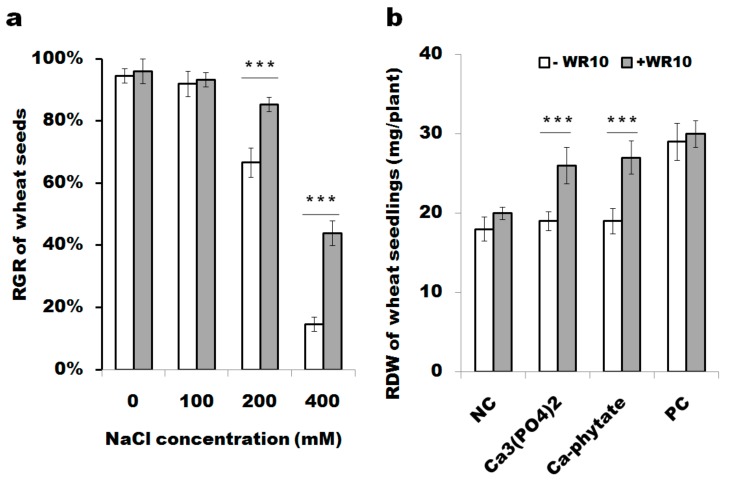
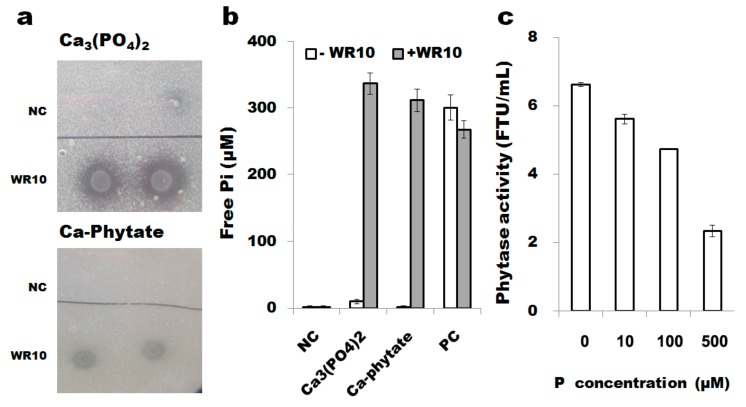
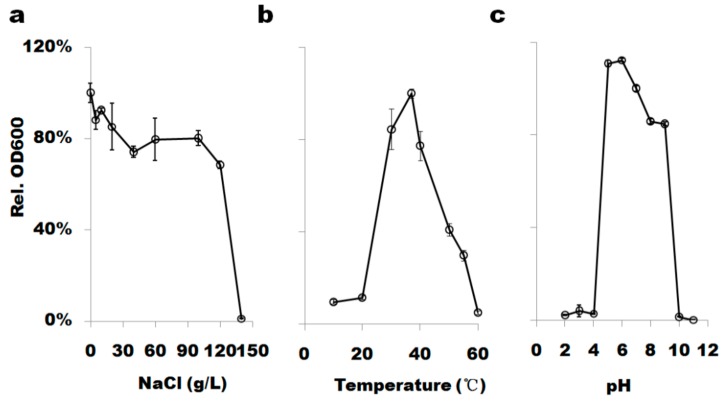
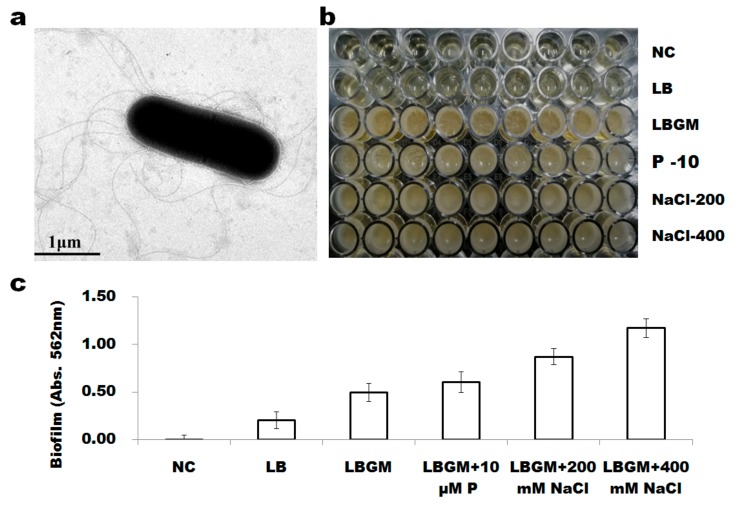
An indole-3-acetic acid producing WR10 was previously isolated from the root of wheat ( L.). In this study, the strain WR10 was used for relieving abiotic stresses in wheat under low phosphorus and high saline in hydroponic co-culture models. Significantly, strain WR10 improved wheat seed relative germination rate under salinity stress (200/400 mM NaCl) and the root dry weight in wheat seedlings under phosphorus stress (10 μM KHPO) when insoluble phosphates are available. To provide insights into its abiotic stress-alleviating properties, the strain was characterized further. WR10 grows well under different culture conditions. Particularly, WR10 resists salt (12% NaCl) and hydrolyzes both inorganic and organic insoluble phosphates. WR10 uses many plant-derived substrates as sole carbon and energy sources. It produces catalase, amylase, phosphatase, phytase, reductase, and 1-aminocyclopropane-1-carboxylate (ACC) deaminase. In addition, WR10 possesses long peritrichous flagella, and its biofilm formation, as well as phytase production, is induced by abiotic stresses. Overall, the salinity-alleviating property of WR10 in wheat can be attributed to its inherent tolerance to NaCl, formation of biofilm, and production of enzymes, like catalase, amylase, and ACC deaminase. Meanwhile, WR10 reduces low-phosphorus stress in wheat by production of phosphatases and phytases in the presence of insoluble phosphates.
先前从小麦(L.)根部分离出一株产吲哚 - 3 - 乙酸的WR10。在本研究中,菌株WR10被用于在水培共培养模型中缓解低磷和高盐条件下小麦的非生物胁迫。值得注意的是,在有不溶性磷酸盐存在的情况下,菌株WR10提高了盐胁迫(200/400 mM NaCl)下小麦种子的相对发芽率以及磷胁迫(10 μM KHPO)下小麦幼苗的根干重。为深入了解其缓解非生物胁迫的特性,对该菌株进行了进一步表征。WR10在不同培养条件下生长良好。特别是,WR10耐盐(12% NaCl),并能水解无机和有机不溶性磷酸盐。WR10利用多种植物衍生底物作为唯一碳源和能源。它能产生过氧化氢酶、淀粉酶、磷酸酶、植酸酶、还原酶和1 - 氨基环丙烷 - 1 - 羧酸(ACC)脱氨酶。此外,WR10具有长周生鞭毛,其生物膜形成以及植酸酶产生受非生物胁迫诱导。总体而言,WR10在小麦中的耐盐特性可归因于其对NaCl的固有耐受性、生物膜形成以及过氧化氢酶、淀粉酶和ACC脱氨酶等酶的产生。同时,WR10在有不溶性磷酸盐存在时通过产生磷酸酶和植酸酶来减轻小麦的低磷胁迫。