Crop and Environment Research Center, College of Agronomy, Hunan Agricultural University, Changsha, 410128, China.
Key Laboratory of Crop Physiology, Ecology and Genetic Breeding of Ministry of Education, Jiangxi Agricultural University, Nanchang, 330045, China.
Sci Rep. 2019 Oct 31;9(1):15786. doi: 10.1038/s41598-019-52376-2.
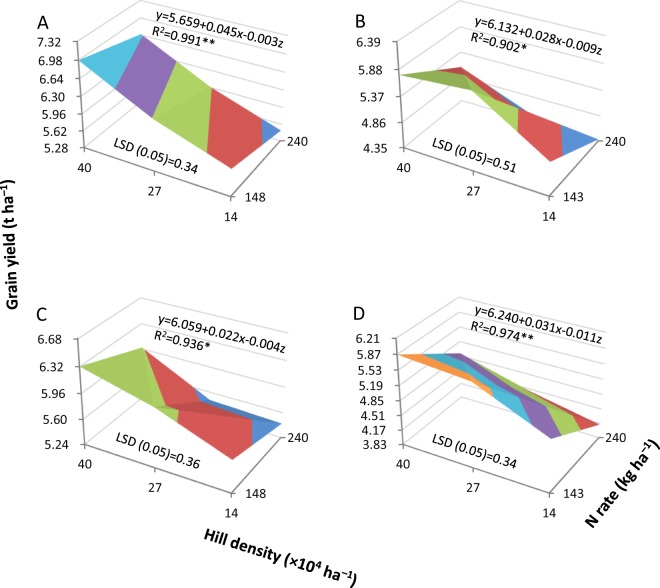
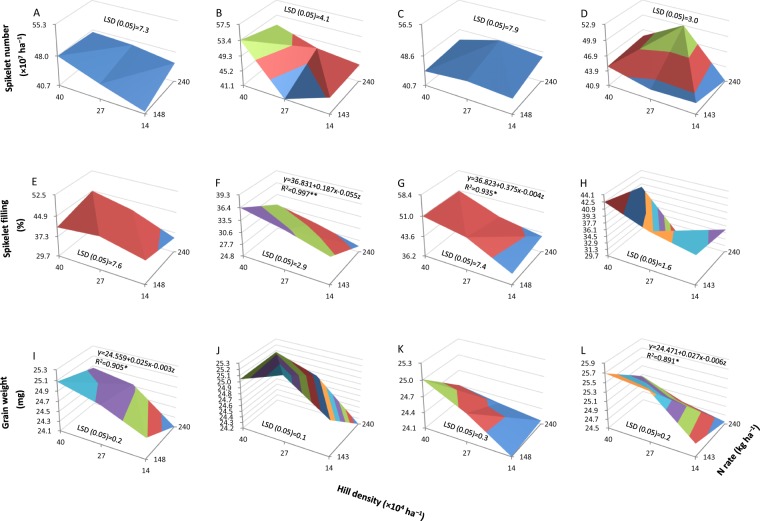
Low light is a common environmental factor that adversely affects rice yields. This study was conducted to evaluate the combined effect of hill density and nitrogen (N) fertilizer rate on yield attributes in hybrid rice under low-light conditions. Field experiments were conducted in 2014 and 2015. Two hybrid rice cultivars (Y-liangyou 1 and Luoyou 9348) were grown under combinations of three hill density levels (high, 40 × 10 hills ha; moderate, 27 × 10 hills ha; low, 14 × 10 hills ha) and two N rate levels (high, 240 kg ha; moderate, 143-148 kg ha), and shaded from heading to maturity. Grain yield was highest in the combination of high hill density and moderate N rate and significantly declined with decreasing hill density combined with increasing N rate for both cultivars in both years. Averaged across two cultivars and two years, grain yield declined by about 4% for each 10% decrease in hill density combined with each 10% increase in N rate. A significant reduction in spikelet filling percentage was observed with decreasing hill density combined with increasing N rate in Y-liangyou 1 in 2015 and Luoyou 9348 in 2014. The same trend was observed for grain weight in Y-liangyou 1 in 2014 and Luoyou 9348 in 2015. These results indicate that adopting the practice of decreasing hill density combined with increasing N rate can result in poor grain filling and consequently yield decline in hybrid rice under low-light conditions.
弱光是影响水稻产量的常见环境因素。本研究旨在评估在弱光条件下,杂交稻的行株距和氮肥用量对产量性状的综合影响。试验于 2014 年和 2015 年在大田进行。选用两个杂交稻品种(Y-两优 1 号和隆两优 9348),设置 3 个行株距水平(高密度,40×10 蔸/公顷;中密度,27×10 蔸/公顷;低密度,14×10 蔸/公顷)和 2 个氮肥用量水平(高氮,240 公斤/公顷;中氮,143-148 公斤/公顷),并在抽穗至成熟期间遮光处理。结果表明,在两个品种和两年的试验中,高行株距和中氮水平的组合产量最高,随着行株距的降低和氮肥用量的增加,产量显著下降。两个品种两年的平均产量,每行株距降低 10%,氮肥用量增加 10%,产量下降约 4%。在 2015 年的 Y-两优 1 号和 2014 年的隆两优 9348 中,随着行株距的降低和氮肥用量的增加,结实率显著降低。在 2014 年的 Y-两优 1 号和 2015 年的隆两优 9348 中,谷粒重也表现出同样的趋势。这些结果表明,在弱光条件下,采用降低行株距和增加氮肥用量的措施可能导致杂交稻籽粒灌浆不良,从而导致产量下降。