Banini Bubu A, Sanyal Arun J
Division of Gastroenterology, Hepatology and Nutrition, Department of Internal Medicine, Virginia Commonwealth University, Richmond, VA 23298, USA.
Hepatoma Res. 2019;5. doi: 10.20517/2394-5079.2019.30. Epub 2019 Sep 23.
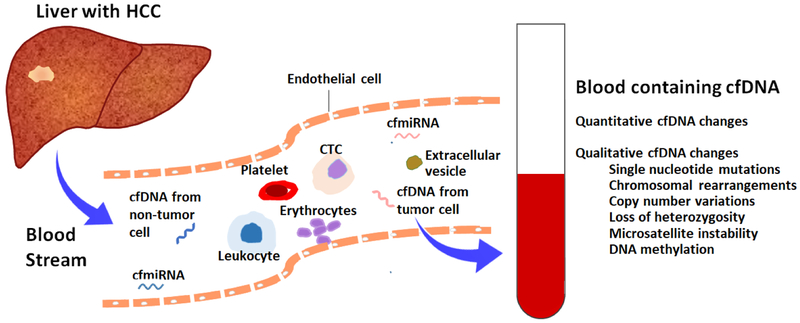
Hepatocellular carcinoma (HCC) is one of the most common malignant tumors worldwide and is associated with high mortality. The currently used methods for diagnosing HCC, including imaging modalities and liver biopsy, detect tumors at a relatively advanced stage or are invasive. Non-invasive biomarkers are urgently needed to facilitate screening and early diagnosis of HCC, as well as treatment monitoring and detection of tumor recurrence. Liquid biopsy, the analysis of blood or other body fluids to obtain genetic and epigenetic information, has historically been applied to other types of cancer including breast and prostate cancer. Over the past few decades, liquid biopsy analysis has shed significant insights on genetic and epigenetic aberrations in HCC detectable in peripheral blood. Aberrations in nucleic acids found circulating freely in body fluids or contained within extracellular vesicles such as exosomes or microvesicles show potential clinical utility as non-invasive biomarkers. In this review, we present available literature on cell-free nucleic acids in the diagnosis of HCC.
肝细胞癌(HCC)是全球最常见的恶性肿瘤之一,死亡率很高。目前用于诊断HCC的方法,包括成像方式和肝活检,在相对晚期才能检测到肿瘤,或者具有侵入性。迫切需要非侵入性生物标志物来促进HCC的筛查和早期诊断,以及治疗监测和肿瘤复发检测。液体活检,即分析血液或其他体液以获取遗传和表观遗传信息,历史上已应用于包括乳腺癌和前列腺癌在内的其他类型癌症。在过去几十年中,液体活检分析对在外周血中可检测到的HCC的遗传和表观遗传异常有了重要见解。在体液中自由循环或包含在细胞外囊泡(如外泌体或微泡)中的核酸异常显示出作为非侵入性生物标志物的潜在临床应用价值。在本综述中,我们介绍了关于游离核酸在HCC诊断中的现有文献。