School of Biological Sciences, Washington State University, Pullman, Washington, 99164, USA.
Global Lands Program, The Nature Conservancy, Fort Collins, Colorado, 80524, USA.
Ecol Appl. 2020 Mar;30(2):e02031. doi: 10.1002/eap.2031. Epub 2019 Dec 2.
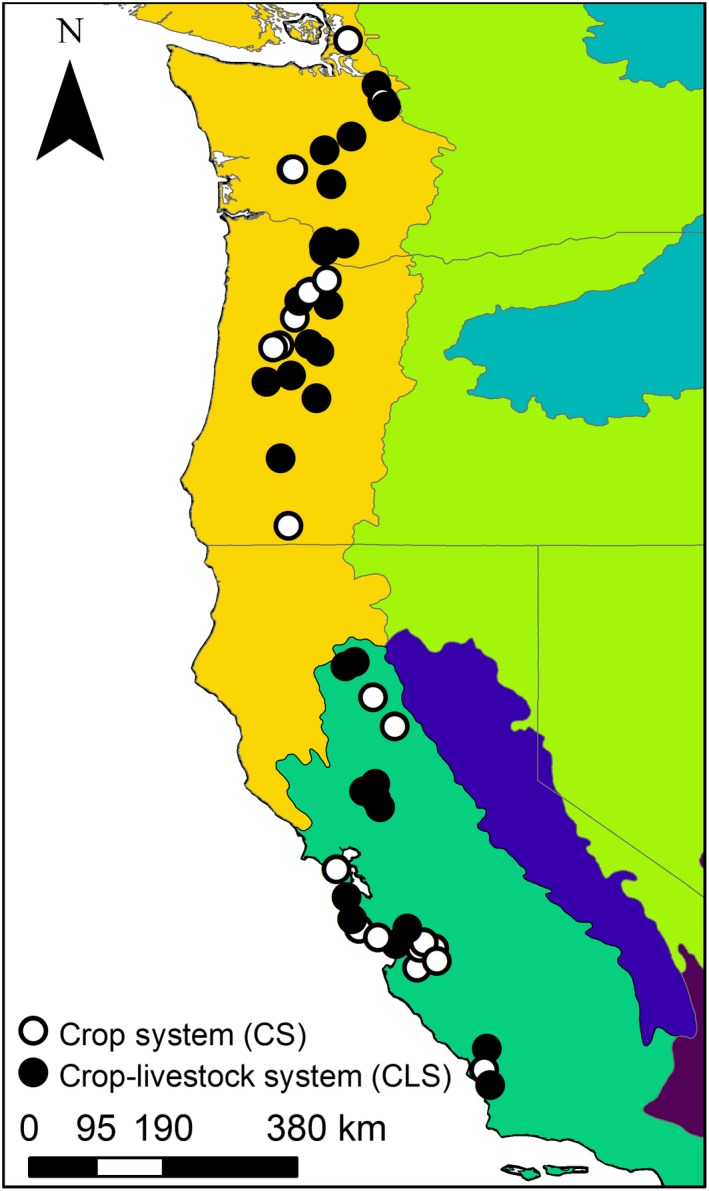
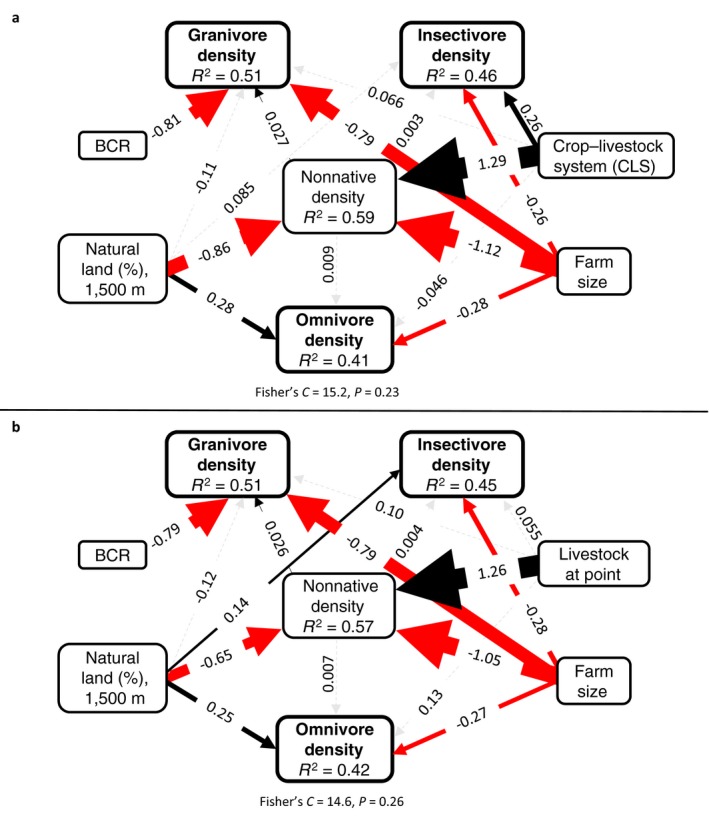
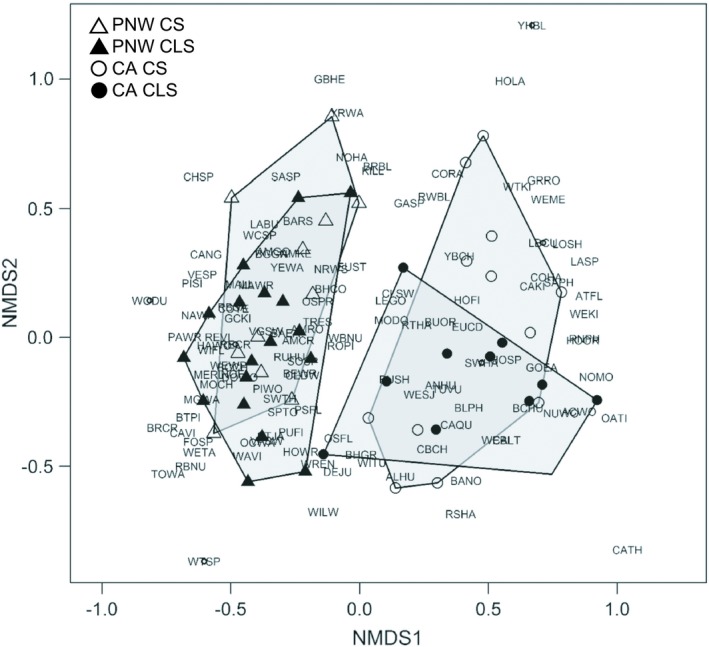
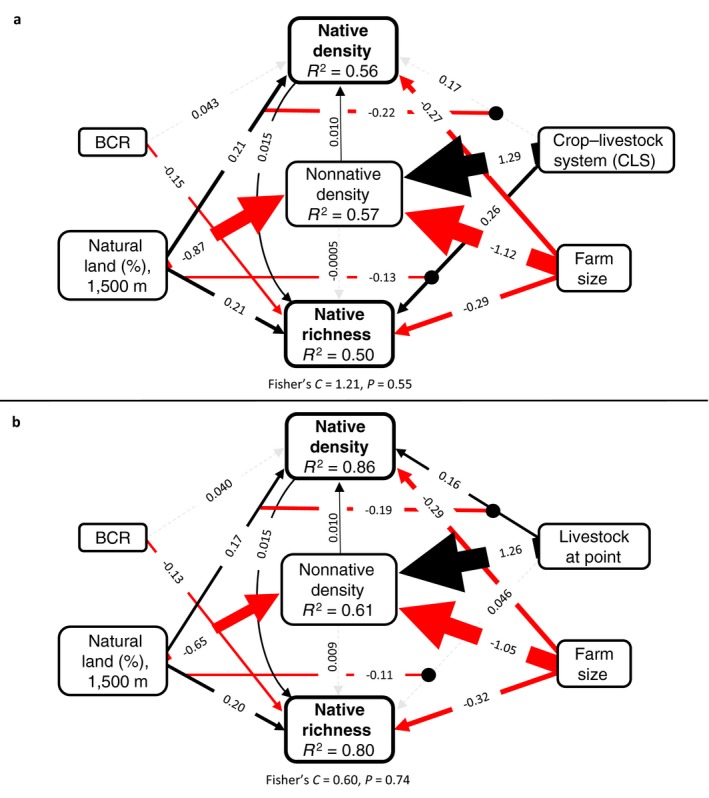
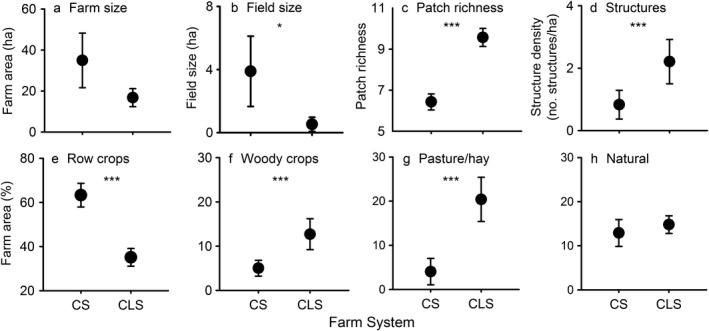
Agricultural intensification is a leading threat to bird conservation. Highly diversified farming systems that integrate livestock and crop production might promote a diversity of habitats useful to native birds foraging across otherwise-simplified landscapes. At the same time, these features might be attractive to nonnative birds linked to a broad range of disservices to both crop and livestock production. We evaluated the influence of crop-livestock integration on wild bird richness and density along a north-south transect spanning the U.S. West Coast. We surveyed birds on 52 farms that grew primarily mixed vegetables and fruits alone or integrated livestock into production. Crop-livestock systems harbored higher native bird density and richness relative to crop-only farms, a benefit more pronounced on farms embedded in nonnatural landscapes. Crop-livestock systems bolstered native insectivores linked to the suppression of agricultural pest insects but did not bolster native granivores that may be more likely to damage crops. Crop-livestock systems also significantly increased the density of nonnative birds, primarily European Starlings (Sturnus vulgaris) and House Sparrows (Passer domesticus) that may compete with native birds for resources. Models supported a small, positive correlation between nonnative density and overall native bird density as well as between nonnative density and native granivore density. Relative to crop-only farms, on average, crop-livestock systems exhibited 1.5 times higher patch richness, 2.4 times higher density of farm structures, 7.3 times smaller field sizes, 2.4 times greater integration of woody crops, and 5.3 times greater integration of pasture/hay habitat on farm. Wild birds may have responded to this habitat diversity and/or associated food resources. Individual farm factors had significantly lower predictive power than farming system alone (change in C statistic information criterion (ΔCIC) = 80.2), suggesting crop-livestock systems may impact wild birds through a suite of factors that change with system conversion. Collectively, our findings suggest that farms that integrate livestock and crop production can attract robust native bird communities, especially within landscapes devoted to intensified food production. However, additional work is needed to demonstrate persistent farm bird communities through time, ecophysiological benefits to birds foraging on these farms, and net effects of both native and nonnative wild birds in agroecosystems.
农业集约化是鸟类保护的主要威胁。高度多样化的农牧结合系统可以促进栖息地的多样化,有利于在原本简化的景观中觅食的本地鸟类。与此同时,这些特征可能对与作物和畜牧业生产的广泛不利因素有关的非本地鸟类具有吸引力。我们评估了沿美国西海岸南北向地带的农牧结合对野生鸟类丰富度和密度的影响。我们调查了 52 个主要种植混合蔬菜和水果的农场或在生产中结合了牲畜的农场的鸟类。与仅种植作物的农场相比,农牧结合系统的本地鸟类密度和丰富度更高,在非自然景观中的农场中这种益处更为明显。农牧结合系统支持与农业害虫抑制有关的本地食虫鸟类,但并未支持可能更有可能破坏作物的本地食谷鸟类。农牧结合系统还显著增加了非本地鸟类的密度,主要是欧洲椋鸟(Sturnus vulgaris)和家麻雀(Passer domesticus),它们可能与本地鸟类争夺资源。模型支持非本地密度与本地鸟类密度之间存在小的正相关关系,以及非本地密度与本地食谷动物密度之间存在正相关关系。与仅种植作物的农场相比,平均而言,农牧结合系统具有高出 1.5 倍的斑块丰富度,高出 2.4 倍的农场结构密度,小 7.3 倍的田地面积,高出 2.4 倍的木本作物整合度,高出 5.3 倍的牧场/干草栖息地整合度。野生鸟类可能对这种栖息地多样性和/或相关食物资源做出了反应。单个农场因素的预测能力明显低于单独的农业系统(变化的信息准则(ΔCIC)统计量= 80.2),这表明农牧结合系统可能通过一系列随系统转换而变化的因素来影响野生鸟类。总的来说,我们的研究结果表明,结合了牲畜和作物生产的农场可以吸引丰富的本地鸟类群落,尤其是在致力于集约化粮食生产的景观中。然而,还需要进一步的工作来证明随着时间的推移,农场鸟类群落的持续存在,这些农场的鸟类觅食的生态生理益处,以及农业生态系统中本地和非本地野生鸟类的净效应。