Department of Bioengineering, Stanford University, Stanford, CA 94305, USA.
Graduate Program in Biophysics, Stanford University, Stanford, CA 94305, USA.
Curr Biol. 2019 Nov 18;29(22):3838-3850.e3. doi: 10.1016/j.cub.2019.09.034. Epub 2019 Oct 31.
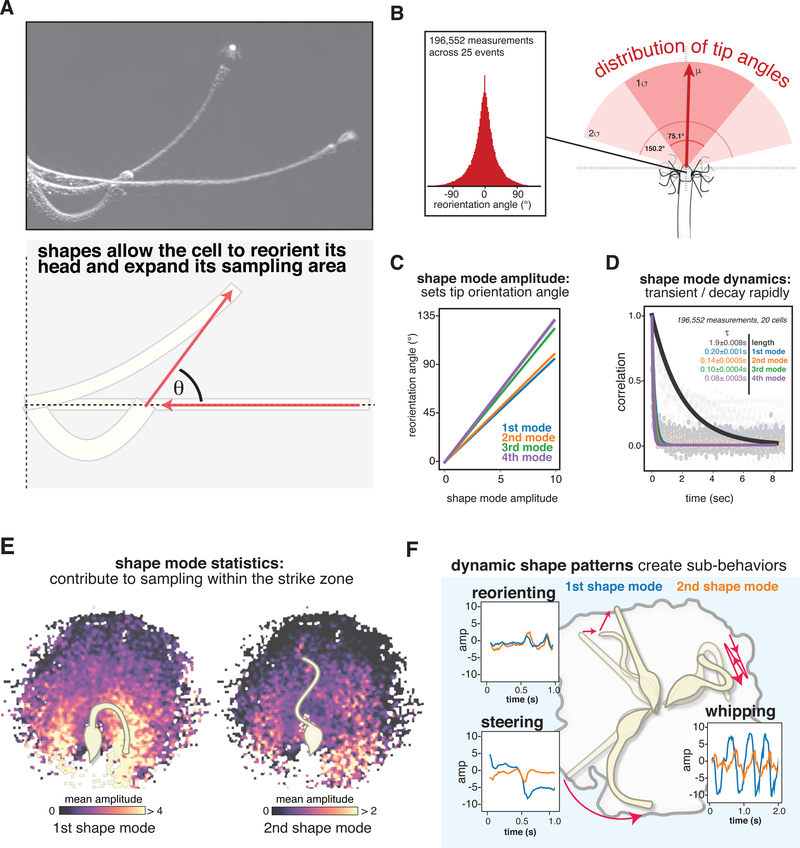
Many single-celled protists use rapid morphology changes to perform fast animal-like behaviors. To understand how such behaviors are encoded, we analyzed the hunting dynamics of the predatory ciliate Lacrymaria olor, which locates and captures prey using the tip of a slender "neck" that can rapidly extend more than seven times its body length (500 μm from its body) and retract in seconds. By tracking single cells in real-time over hours and analyzing millions of sub-cellular postures, we find that these fast extension-contraction cycles underlie an emergent hunting behavior that comprehensively samples a broad area within the cell's reach. Although this behavior appears complex, we show that it arises naturally as alternating sub-cellular ciliary and contractile activities rearrange the cell's underlying helical cytoskeleton to extend or retract the neck. At short timescales, a retracting neck behaves like an elastic filament under load, such that compression activates a series of buckling modes that reorient the head and scramble its extensile trajectory. At longer timescales, the fundamental length of this filament can change, altering the location in space where these transitions occur. Coupling these fast and slow dynamics together, we present a simple model for how Lacrymaria samples the range of geometries and orientations needed to ensure dense stochastic sampling of the immediate environment when hunting to locate and strike at prey. More generally, coupling active mechanical and chemical signaling systems across different timescales may provide a general strategy by which mechanically encoded emergent cell behaviors can be understood or engineered.
许多单细胞原生动物利用快速的形态变化来执行类似动物的快速行为。为了了解这些行为是如何编码的,我们分析了捕食性纤毛虫 Lacrymaria olor 的捕猎动态,该纤毛虫利用细长的“颈部”的尖端定位和捕获猎物,颈部可以迅速延伸超过其体长的七倍(从身体延伸 500μm),并在几秒钟内缩回。通过实时跟踪单个细胞数小时,并分析数百万个亚细胞姿势,我们发现这些快速的伸缩循环是一种新兴的捕猎行为的基础,该行为全面地在细胞可及范围内广泛采样。尽管这种行为看起来很复杂,但我们表明,它是自然产生的,因为交替的亚细胞纤毛和收缩活动重新排列细胞的螺旋细胞骨架,以延伸或缩回颈部。在短时间尺度上,缩回的颈部在负载下表现为弹性细丝,因此压缩会激活一系列使头部重新定向并打乱其延伸轨迹的屈曲模式。在较长的时间尺度上,该细丝的基本长度可以改变,从而改变这些转变发生的空间位置。将这些快速和缓慢的动力学结合在一起,我们提出了一个简单的模型,用于解释 Lacrymaria 如何在捕猎时采样所需的几何形状和方向范围,以确保对周围环境进行密集的随机采样,从而定位和攻击猎物。更一般地说,在不同的时间尺度上耦合主动机械和化学信号系统可能为理解或设计机械编码的新兴细胞行为提供一种通用策略。