Department of Clinical Physiology, Växjö Central Hospital, Växjö, Sweden.
Department of Research and Development, Region Kronoberg, Växjö, Sweden.
Scand J Prim Health Care. 2019 Dec;37(4):426-433. doi: 10.1080/02813432.2019.1684429. Epub 2019 Nov 4.
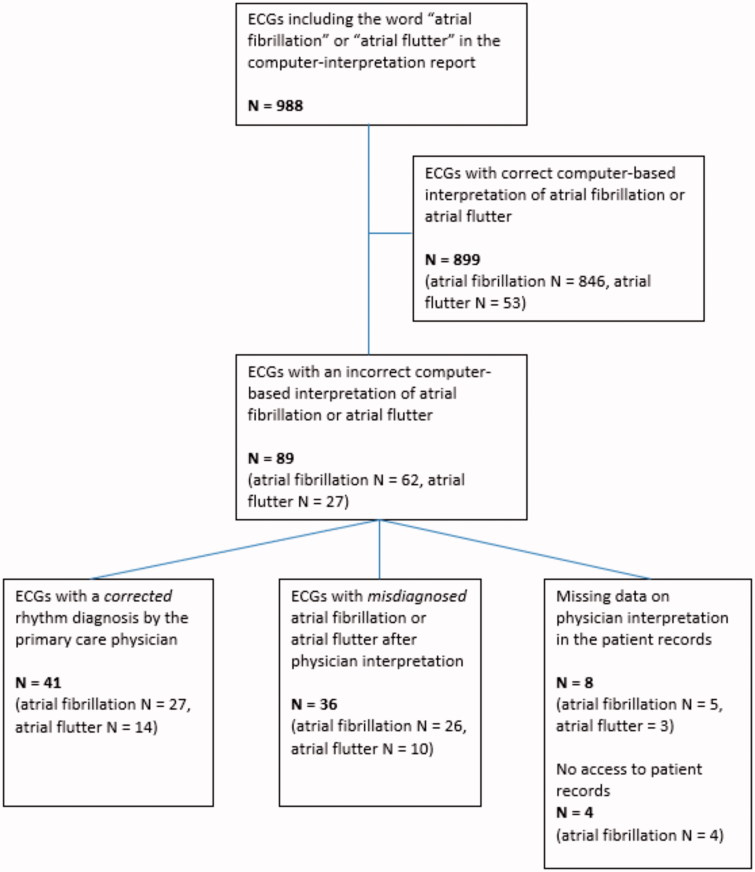
To describe the incidence of incorrect computerized ECG interpretations of atrial fibrillation or atrial flutter in a Swedish primary care population, the rate of correction of computer misinterpretations, and the consequences of misdiagnosis. Retrospective expert re-analysis of ECGs with a computer-suggested diagnosis of atrial fibrillation or atrial flutter. Primary health care in Region Kronoberg, Sweden. All adult patients who had an ECG recorded between January 2016 and June 2016 with a computer statement including the words 'atrial fibrillation' or 'atrial flutter'. Number of incorrect computer interpretations of atrial fibrillation or atrial flutter; rate of correction by the interpreting primary care physician; consequences of misdiagnosis of atrial fibrillation or atrial flutter. Among 988 ECGs with a computer diagnosis of atrial fibrillation or atrial flutter, 89 (9.0%) were incorrect, among which 36 were not corrected by the interpreting physician. In 12 cases, misdiagnosed atrial fibrillation/flutter led to inappropriate treatment with anticoagulant therapy. A larger proportion of atrial flutters, 27 out of 80 (34%), than atrial fibrillations, 62 out of 908 (7%), were incorrectly diagnosed by the computer. Among ECGs with a computer-based diagnosis of atrial fibrillation or atrial flutter, the diagnosis was incorrect in almost 10%. In almost half of the cases, the misdiagnosis was not corrected by the overreading primary-care physician. Twelve patients received inappropriate anticoagulant treatment as a result of misdiagnosis.Key pointsData regarding the incidence of misdiagnosed atrial fibrillation or atrial flutter in primary care are lacking. In a Swedish primary care setting, computer-based ECG interpretations of atrial fibrillation or atrial flutter were incorrect in 89 of 988 (9.0%) consecutive cases.Incorrect computer diagnoses of atrial fibrillation or atrial flutter were not corrected by the primary-care physician in 47% of cases.In 12 of the cases with an incorrect computer rhythm diagnosis, misdiagnosed atrial fibrillation or flutter led to inappropriate treatment with anticoagulant therapy.
描述在瑞典初级保健人群中计算机错误解读心房颤动或心房扑动的发生率、纠正计算机错误解读的速度以及误诊的后果。对心电图进行计算机提示诊断为心房颤动或心房扑动的回顾性专家重新分析。瑞典 Kronoberg 地区的初级保健。2016 年 1 月至 2016 年 6 月期间,所有接受心电图记录的成年患者,计算机记录的心电图中有“心房颤动”或“心房扑动”字样。心房颤动或心房扑动的计算机错误解读的数量;初级保健医生纠正的速度;心房颤动或心房扑动误诊的后果。在 988 份计算机诊断为心房颤动或心房扑动的心电图中,有 89 份(9.0%)不正确,其中 36 份未被解释医生纠正。在 12 例中,心房颤动/扑动的误诊导致了抗凝治疗的不当治疗。计算机错误诊断的心房扑动比例较高,80 例中的 27 例(34%)高于心房颤动,908 例中的 62 例(7%)。在基于计算机的心房颤动或心房扑动诊断的心电图中,近 10%的诊断是错误的。在近一半的情况下,过度阅读的初级保健医生未纠正误诊。由于误诊,12 名患者接受了不当的抗凝治疗。关键点关于初级保健中误诊的心房颤动或心房扑动发生率的数据缺乏。在瑞典初级保健环境中,连续 988 例中的 89 例(9.0%)心电图的计算机解读错误。初级保健医生未纠正 47%的情况下计算机诊断的心房颤动或心房扑动错误。在 12 例计算机节律诊断错误的情况下,误诊的心房颤动或扑动导致了抗凝治疗的不当治疗。