Department of Internal Medicine B, University Medicine Greifswald, Ferdinand-Sauerbruch-Straße, 17475, Greifswald, Germany.
German Center for Diabetes Research (DZD), Partner Site Greifswald, Greifswald, Germany.
Cardiovasc Diabetol. 2019 Nov 4;18(1):145. doi: 10.1186/s12933-019-0948-4.
Mortality attributable to heart failure remains high. The prevalence of heart failure in patients with diabetes mellitus ranges from 19 to 26%. It is estimated that up to 21.1 million adults in the United States have diagnosed diabetes mellitus and around 80.8 million have impaired fasting glucose. We investigated the associations of fasting glucose (FG) and fasting insulin (FI), the homeostasis model assessment-insulin resistance index (HOMA-IR) and 2-h postload glucose (2HG) and insulin (2HI) with parameters of left ventricular geometry and function and arterial stiffness determined by magnetic resonance imaging in individuals without diagnosed type 2 diabetes.
Cross-sectional analyses of 1001 individuals (453 women, 45.3%), aged 21 to 80 years, from two independent population-based studies, the Study of Health in Pomerania (SHIP-TREND-0) and KORA FF4 Study. FG, FI, HOMA-IR, 2HG and 2HI, as well as glucose tolerance categories, were analyzed for associations with heart and arterial parameters using multivariable-adjusted linear regression models.
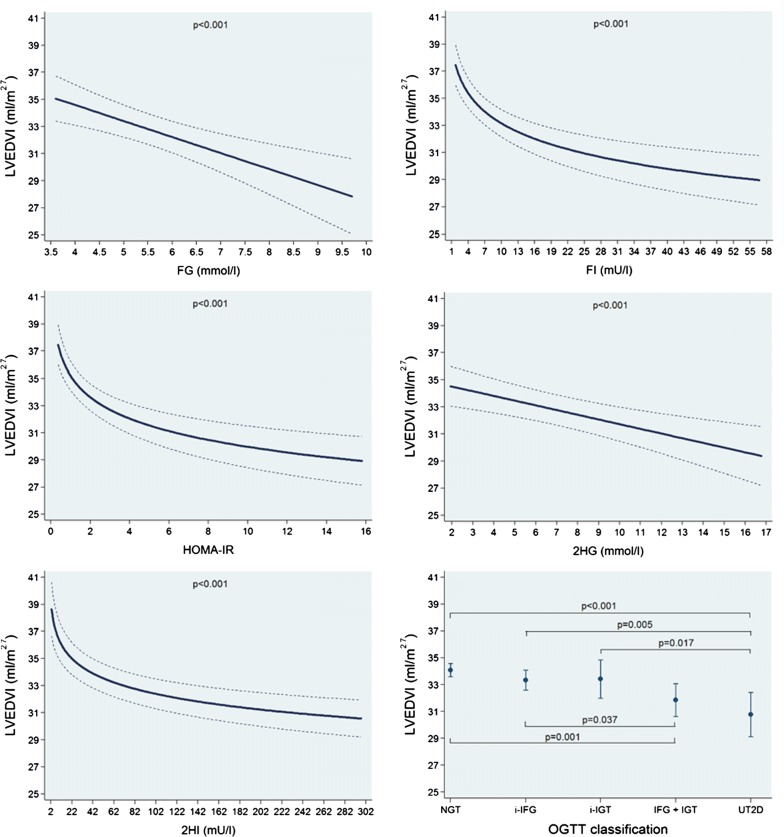
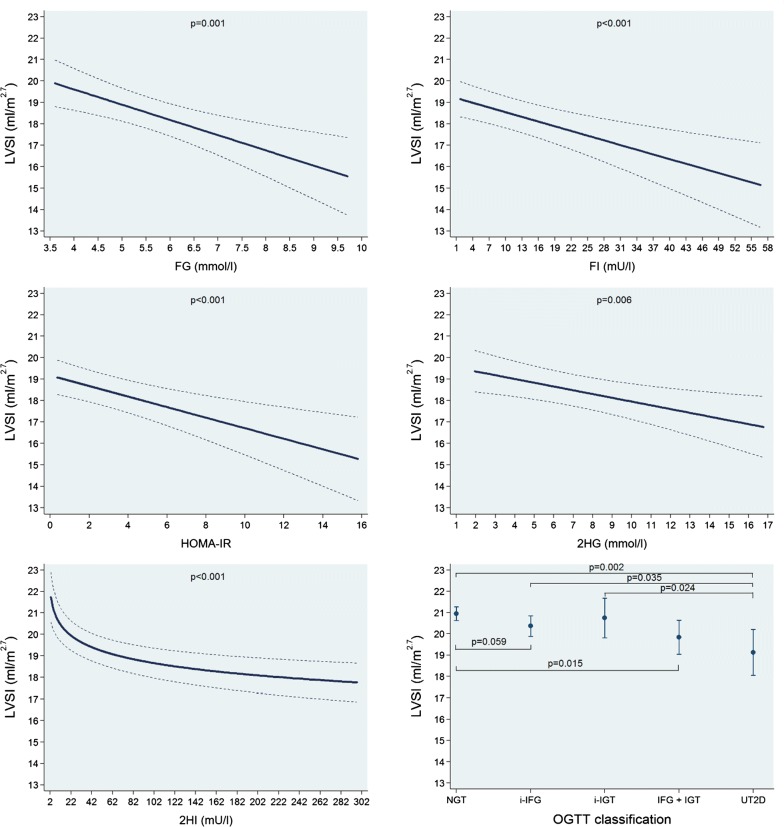
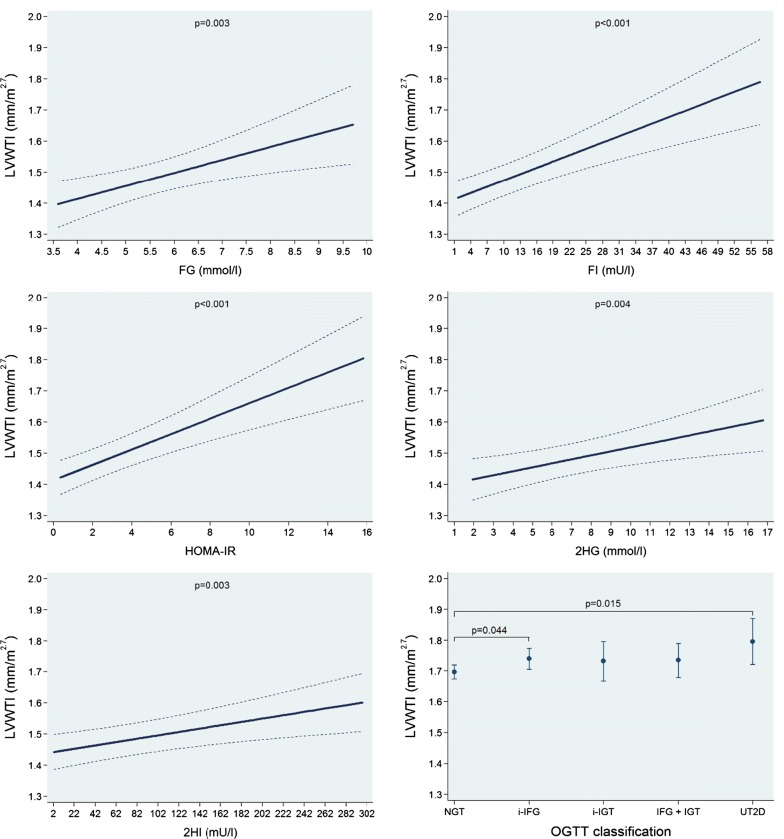
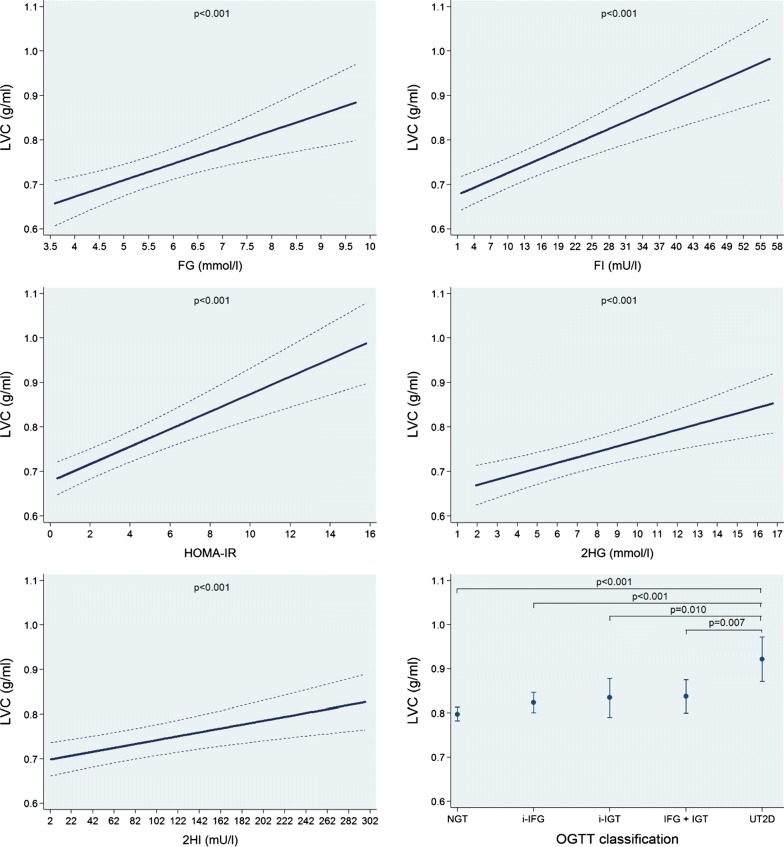
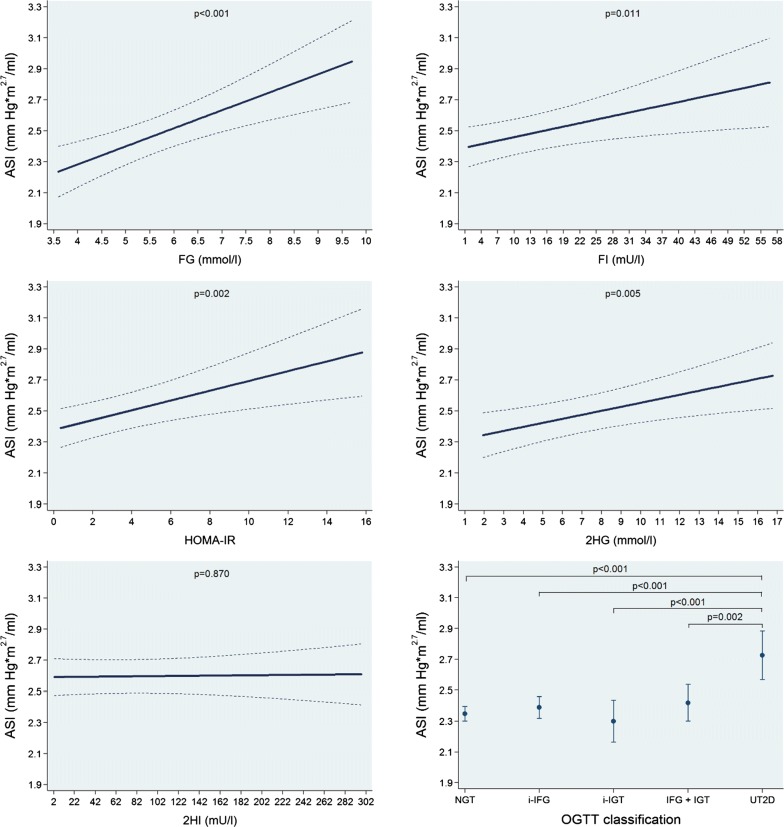
In total, 390 individuals (39%) had prediabetes (isolated impaired fasting glucose, isolated glucose tolerance or both), and 49 (4.9%) were found to have unknown type 2 diabetes. In the multivariable-adjusted analysis, positive linear associations of FG, FI, HOMA-IR, 2HG and 2HI with arterial stiffness index and left ventricular wall-thickness and concentricity and inverse linear associations with left ventricular end-diastolic volume were observed. A 1 mmol/l higher FG was associated with a 1.18 ml/m (1.80 to 0.57; p < 0.001) lower left ventricular end-diastolic volume index, a 0.042 mm/m (0.014 to 0.070) higher left ventricular wall-thickness index, a 0.12 mmHg m/ml (0.06 to 0.17; p < 0.001) greater arterial stiffness index and a 0.037 g/ml (0.018 to 0.056; p < 0.001) higher left ventricular concentricity.
Our findings suggest that higher glucose levels in the prediabetic range and insulin resistance might lead to higher arterial stiffness and concentric remodeling of the heart.
心力衰竭导致的死亡率仍然很高。糖尿病患者中心力衰竭的患病率为 19%至 26%。据估计,美国有多达 2110 万成年人被诊断患有糖尿病,约 8080 万人有空腹血糖受损。我们研究了空腹血糖(FG)和空腹胰岛素(FI)、稳态模型评估胰岛素抵抗指数(HOMA-IR)以及 2 小时餐后血糖(2HG)和胰岛素(2HI)与磁共振成像确定的无 2 型糖尿病个体的左心室几何和功能以及动脉僵硬度参数之间的关系。
对来自两个独立的基于人群的研究(波美拉尼亚研究[SHIP-TREND-0]和 KORA FF4 研究)的 1001 名年龄在 21 至 80 岁的个体(453 名女性,45.3%)进行横断面分析。使用多变量调整线性回归模型分析 FG、FI、HOMA-IR、2HG 和 2HI 以及葡萄糖耐量类别与心脏和动脉参数的关系。
共有 390 名个体(39%)患有糖尿病前期(孤立性空腹血糖受损、孤立性葡萄糖耐量受损或两者兼有),49 名个体(4.9%)被发现患有未知的 2 型糖尿病。在多变量调整分析中,观察到 FG、FI、HOMA-IR、2HG 和 2HI 与动脉僵硬度指数以及左心室壁厚度和向心性呈正线性关联,与左心室舒张末期容积呈负线性关联。FG 每升高 1mmol/l,左心室舒张末期容积指数降低 1.18ml/m(1.80 至 0.57;p<0.001),左心室壁厚度指数升高 0.042mm/m(0.014 至 0.070),动脉僵硬度指数升高 0.12mmHg/ml(0.06 至 0.17;p<0.001),左心室向心性升高 0.037g/ml(0.018 至 0.056;p<0.001)。
我们的研究结果表明,糖尿病前期范围内的血糖升高和胰岛素抵抗可能导致更高的动脉僵硬度和心脏向心性重塑。