Departamento de Ciencias Biológicas, Universidad de los Andes, Bogotá, Cundinamarca, Colombia.
Smithsonian Tropical Research Institute, Panamá, República de Panamá.
PLoS One. 2019 Nov 6;14(11):e0224218. doi: 10.1371/journal.pone.0224218. eCollection 2019.
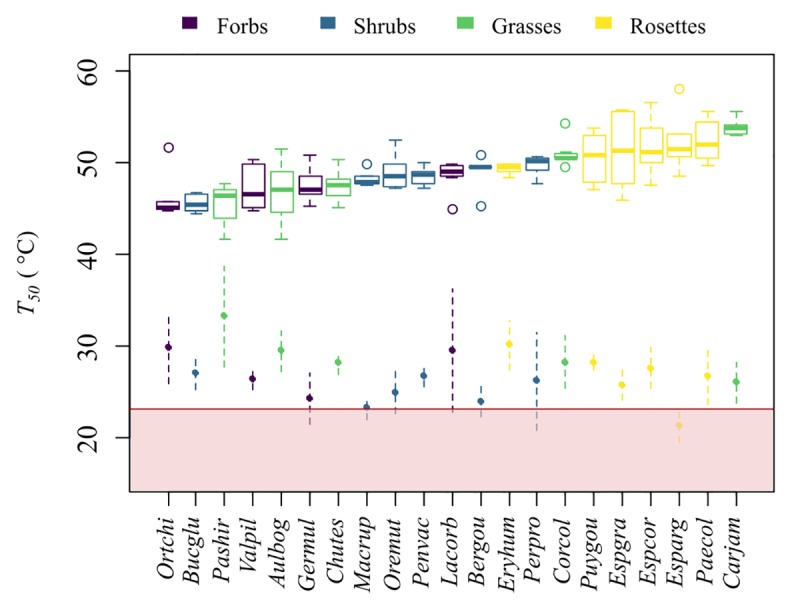
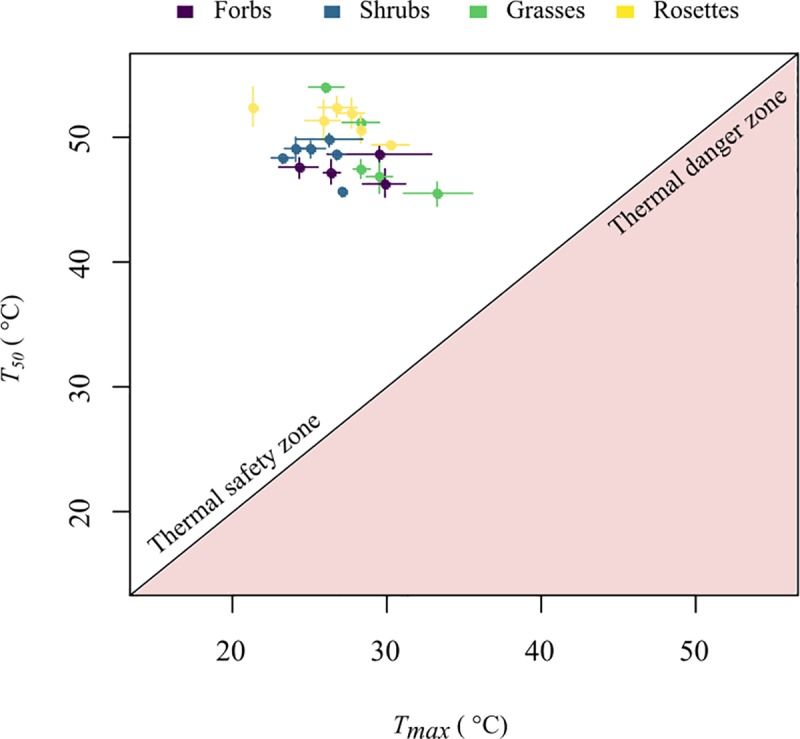
Tropical plant species are expected to have high heat tolerance reflecting phenotypic adjustments to warm regions or their evolutionary adaptation history. However, tropical highland specialists adapted to the colder temperatures found in the highlands, where short and prostrated vegetation decouples plants from ambient conditions, could exhibit different upper thermal limits than those of their lowland counterparts. Here we evaluated leaf heat tolerance of 21 tropical alpine paramo species to determine: 1) whether species with restricted distribution (i.e., highland specialists) have lower heat tolerance and are more vulnerable to warming than species with widespread distribution; 2) whether different growth forms have different heat tolerance; and 3) whether species height (i.e., microhabitat) influences its heat tolerance. We quantified heat tolerance by evaluating T50, which is the temperature that causes a reduction in 50% of initial Fv/Fm values and reflects an irreversible damage to the photosynthetic apparatus. Additionally, we estimated the thermal safety margins as the difference between T50 and the maximum leaf temperature registered for the species. All species presented high T50 values ranging between 45.4°C and 53.9°C, similar to those found for tropical lowland species. Heat tolerance was not correlated with species distributions or plant height, but showed a strong relationship with growth form, with rosettes having the highest heat tolerance. Thermal safety margins ranged from 12.1 to 31.0°C. High heat tolerance and broad thermal safety margins suggest low vulnerability of paramo species to warming as long as plants are capable of regulating the leaf temperature within this threshold. Whether paramo plants would be able to regulate leaf temperature if drought episodes become more frequent and transpirational cooling is compromised is the next question that needs to be answered.
热带植物物种预计具有较高的耐热性,这反映了它们对温暖地区的表型调整或进化适应历史。然而,适应高海拔地区较冷温度的热带高山特有种,其短而匍匐的植被与环境条件分离,可能具有与低地对应种不同的上热限。在这里,我们评估了 21 种热带高山高原种的叶片耐热性,以确定:1)分布范围受限的物种(即高山特有种)是否比分布广泛的物种具有更低的耐热性,更容易受到升温的影响;2)不同的生长形式是否具有不同的耐热性;以及 3)物种的高度(即微生境)是否影响其耐热性。我们通过评估 T50 来量化耐热性,T50 是导致初始 Fv/Fm 值降低 50%的温度,反映了光合作用装置的不可逆损伤。此外,我们估计了热安全裕度,即 T50 与物种记录的最大叶片温度之间的差异。所有物种的 T50 值都在 45.4°C 到 53.9°C 之间,与热带低地物种相似。耐热性与物种分布或植物高度无关,但与生长形式密切相关,其中莲座叶丛具有最高的耐热性。热安全裕度范围为 12.1°C 至 31.0°C。高耐热性和宽热安全裕度表明,只要植物能够在这个阈值内调节叶片温度,高山高原种对升温的脆弱性就较低。如果干旱事件变得更加频繁,蒸腾冷却受到影响,高山高原植物是否能够调节叶片温度,这是下一个需要回答的问题。